



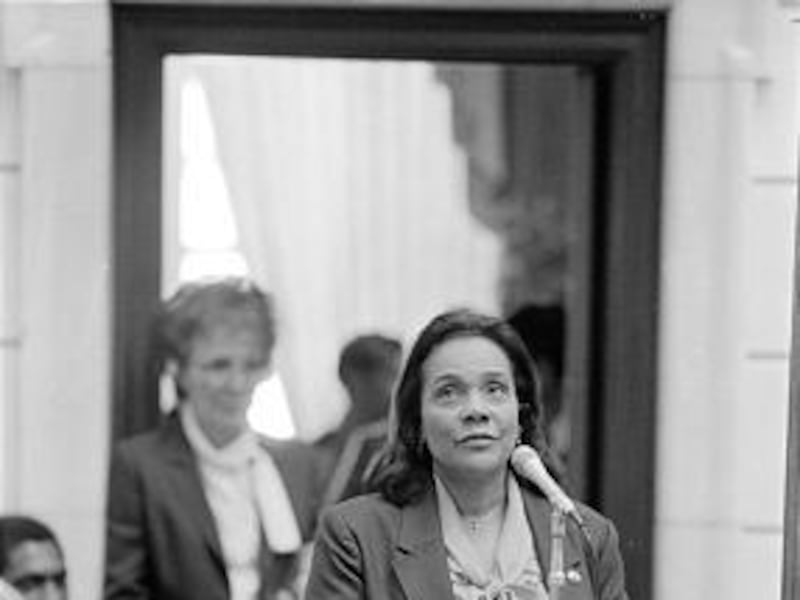
As part of Monday's observance of Martin Luther King Jr. Day, the Deseret News is showcasing historic photographs from its archives that document visits to Utah by the civil rights leader and his wife, Coretta Scott King, who also was important in the fight against racial injustice.
In January 1961, King addressed an audience of more than 1,500 in the University of Utah's Union Building.
"The Negro must work for first-class citizenship, but he must never seek second-class methods to obtain it," he said.
Rev. King, pastor of Ebenezer Baptist Church in Atlanta, noted prejudice existed on both sides of the Mason-Dixon Line but the problem was more subtle and more difficult to get at in the North.
"At least in the North we have broken down the legal barriers," he said.
A missed connection in Denver had delayed his arrival by an hour. Learning that, organizers scrambled to find a stand-in to speaker until King reached the Union. They found Professor J.D. Williams eating lunch in the building's Panorama Room and asked him to fill in. Williams, at that time chairman of the U.'s political science department, delivered an impromptu history of black people in America.
"J.D. held the audience for an hour," said Barbara Wright Williams, the professor's widow. Then, she noted, "Martin Luther King appeared."
In one of the archival photographs, a young J.D. Williams can be seen with King.
The Rev. France A. Davis, pastor of Calvary Baptist Church, 1090 S. State, recalled that he marched with King on the "march from Selma to Montgomery (Ala.), and the big one in Washington, D.C." During the 1963 rally at the Lincoln Memorial, King delivered his famous "I have a dream" speech." "It was a magnificent occasion and speech," the Rev. Davis said. He recalls King as "very personable" and able to "talk to anybody on their level… was very easy-going, didn't seem to be stressed out a whole lot — a good man."
The Deseret News interviewed the Rev. Davis shortly before he left for the inauguration of Barack Obama.
"It's a fulfillment of the dream that he talked about in 1963 and at other times," the Rev. Davis said. "I never thought I'd live long enough to see the reality of what he was talking about. But I think we all see it now in this president-elect and what he's doing in terms of forming his cabinet."
The Rev. Davis added, "We as a people, not just one group but all kinds of people, are reclaiming our rightful place as a nation."
After he moved to Utah, the Rev. Davis spent time with Mrs. King and the King children when they came to the state.
Coretta Scott King, dubbed the first lady of the American civil rights movement, visited Utah at least thrice. In November 1970, more than two years after her husband's assassination, she delivered a speech at the University of Utah's Special Events Center.
"We have just begun to experiment with democracy," she said, referring to the equal treatment of all Americans. "Racism is still one of the most divisive and corroding evils of our society. Racism is so deeply imbedded into the psyche of most white Americans that they are not even conscious of its existence."
As pressure was growing for the Utah Legislature to adopt the King holiday in 1986, she was invited to speak at Brigham Young University. Mrs. King addressed legislators as they decided to approve the state holiday.
"Thank you twice for what you've done," she said. Addressing an overflow crowd at BYU the same day, she praised Utahns for their warmth and friendliness and said the same qualities were part of her husband's nonviolent, pro-peace movement.
"I've just felt so much at home here today in the state of Utah," she said. "I've been here a couple of times before, but this is the first time I've felt the warmth and support here for my husband's message."
Mrs. King died on Jan. 30, 2006.
The images were selected from the Deseret News archives by photo researcher Ronald Fox, who is writing a book about presidential visits to Utah. Finding photographs of the Rev. King and his wife was "just like the movie National Treasure," he said.
"We're rediscovering history. And it's related directly to Utah."