

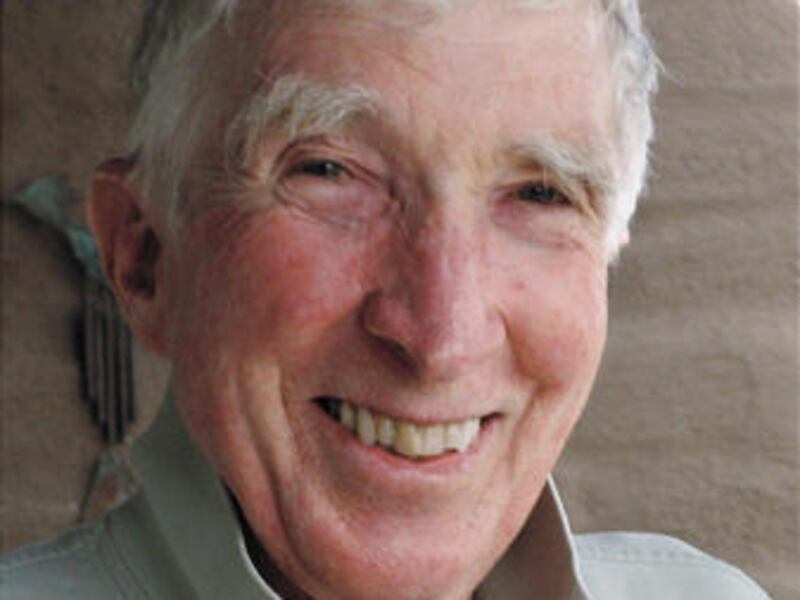
John Updike, who wrote of sex, death, God and middle-class American life in elegantly crafted novels and short stories that earned him a place among the giants of postwar American literature, died Tuesday.
Updike died of lung cancer at a hospice near his home in Beverly Farms, Mass., said his longtime publisher, Alfred A. Knopf. He was 76.
Few contemporary writers have rivaled Updike in output or quality of work sustained during a career that spanned half a century. He published his first novel in 1959 and wrote 26 more, most recently 2008's "The Widows of Eastwick." He published more than a dozen short-story collections and several volumes of poetry. He was a prolific and highly regarded reviewer and essayist, weighing in on subjects ranging from baseball's Ted Williams to painter Edward Hopper. He was a two-time winner of both the Pulitzer Prize and the National Book Award, and his books generally made the best-seller lists. Tall and hawk-nosed, with a warm if sly grin, Updike was among the most recognizable of American literary novelists.
Updike, who told an interviewer in 1966 that "my subject is the American Protestant small town middle class," is best-known for his four "Rabbit" novels. Beginning with "Rabbit, Run" (1960), and continuing through "Rabbit Redux" (1971), "Rabbit Is Rich" (1981) and "Rabbit at Rest" (1990) they follow the life of Harry "Rabbit" Angstrom, a former high-school basketball star, as he wrestles with marriage, adultery, divorce, children, age and suburban angst.
"The tetralogy to me is the tale of a life, a life led by an American citizen who shares the national passion for youth, freedom, and sex, the national openness and willingness to learn, the national habit of improvisation," Updike would write. "He is furthermore a Protestant, haunted by God whose manifestations are elusive, yet all-important."
While often thought of primarily as a chronicler of suburban angst, Updike ranged more widely than that. "The Coup" (1978) is set in post-colonial Africa. "Gertrude and Claudius" (2000) imagines the events leading up to Shakespeare's "Hamlet." After Sept. 11 Updike wrote "The Terrorist" (2006), about an Arab-American youth seduced into a terrorist plot.
Updike was born in 1932 in Shillington, Penn., the only child of a high-school mathematics teacher and his wife. He graduated from Harvard University, and after studying painting in England for a year, accepted a position at the New Yorker magazine, where his work appeared frequently through the course of his life.
Updike opted to live not in New York but in suburban Massachusetts, where he settled with his first wife and four children in order to live a more normal American life. He wrote virtually a book a year, becoming one of the few literary writers to earn a living without having to teach. He was married twice and is survived by his second wife, Martha, and his four children.
Unlike such contemporaries as Philip Roth and Norman Mailer, Updike did not deal in "extremity," said Terrence Doody, a professor of English at Rice University.
"He was always remarkably sane, middle-class, an observant Christian. He gave us an astonishing record of American experience from about 1960 to 2007."
Contributing: Associated Press