

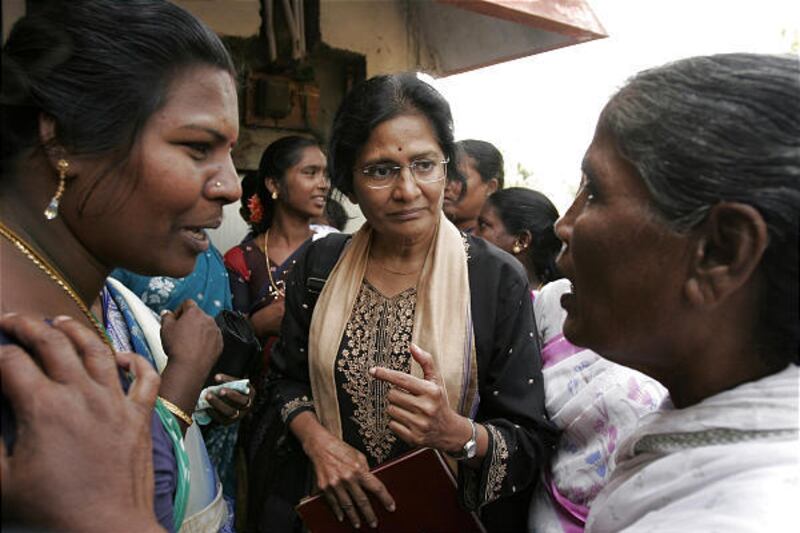

PROVO — Padma Venkataraman headed a lending effort in India before the term "micro-loan" was a buzzword, said Becky Douglas, founder of the charity Rising Star Outreach. Not only was Venkataraman a pioneer in the movement, but she offered the loans to a segment of the population believed to be the least likely to repay them.
"Nobody thought leprosy-affected people could take money and do something with it," Venkataraman said.
The daughter of R. Venkataraman, the former president of India, spoke Oct. 8 at a David M. Kennedy lecture at Brigham Young University about her humanitarian efforts.
Creating a successful, sustainable micro-lending program in any population has its challenges, but helping those with significant deformities who have spent their lives begging was particularly ambitious. Many had lost fingers, hands and feet to the disease, making work difficult, Venkataraman said.
But perhaps even more daunting to their self-suffciency was the social stigma associated with the disease. Leprosy-affected individuals were, and still are, believed by some of their countrymen to be cursed by God. They are literally outcasts of society, called "untouchables," an attitude that disfigures and stifles their motivation and ambition, said Douglas, a member of The Church of Jesus Christ of Latter-day Saints, in her introduction of Venkataraman.
"Poverty is about more than just not having money," Douglas said. "You have to reach the entire person if you really want to raise and heal."
Venkataraman's efforts of reaching out began 20 years ago with a leprosy colony near New Delhi that was home to more than 4,000 people. Initially, she thought making a difference would be impossible as the poverty and deformities were so acute. But as one loan turned a beggar into a tea shop owner, and another loan turned a panhandler into milk salesman, it became a self-sustaining, progressive community that continues to function independently of her intervention to this day. That village is now known as "the village of hope."
Douglas and Venkataraman partnered in 2003 to initiate a large-scale financial rehabilitation project. Rising Star Outreach added micro-lending to the work it already was doing in providing education for the children of people in the colonies. According to the organization's Web site, 31 colonies are participating, and there are about 1,000 loans out at any given time.
Prior to her partnership with Rising Star, she spent nearly two decades with the U.N. in Vienna as a permanent representative of the All India Women's Conference, president of the U.N. Women's Guild, and vice president of the NGO Committee on Women. She's also a founding member of the Women's India Association.
Venkataraman's methodology consists of extensive training with the individuals managing and receiving the loans, creating women's self-help groups and involving the colonies in discussions at each step of the process. That last point is the one that leads to long-term sustainability, she said. A group of outsiders doesn't come into a colony trying to change or take over it, but rather, the individuals come up with their own ideas and take their own steps.
"That made my work much easier," she said. "Because it is their work and they are now participating."
Venkataraman's program, like some other micro-lending programs, is about creating self-reliance in the loan recipients, but she took it one step further. Rather than a bank loaning the money and earning the interest upon loan repayment, the colonies are given the money to loan out, and they collect the interest. All the money is donated by generous benefactors and once given to the colonies, it stays in the colonies. A welfare committee consisting of five to seven members of the colony collect the loan payments and deposit them in the colony's own bank account.
"If they lose it, they are losing their own money," Venkataraman said.
She has watched their confidence grow throughout the process. Initially, when some people in one colony thought she was going to be in charge of collecting the loans, they pleaded for her to charge only 2 or 3 percent interest, saying they were incapable of paying more. But when they saw that they'd be in charge and got into the practice of it, they set the rate at 10 percent, an obvious example of how they came to view themselves as capable.
Because of the opportunities the loans provide, former beggars now provide all sorts of goods and services. One man bought a small wood-working tool with his loan, which he uses to carve beautiful doors, headboards and other carpentry goods. His business has grown and expanded to where he employs 12 others from his colony.
Another used his $20 loan to buy a few goods to sell to others in his colony. Today, his store includes a great variety of products, including vegetables, cookies and shampoo.
"For him, and for his colony people, this is like a mini-mall," she said.
As they provide for themselves and their families rather than relying on handouts, the individuals in the colonies come to believe what Venkataraman has believed all along: "They are not crippled in their spirit or in their mind," she said. "They have even forgotten that they're leprosy-affected."