



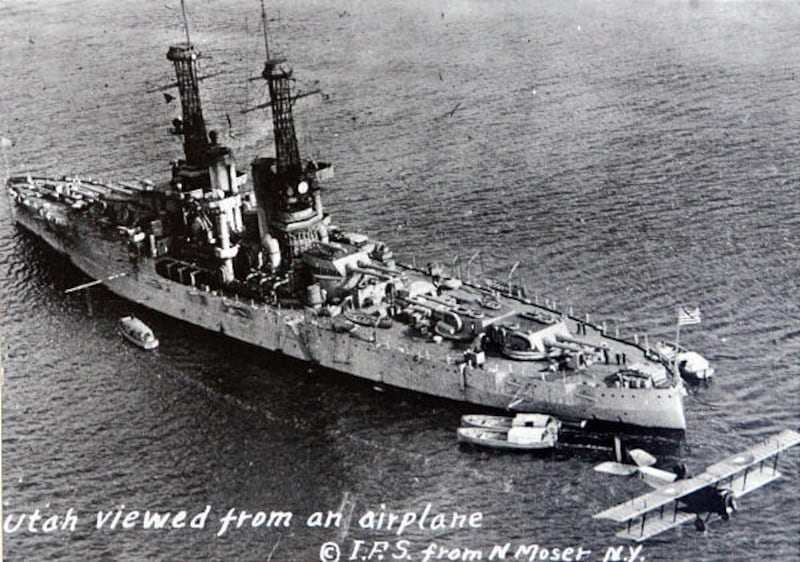

Every year there are fewer of them, they move more slowly, but their pride and memories of serving on the USS Utah — and surviving its watery death — remain as sharp as if nearly 68 years have not passed.
"I still have flashbacks," Clark Simmons, 88, said, maneuvering along the marbled hallway of the state Capitol's fourth floor Wednesday morning, wagging his cane. "Some nights it is worse than others; it just depends on how I feel."
He was quiet then for a few moments, gazing at the model of the USS Utah on display as part of an exhibit that will continue until Dec. 23, the 100th anniversary of the launch of what was then the world's largest battleship. The Utah was actually born in the words of President Theodore Roosevelt six years earlier, on May 29, 1903, when he announced the ship in an address to Utahns gathered at the Salt Lake Tabernacle. The ship would be christened in 1909 by Gov. William Spry's daughter at a ceremony in New York.
Now, 100 years later, Simmons was among just four of the USS Utah survivors who made the trek to Utah for a reunion of sorts, to be feted by veterans' associations and, of course, take in the exhibit that memorializes such a dramatic and important time in their life — the sinking of the Utah at Pearl Harbor.
"This is a true honor," said Fred Mason, department commander of Utah's American Legion. "We've been around since 1919, established to serve veterans and their families. If we didn't jump on this, we're not doing our job. There are too few of them anymore."
The foursome, the youngest of whom is 85, had a chance encounter with dozens of schoolchildren on tour at the Capitol from Lakeside Elementary School in Davis County's West Point.
"Who attacked you?"
"What did you do?"
"Were you hurt?"
The questions came fast, but only after applause and the introduction by Mason, who had tears in his eyes when he described the men to the children as "America's greatest generation."
Many of the men in Utah for this trip have been here for previous reunions. They had hoped there would be eight this time, but failing health prevented the other half from attending.
"For a lot of them, this will be their last trip," said Pam Becerra, with the USS Utah Survivors Association.
The Utah was among 18 ships that were sunk or run aground in the Dec. 7, 1941, attack on Pearl Harbor and is often called the forgotten ship because for so many years its resting spot was off limits to civilians, and it wasn't until 1972 that a monument was erected.
Warren Upton, who'll be 90 on Saturday, said the men didn't have time to panic when the attack happened.
"It happened so suddenly, it surprised everyone. It was a scramble," he said. "It wasn't until that night when we had time to think about it that we realized what we'd gone through."
Bob Ruffato, 86, agreed, saying the entire attack was like a blur, but its impacts played out in gruesome slow motion afterward when he was assigned to the "burial party."
"I'd never seen a dead person before. It was gruesome — and seeing your shipmates die — it was bad, very bad."
He recalled a young man whose body was so bloodied its outline was in red splashes on a sheet. His face bruised and lips swollen, the sailor could only utter two words: "How? Why?"
"Then he died," Ruffato said.
When the Utah sunk, 58 or 56 men (accounts vary) went down with her. And so did the ashes of a baby girl that had been brought on board for burial at sea by her sailor father.
Her twin, Mary Wagner Creigh, visits the grave of the USS Utah and her sister every year. "I'm honored," she said, "that those men are with her, guarding her, singing her lullabies, keeping track of what she's doing."
e-mail: amyjoi@desnews.com