







University of Utah student Rachel Rizzo has gone back to her old space at the library. Her old space, however, is now brand new.
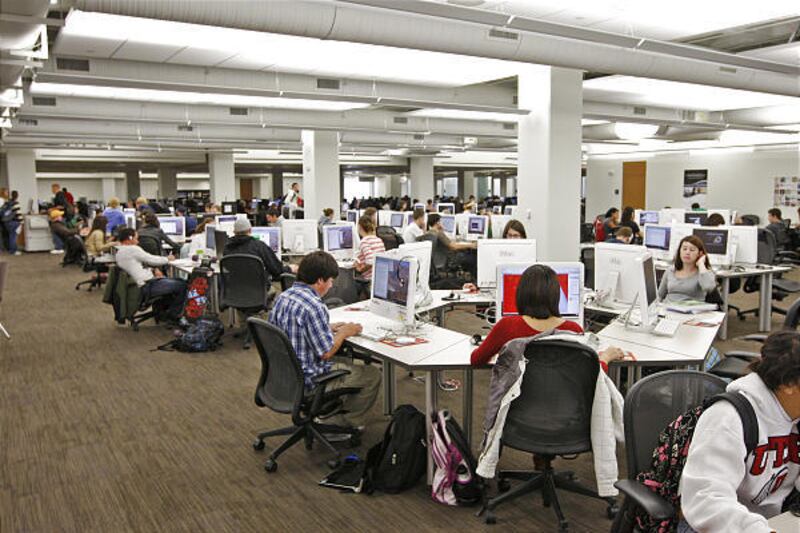
"It's absolutely amazing," she said. "It's much more open and there's so much natural light coming in, which is nothing like the dark cave it used to be in there. And you wouldn't believe what that natural light does for studying."
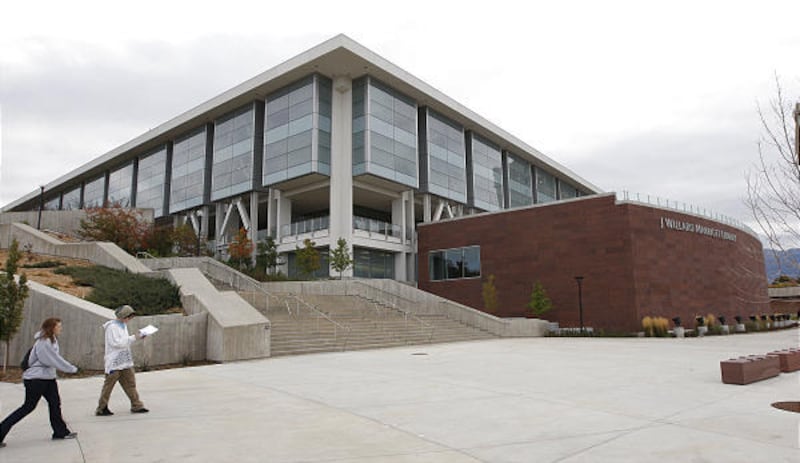
For a building that was stuck in the 20th century only four years ago, the J. Willard Marriott Library at the U. has now shot so far into the future that officials believe they won't even have to replace the furniture for several decades.
"We tried very carefully to do everything right," said library director Joyce Ogburn. "That includes making an investment in quality, which in this case means high-quality furnishings that have 20- to 40-year-long warranties. People are pretty hard on furniture."
The flashy furnishings that look expensive have been one of the few complaints by students at the university, but Ogburn said there's little else to complain about in the almost-brand-new 516,000-square-foot space.
"Everything has changed," she said. "It's now more designed for people."
The overhaul, which intended to provide a seismic and safety upgrade for the nearly 41-year-old building, began in 2005, when the school received $48 million in funding from the Utah Legislature. Other funding, to the tune of more than $20 million in pledges and donations, and a $3 million check from the federal government, helped to cover the nearly $80 million in much-needed changes.
"They've definitely made an effort to make it more comfortable for students," Rizzo said, adding that for an almost entirely "commuter campus," a central hub for students to study is imperative. "The Union Building works, but for studying, the library is so much better."
Rizzo's old spot was in a corner on the main floor, but it has morphed into a spot in the Grand Reading Room, surrounded by a wall of glass windows, which Ogburn said "looks out across the valley and gives students a quiet space to think and work."
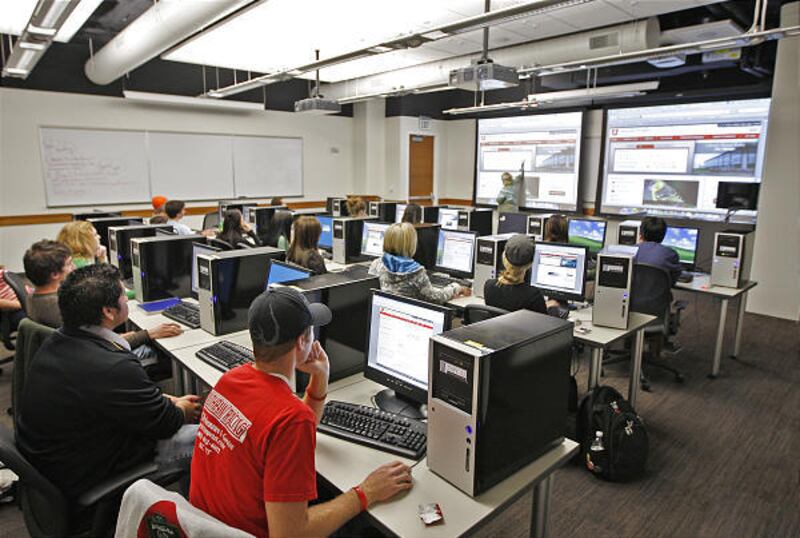
The plethora of open and lighted spaces come in addition to such features as a new Automated Retrieval Center housing four robots that can search over 2 million items, a full-service cafe, new classrooms for instruction and group gatherings, multimedia work stations, state-of-the-art computer labs and stations throughout the library to make searching for books and passages in journals, once searched by hand, easier to find.
But throughout the four-year process, navigating through the sometimes crowded building became difficult.
"We did our best to maintain a pleasant and productive environment," Ogburn said. But at one point in 2007, a crane was parked in the center of the building for several months, removing and replacing the glass on the outside.
"It was something we did not think we would have to do, but we made it work," she said. Over the entire process, schedules were re-configured to accommodate additional changes and the occasional problems, ultimately pushing back the completion date nearly an entire year.
"It was the most complicated renovation ever undertaken in the state of Utah because we stayed in the building throughout the construction process, renovations were done top to bottom and we had to keep the services going the whole time," Ogburn said. "The hang-ups, as in all projects, were unavoidable."
But popular areas in the library, such as the student commons, were always hopping throughout the construction, and Rizzo said that although it was sometimes "a pain," students just found a new place to go. "We just dealt with it," she said. It was a small price to pay for the then-freshman, now-senior studying finance at the U. The end results to her are far more pleasing.
The library, which Rizzo said rivals the structure and popularity of the City Library downtown, houses more than $300 million worth of manuscripts, books and photographs, including the Gutenberg Bible, a first edition of the Book of Mormon and a copy of Sir Isaac Newton's 1687 book "Principa," which outlines the laws of gravity and planetary motion and is worth up to $350,000. Other collections include the Utah Digital Newspapers project, which has digitized hundreds of thousands of copies of several of Utah's major newspaper publications dating back to the mid-1800s, the Utah Artists project that provides access to local works and other multimedia collections including photographs, articles and unique artifacts.
State law requires that at least 1 percent of the budget go to local artists to supply decoration for the state-owned building. The contribution includes art glass on the main stairwell, cast-iron books lining one floor and a color-changing sculpture hanging in the third-floor atrium, which "catches the light and bends it to create a variety of colors," Ogburn said. A number of other paintings and artworks dots the five floors of what she says is one of the most important buildings on campus.
"We're relieved it's all over," Ogburn said. "And we're really happy with the results."
In 1968, the most modern feature of the J. Willard Marriott Library at the U. was the individual study carrels. Now, the library director can't even say what is her favorite, but she's just happy that it seems to be busy.
e-mail: wleonard@desnews.com