



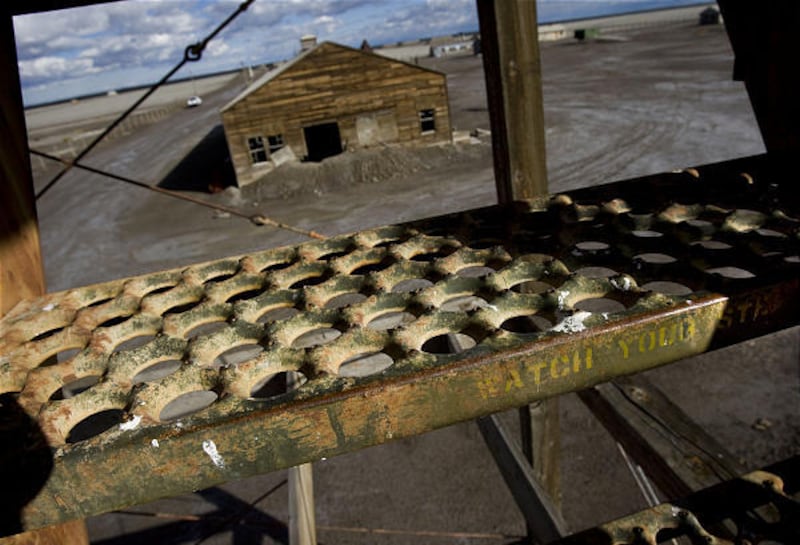


WENDOVER, Tooele County —Carved from salt flats and sagebrush at the intersection of Isolation and Bleak, Wendover Airfield circa 1945 was as key to America's war effort as it was removed from prying eyes.
During a USO performance there, legendary comedian Bob Hope had servicemen in the audience howling with laughter when he jokingly referred to the World War II airbase as "Leftover Field."
Hope's punch line still works describing the airfield's dilapidated remnants. Only it's no longer a laughing matter for Jim Petersen, director of Tooele County's Wendover Airport, which encompasses much of the base's historic footprint.
Like an old soldier, Wendover Field is fading away. And Petersen, an electrical engineer by training, and aviation history buff by serendipity, is burdened knowing the clock is ticking on preserving Wendover's often ignored legacy that helped usher in the Atomic Age and bring World War II to a swifter end.
There's plenty that needs preserving, too. More than 90 vintage Army Air Force buildings remain out of over 600 that once stood during the base's heyday, when upward of 20,000 officers, enlisted men and civilians were at one time stationed there. But it's a half-full, half-empty number given that hundreds of structures have been ripped down for scrap or salvage, or allowed to surrender to age and elements.
"There's nothing to compare with it anywhere," said Peter?sen, sitting behind the wheel of a restored Willys Jeep while giving a tour, much like one he took nearly a decade ago when he fell under the airfield's spell.
"I was captivated," said the 62-year-old, who also wears a second hat as head of the nonprofit Historic Wendover Airfield Foundation, which he formed in 2001. "The more I researched the history and found out, the more convinced I became that it needed to be saved. This is a part of Utah history that a lot of people don't know about."
Petersen recently scored a huge victory in his battle against time when the airfield's hulking main hangar was placed on the National Trust for Historic Preservation's list of America's 11 Most Endangered Public Places.
Work also began in early November on a $450,000 Save America's Treasures grant that will stabilize the 50,000-square-foot hangar that housed B-29 Superfortresses Enola Gay and Bockscar, which dropped the first atomic bombs over Hiroshima and Nagasaki late in the summer of 1945.
"Most people don't realize the significance of the contribution to the Manhattan Project that took place here," Petersen explained.
OFF THE GRID
The Manhattan Project conjures up images of scientists donning lab coats, scribbling complex formulas on chalkboards to create the original weapons of mass destruction.
Few connect the dots with how those WMDs were ultimately delivered to their targets, or the intense training needed to do so. Which is how Col. Paul Tibbets and distant Wendover Field happened to team up.
In the early fall of 1944, while the science of the atomic bomb continued to be worked out in Los Alamos, N.M., Tibbets went about assembling his own specialized outfit to handle the logistics for what was then believed would be simultaneous atomic bombing missions to Europe and Japan.
The Army brass certainly tabbed the right man in the rock steady, no-nonsense Tibbets. Regarded by many as the best flier in the Army Air Corps, Tibbets was assigned to organize, train and lead those first atomic sorties, including piloting the Enola Gay (named for his mother) to drop its history-shaping payload.
Because of the security demands of such a highly classified project, Tibbets looked beyond the boondocks to keep his secret.
So when first spying Wendover Field and the surrounding 3.5 million-acre military reserve, which had already been pressed into service for long-range bomber training in 1942, it appeared perfect for his purposes. Buffered by miles of emptiness in every direction, it wasn't only off the grid; there was no grid. The situation on the ground was equally promising as the base approached self-sufficiency, offering complete machining facilities and experienced ground support crews.
The tiny adjacent civilian enclave was a watering station for the steam locomotives of the Western Pacific Railroad. The closest thing to a landmark was the State Line Hotel, which straddled the Utah-Nevada line, beckoning the weary traveling two-lane U.S. 40. The hotel's liquor and games of chance served as the camp's unofficial morale officer, offering temporary amnesia to soldiers wishing to forget their solitary posting.
Bombardment training at Wendover ended in April 1944, replaced by a short-lived combat training program for P-47 fighters. Tibbets' newly created 393rd Bombardment Squadron, part of 509th Composite Group, started arriving in September and would remain until deploying to the Pacific's Mariana Islands the following June. From there, the atomic strikes against Japan would be launched.
After the war, Wendover Field continued to be used for training and gunnery practice. The Air Force closed the base in 1969, turning it over to Wendover city in 1977. Tooele County took ownership of the airport and its structures in 1998.
The airfield has also enjoyed modest success as a movie location for popular films such as "The Philadelphia Experiment" (1984); "Con Air" (1995); "Mulholland Falls" (1996); "Independence Day" (1996), "Hulk" (2003) and "The Core" (2003).
DESERT SECRETS
After canceling scouting trips to other training site candidates in Grand Bend, Kan.; and Mountain Home, Idaho, near Boise, Tibbets rolled up his sleeves and went to work, quickly turning the remote airbase into an armed camp. Barbed wire sprouted like weeds. Sentries and patrols increased. It felt like visiting the privy required a pass signed in triplicate.
Painted signs cautioning against security breaches were posted everywhere. One read: "What you hear here, what you see here, when you leave here, let it stay here." While not as catchy as Las Vegas' signature tagline, it still got its point across.
Federal agents intercepted mail and monitored phone calls at levels that by comparison would make today's Patriot Act look like the Bill of Rights. No mention of a family birth or bar mitzvah from the outside went undetected inside. What was gleaned was often shared with those it directly affected as a reminder that they were being watched.
Petersen said Wendover was rarely referred to by name. Instead it was designated "Site K," or "Kingman" to further obfuscate.
The circuitous delivery of a modified part for a bomb assembly illustrates the extraordinary security measures in place at the time. Rather than the manufacturer shipping the part directly to the airbase, it was first sent to Chicago where it was repacked in a new carton and then shipped to Wendover.
CURRENT STRUGGLES
Petersen still envisions turning Wendover into a living museum — a Williamsburg, if you will, of Army Air Force bases. Admission-paying visitors would visit refurbished buildings, view vintage aircraft and listen to the Wendover story as told by tour guides dressed in period uniforms. All that's missing from his dream scenario is the Andrews Sisters' "Boogie Woogie Bugle Boy" playing in the background over the airfield's PA system.
But correcting history's six-decade-long slight isn't cheap. Even with the close proximity of several casinos, he knows the long odds he's facing. The economic downturn has made it difficult to find sponsors. Nor does the state of Utah appear to recognize the historic jewel under its nose just waiting to sparkle.
Petersen thought he'd made inroads with then-Gov. Jon Huntsman Jr. when he had the governor out for a tour in 2008. Petersen felt Huntsman came away favorably impressed and thought the visit might lead to an infusion of state cash, but that hope evaporated like a drop of rain in the West Desert after President Barack Obama named Huntsman his ambassador to China this year.
"I'm not sure we can count on state money," Petersen said. "Realistically, I don't know if we can compete with things (wanting state funding) in Salt Lake proper. It's only two hours away, but sometimes that two hours is too far."
Petersen is banking on the Historic Preservation Trust's designation generating added interest. "It's a critical-mass issue," Petersen said. "As we get more and more here, we'll have a little more for people to see, and that in turn will attract even more people."
But he's quick to remind that the current stabilization project is only a fraction of the hangar's total $5 million renovation price tag. "To do it right," he said.
A Salt Lake area construction company has started replacing the ramshackle hangar's siding and roofing panels, along with scores of broken windowpanes. Work will be completed early next year.
The grant, requiring matching local funding (Petersen says he has two-thirds already in hand), also provides for limited restoration of wooden floors, doors and walls of the hangar's mezzanine areas. Originally used for offices, Petersen wants to turn this space into more displays, expanding the small museum already opened in the airport's restored operation center.
PAST SUCCESSES
Petersen has already shown a penchant for turning limited dollars and endless gumption into renovation successes. The Norden bombsight building, now 80 percent completed, is a good example.
Reduced to relic status by the computer age, the Norden bombsight was a technological marvel for its day, making precision high-altitude bombing possible. Keeping such a sophisticated instrument out of enemy hands posed major security issues, which were solved at Wendover by securing the bombsights in concrete vaults behind heavy bank-type doors (still in place). Bombardiers were required to check them in and out for training. The vaults also maintained the bombsights at a steady temperature, improving the mechanism's performance.
Another Petersen reclamation project remains a work in progress. After pulling together $150,000 to restore the outside of the Officers Club building, he's next tackling its large hall-like interior. When finished, he wants to rent it out for special occasions and has already fielded several inquiries.
"We don't want to overdo it. I'd like to keep it somewhat Spartan. But I will make the bathrooms nicer," he said, laughing.
NOW AND THEN
Gazing south from one of the concrete bomb-loading pits, the view remains as if frozen in time. Beyond one of the airport's crisscrossed runways, two original World War II-era wooden buildings and observation tower rise out of the desert. In the distance, ragged mountains serve as a lunar-like backdrop.
It's essentially the same scene that greeted Tibbets and his men daily as they carried out often mundane, but vital tasks.
Bomb-loading pits, which resemble the oil-changing bay at your local Jiffy Lube, were employed to lift the massive, odd-shaped bomb mock-ups into the bellies of the Superfortress fleet.
In practice, this proved a bigger challenge than anyone had anticipated, even for aircraft that had been fitted with larger bomb bays. Wendover crews solved the problem by installing hydraulic lifts in the loading pits to assist raising the five-ton bombs into the bombers.
More than 150 prototypes of the "Little Boy" and "Fat Man" atomic bomb configurations were assembled and tested at Wendover, Petersen said. Three working atomic bombs, minus their plutonium cores, were readied there — one each of the Fat Man and Little Boy designs used against Japan, and a third backup.
Tibbets pushed flight crews to be able to consistently hit within 25 feet of a target. Full-size practice bombs were often referred to as "pumpkins" because the prototypes were round and sometimes painted orange.
He also pushed himself. During a meeting in Los Alamos with Dr. Robert Oppenheimer, the Manhattan Project director, Tibbets learned he'd need to steer his B-29 sharply when making his escape to achieve as much separation as possible when the weapon exploded. Upon returning to Wendover, Tibbets practiced steeper and steeper turns until he could confidently repeat them within a range between 40 and 42 seconds.
At 8:15 a.m. on Aug. 6, 1945, with Wendover's glistening salt flats now a fading memory, the Enola Gay released the 8,900-pound Little Boy 30,000 feet above Hiroshima. Forty-three seconds later — barely time to blink after Tibbets had efficiently completed his steep banked turn — the bomb detonated on schedule, and the world was forever changed. Because so few knew or understood the work that had taken place there, Wendover's secrets were soon forgotten once hostilities concluded.
"Wendover has been largely overlooked by people," Theodore "Dutch" Van Kirk, the Enola Gay's navigator and last surviving crew member, told the Las Vegas Review-Journal in 2005.
"But it's a place that should be remembered for having helped save many lives," Kirk said. "Thousands more people would have been killed, Japanese and American, if we had not dropped those bombs. And we learned to do it in Wendover."
e-mail: chuck@desnews.com