

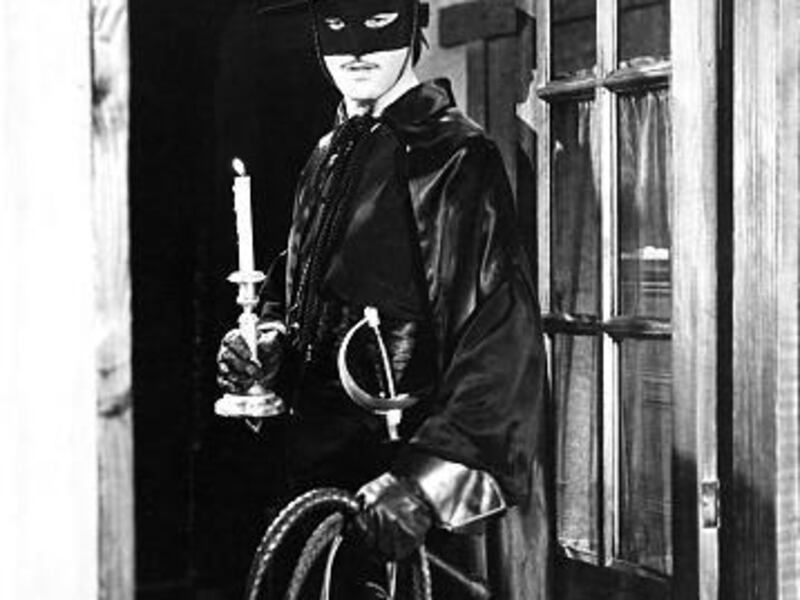
Dressed in black from head to toe, wearing a mask and cape, this rooftop-hopping hero only comes out at night to avenge the oppressed. He first appeared on paper in 1919, and the movies seem to reinvent him for every generation with a different charismatic, athletic, swashbuckling star.
If you're thinking Batman, think again — that masked avenger didn't show up until 1939, when he was "The Bat-Man."
Here's another hint. This guy likes to carve Z's on doors — or on the front of a bad guy's shirt.
Now you've got it: Zorro.
Over the years, quite a few actors have played the role — Frank Langella, Alain Delon, even George Hamilton (albeit in a spoof) have all played Don Diego de la Vega (or a variation on that name), better known as his nocturnal alter ego, El Zorro.
But some performers did more than merely play the "Robin Hood of the West" — they defined him for their respective generations.
First came "The Mark of Zorro" in 1920, starring Douglas Fairbanks, just a year after Zorro made his initial appearance in a serialized magazine story. And from the moment his action-filled silent epic hit the screen, Fairbanks owned the character.
In 1940, it was Tyrone Power in a fine remake of "The Mark of Zorro" — which near the end has a still gripping duel to the death between Power and villain Basil Rathbone.
And, of course, modern moviegoers think of Zorro in the form of Antonio Banderas after he starred in "The Mask of Zorro" (1998) and "The Legend of Zorro" (2005) — a pair of exciting films that are packed with wall-to-wall stunts.
But with all due respect to those wonderful movies, for baby boomers like me there is only one Zorro: Guy Williams.
Yes the same Guy Williams who would later play Professor Robinson in the campy '60s sci-fi show "Lost in Space." But forget about that.
In 1957, Williams was plucked from obscurity by Walt Disney to star as "Zorro" in a half-hour black-and-white adventure series. The show ran for two years, and then four hourlong episodes followed on the "Disneyland" series (as well as a couple of theatrical films culled from edited episodes, as Disney had done earlier with "Davy Crockett").
And it's a genuine thrill to see those shows finally come to DVD in season sets with the release of "Zorro: The Complete First Season" (Disney, 1957-58, six discs, b/w, $59.99) and "Zorro: The Complete Second Season" (Disney, 1958-59, six discs, b/w, $59.99) — including the follow-up "Disneyland" shows (82 episodes in all). There are also bonus featurettes and an introduction by Leonard Maltin.
"Disneyland," an anthology program, had been on the air for three years when Disney decided to try his hand at an episodic series, and he spared no expense for this venture.
Remember that TV series in the '50s averaged 39 episodes per season (today it ranges from 12 to 25), and "Zorro" was lavished with a bigger budget than most. And it shows. These episodes, looking quite spiffy in glorious, remastered black-and-white prints, have the look of theatrical films.
If you have doubts, compare "Zorro" to other shows of the period, say "The Cisco Kid" or "The Lone Ranger," and notice the difference in production values. "Zorro" even had a new music score for each episode; most shows simply recycled canned instrumentals.
As for the show itself, yes it was geared for "family audiences," which is code for "kids." And some of the elements are certainly simplistic, especially the comedy. But I greatly enjoyed revisiting these, primarily because of Guy Williams, who seems born to play the role.
Williams had already taken up fencing as a hobby when he landed the show, and his ability with a sword is striking. According to the featurettes, he also had the idea of not making Don Diego a fop, as had been the case in previous "Zorros." Instead he played him as an educated, if well-to-do, everyman by day, donning the cape and mask at night.
The show is also bolstered by a number of talented supporting players and first-rate guest stars, such as Annette Funicello (in four episodes), Rita Moreno (a year before "West Side Story"), Cesar Romero, Gilbert Roland, Ricardo Montalban, Mary Wickes, Lee Van Cleef, Dan Blocker, Robert Vaughn and Ross Martin.
And, in an odd bit of foreshadowing, another guest was Jonathan Harris, who would later play goofy villain Dr. Smith on "Lost in Space."
e-mail: hicks@desnews.com