

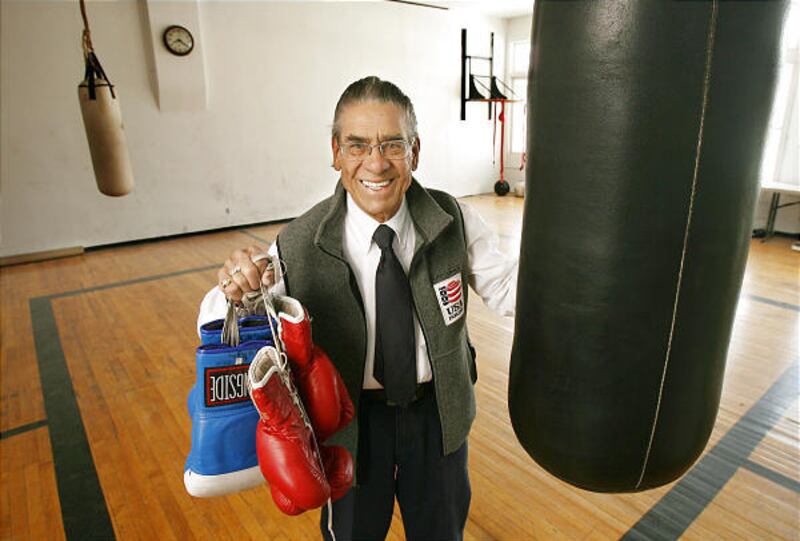

Leo Montoya, a 45-year Salt Lake west-side resident and legendary boxing trainer, is the prototypical gym rat.
Montoya's been around so long, he seems to have out-boxed "Father Time" in his lifetime passion.
"I've been training 25 to 35 boxers two hours (every) day for 55 years since 1953" in his 100-year-old gym, the 80-year-old Montoya said. He seems as much a staple of the neighborhood as his Leo Montoya Boxing Club facility, located at 246 N. 600 West.
Montoya, who claims to be the oldest coach in the western United States, was only 21 when he won the Pan American Games' gold medal at 147 pounds in 1949 in St. Louis.
His illustrious Amateur Athletic Union coaching career at nationals has seen him coach bronze medalist Art Sandova and qualifiers Shane Richards in the 1960s, and Tyler Peterson and R. Sandler in the 1970s and '80s, respectively.
Twenty-something Jose Haro Jr., of Tacoma, Wash., still fights and qualified for the 2007 nationals in Marquette, Mich. Though Haro didn't want to train, "it still cost me $1,000 to take him there," moaned the longtime trainer.
Montoya said he's also taken about 100 fighters to regional tournaments.
He resembles film fighter Rocky Balboa's manager, Mickey, in the iconic boxing series "Rocky." The fiery Mickey was tough and demanded more of everything from the easygoing Balboa. Likewise, Montoya expects the best effort from his boxers. And much like "Mick" in the movies, Montoya has a number of successful fighters to prove their toughness.
Montoya says he purchased his gym in 1960. He won't divulge the two-story structure's purchase price, but with its size and near-downtown location, he maintains its current worth is $500,000.
He claims to have had "hundreds" of offers to sell.
Previously, it was used as a meat market, a TV retailer and a second-hand store.
The gym next to Montoya's home is a far cry from the sweaty, stinky and dim-lit warehouse where Balboa trained for his battles with Apollo Creed. Besides the training area streaming with sunlight, the facility includes a large-screen TV, sofa, two bathrooms, dining and meal-preparation areas — and a trophy case stuffed with some 1,000 AAU national and regional trophies.
They were earned by Montoya's sons — Jay, Guy, Luben, Jim, Leo and Max — now all in their 50s or 60s. The earliest trophy is from 1953.
It's a hallowed haven, which reminds one of seemingly heaven-sent fighters who learned to compete well on a national level.
Even after boxing, they've shown grit and stamina in the face of adversity.
Sgt. Rocky "The Rock" Herrera, who trained at Montoya's facility, died in Afghanistan on Aug. 2, 2007, "when he jumped on a grenade to protect his soldiers," said Montoya. "He was like my own son."
Not many can say they had a hand, albeit indirectly, in training soldiers for combat, especially in a gym. The mentor said Herrera related to him, "I told the guys (in Afghanistan), 'If an old man (Montoya) can do (exercises), then so can I.' "
The soldier probably picked up some humor from his old friend as well. Many fighters through the years have picked up a lot from Montoya, like work ethic, intensity and loyalty. Montoya is so renowned for his teaching ability that former U.S. presidents Ronald Reagan, George H. Bush and Bill Clinton sent their autographed photos.
But his reputation as a boxing trainer has spread far and wide. He even has two photos of himself with legendary boxer Mohammed Ali.
"He's a real gentleman," said Montoya.
Many of the trainer's friends generously offer compliments, as evidenced by correspondence from well-wishers throughout the West, including former world middleweight champion Gene Fullmer.
Affable is a good way to describe Montoya, whose devotion to boxing is more than just winning in the ring. Talking boxing skills and family values to his six sons, five daughters and late wife Rebecca "were all good conversations.
"There are a lot of life-teachings in boxing," said Montoya. "When (fighters) get good, they have to take advantage of it."
Besides, he adds, "Boxers can hurt somebody. They hit real hard."
Protecting oneself in real-life scenarios may be the biggest advantage. During the 1960s, several of Montoya's pre-teen fighters were jumped in Blackfoot, Idaho, by several men in their 20s.
"They had been bullying people around there," Montoya said. "My older (16-17) boxers jumped on some people and got the upper hand. ... The police came and no one got hurt."
Montoya says he began training in Helper, Utah, in 1953 with "45 kids," including his six sons, using a bag hung on a tree at a vacant lot. The fighters also did calisthenics and he selected ideas from local youths.
Montoya doesn't charge to train and has allowed many boxers through the years to sleep in his gym. His travel costs to competition sometimes yields help with expenses, but "nobody helps kids that much. Families help very little with travel."
From 1999-2007, Montoya's records reveal he traveled an average of 8,847 miles per year, which translates to $4,072.09 spent annually.
The number of competitions logged, meals eaten, hotel rooms used and other trivia is unknown. His charity to boxers, like virtually all volunteer work, is a road so less-traveled that many seem oblivious to it.
How can he afford it? "Nobody loved kids more than I did," he said. "Everybody loves kids."
His employment is whenever and wherever he can find it.
Montoya's charity endured through 2007's AAU western trials, when he offered his training facility to about "20-30" fighters, he said.
Usually, "Two or three boxers may help me clean up."
But when that bell rings, the man might be to aspiring amateur boxers what Santa Claus is to Christmas — everything.