




Warren Upton will never forget the ship named after this state. He managed to get off the USS Utah after the ship was torpedoed at Pearl Harbor on Dec. 7, 1941. When he finally climbed the ladders and reached the main deck that Sunday morning, he said, "The ship was beginning to list a little more" and Japanese planes were "strafing heavily."
Upton, now 89, had planned to travel from his home in San Jose, Calif., to Salt Lake City for a reception to be held on March 9 marking the 100th anniversary of the laying of the battleship's keel. However, he said, his wife has a medical appointment that will prevent his attending.
William Hughes, 87, another survivor from the Utah on that 1941 day of infamy, will be at the reception, scheduled from 5 to 6:30 p.m. in the Capitol rotunda. Hughes, who lives in the Dallas-Fort Worth area, told the Deseret News that he believes about 40 survivors may be still living.
The USS Utah Association held its first reunion in Salt Lake City in June 1988, Hughes said. "I cannot explain what a thrill it was seeing old shipmates," he said. Other reunions also were held in Utah, he added.
An exhibit of art, photographs and artifacts of the USS Utah will be available for public viewing for several months starting March 9. The display, planned by the Capitol Preservation Board and the Fort Douglas Military Museum, will be on the fourth floor of the Capitol.
The reception and exhibition are sponsored by Ancestry.com, the genealogical research site.
The first mention in the Deseret News of a battleship to be named for Utah was in May 1903. President Theodore Roosevelt and Navy Secretary William Henry Moody were in Utah's capital, speaking in the Salt Lake Tabernacle.
Following Roosevelt's address, Utah Gov. Heber M. Wells said Moody also would speak, and he mentioned that "some day we may want him to name a battleship Utah." The paper reported, "This sentiment took immediately with the audience, which cheered enthusiastically."
Some six years later, on March 9, 1909, work began on the USS Utah at the Naval Shipyard at Camden, N.J., under the symbolic sponsorship of Mary Alice Spry, daughter of then-Utah Gov. William Spry, according to the Web site honoring the ship and crew, www.ussutah.org. Information in this article is derived from the site as well as from Upton, Hughes and reports and historic photos in the Deseret News archives.
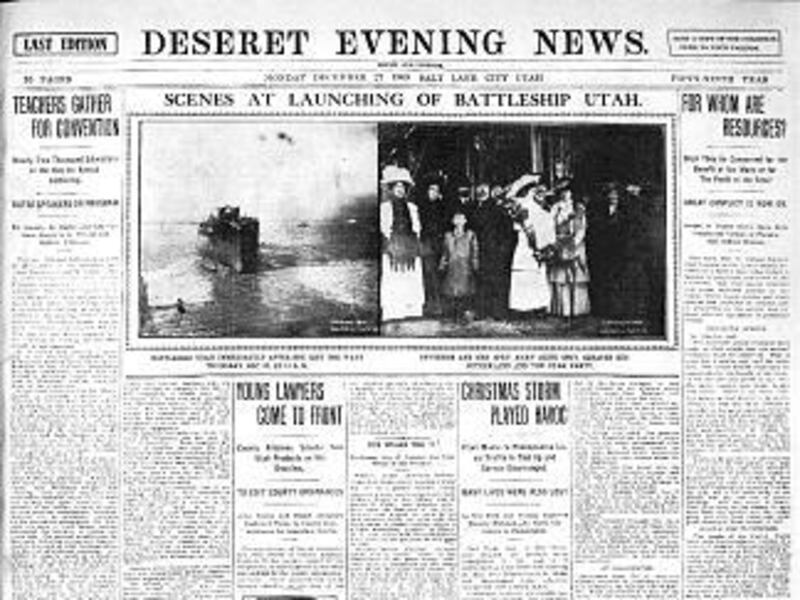
On Dec. 23, 1911, at precisely 10:53 a.m., Mary Alice, then 18 and resplendent in a white fur-trimmed coat, recited the standard words: "I christen thee Utah. Godspeed." And the ship slid into the water to begin its varied career.
Ronald Fox, a North Salt Lake resident, chose the photographs from the paper's archives. A collector of political and Utah history items, Fox is one of the organizers of the USS Utah centennial.
The completed battleship was commissioned at the Philadelphia Navy Yard across the Delaware River from Camden on Aug. 31, 1911. It drew approximately 28 feet of water, weighed 21,825 tons and carried a crew of more than 1,000.
In 1914 it landed a battalion at Vera Cruz, Mexico, in an American show of force. During the fighting that followed, according to the site, seven of the crew earned Medals of Honor. A few years later, the ship helped protect American convoys crossing the North Atlantic during World War I.
The naval disarmament treaty of 1922 required the USS Utah's conversion to a target ship. From then on, it served as the target for bombing and submarine attacks, including dive bombing, torpedo bombing and high-level bombing. Although dummy munitions were used, they were capable of penetrating steel decks, and thick timbers were erected to protect crewmen.
USS Utah also did duty as a machine-gun school. On its last sea voyage, it sailed for Hawaii in August 1941. It was a target ship for bombing exercises until that morning of Dec. 7, when it was among the first ships to be hit by Japanese torpedo bombers in the attack.
Moored at the west side of Pearl Harbor's Ford Island, USS Utah rolled over and sank. It was first hit about 8:01 a.m., and by 8:13 it had capsized. Six officers and 32 enlisted men were lost, while 30 officers and 431 enlisted men survived.
Upton was a Radioman 3rd Class at the time. He was preparing to go ashore to visit Waikiki Beach when the attack began.
"I was just reaching over my locker to get my shaving gear [when] the first torpedo hit us. We didn't know what it was," he said. It was a terrific impact, according to Upton.
The radioman's berth was next to the main radio, two flights below deck, he recalled. The radioman on watch said it was probably a collision by another ship. But within half a minute, "the second torpedo hit us."
The ship started to list to port (left, for landlubbers), and the men realized they needed to get up the ladders so they could go overboard.
With the ladders crowded with desperate crewmen, it took a while to climb up. At one level, someone was lowering a heavy battle grating over the exit, which would have trapped the men below, but he was talked out of it.
"We finally came up to the main deck," Upton said. They found themselves just under the ship's superstructure, with Japanese planes strafing sailors. The ship was listing more, and the protective timbers were bowed.
"I was quite sure we were going over by that time. I slid down the bottom of the ship. There was debris and other men in the water down below, too risky to jump." He was 60 or 70 feet above the water at that point. Mooring lines were snapping as the ship heeled further.
"I was on the bottom of the ship as she rolled over," Upton said. He slid about 40 feet on the hull.
"And sliding down here, there were barnacles around and I was beginning to scratch my legs a bit. When I got down to the bilge keel, kind of a stabilizing keel, I jumped into the water from there."
He plunged 10 or 12 feet into oily water. Luckily, the scum was not on fire at that location, though leaking diesel fuel and oil burned elsewhere in Pearl Harbor.
Upton swam to a mooring quay, helping a lieutenant reach safety. Men from the Utah climbed the quay's cross timbers. Then a ship picked up the survivors and took them to a dock on Ford Island.
"Most of us went into a trench being dug over there for laying a pipe or something. We were in there for a while and saw quite a bit of the action from there."
Asked to describe the sounds, he said, "There were bombs exploding and then there were quiet times, and then they would start in as different planes came back and strafed. It didn't take the old Utah long to capsize. She was on the bottom."
They could see a heroic rescue party headed by Machinist Stanley A. Semanski return to the ship during the strafing. The team cut a hole in the bottom of the ship to rescue Fireman 2nd Class John Vaessen. "He took a torch and cut a hole in it," Upton said. "He (Vaessen) was the only one rescued after the ship had capsized."
Today, he said, Vaessen lives in San Mateo, Calif.
A flatbed truck drove the survivors to a storage building at the Ford Island Naval Air Station, where they unloaded gear such as gas masks, helmets and ammunition. "While we were in there, the second attack came and (the Japanese) started bombing and strafing again.
"Some of the concrete that was blown in the air came right through the roof, and then they started strafing." Machine-gun bullets blasted through holes the concrete had made in the corrugated steel roof. "I think that was the closest they came to getting me," Upton said.
Altogether, America's first casualties of World War II were 2,403 killed, including 68 civilians, and 1,178 wounded, according to Naval Station Pearl Harbor's Internet site. Twenty-one Navy ships sank or were damaged, including all eight battleships in the harbor. Many aircraft and facilities were destroyed at army air fields.
Some of the ships were raised and refitted while others, like the USS Arizona, were too badly damaged. Utah's namesake ship remains next to Ford Island. The naval station site says it was "considered not worth the effort" of repairing.
Upton still keeps in touch with his old shipmates, often by e-mail.
He expressed regret that he could not attend the March 9 reception and display, but he said of the centennial observance, "I think that's great."