

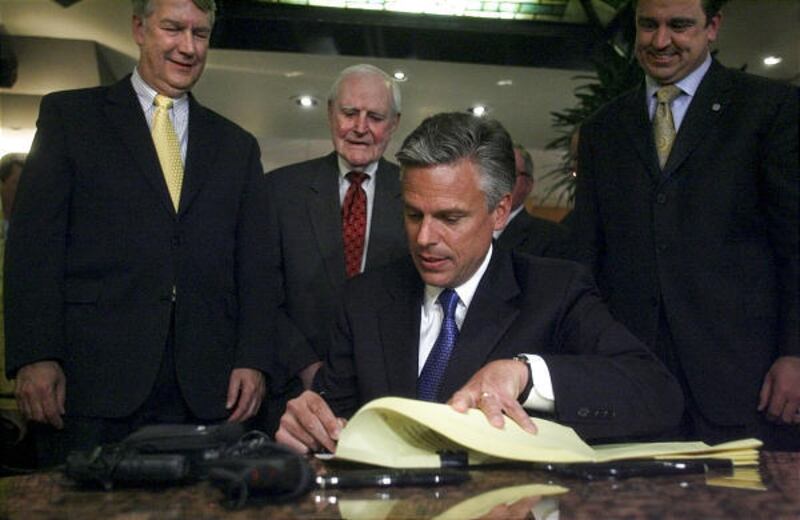

It was standing room only at a downtown private club late Monday afternoon as Gov. Jon Huntsman Jr. signed what he called a historic bill doing away with Utah's members-only bars and changing how restaurants serve alcohol.
"This is an important and new day in our state for purposes of economic enhancement, for purposes of travel and tourism, for purposes of enhancing our image," the governor said. "We're rolling out the welcome mat to the world."
He signed SB187 at a table in the New Yorker, a private club that along with others throughout the state will be able to open its doors to the public on July 1. Under Utah's decades-old private club system, customers had to fill out applications and pay fees before entering the state's equivalent of a bar.
Surrounded by lawmakers, liquor regulators, lobbyists and others involved in the bill, Huntsman joked that the last GOP governor who attempted such sweeping changes in Utah's liquor laws was voted out of office in 1960.
Tom Guinney, an owner of the New Yorker and other private clubs and restaurants along the Wasatch Front, was part of Huntsman's transition team on liquor issues five years ago that recommended getting rid of the private club system because it was confusing to tourists.
Guinney said he was optimistic then that some changes would be made in the state's liquor laws, but not that optimistic. "The one topic I did not believe would change in my lifetime or in my career was the elimination of private clubs."
Huntsman attributed his success to people having "the political will to get it done," and a push from both the public and the tourism industry. Plus, the governor said, "the stars aligned." The Utah Hospitality Association had announced last year it would launch an initiative petition drive to put the issue before voters in 2010.
The bill, sponsored by Sen. John Valentine, R-Orem, and incorporating separate legislation from Rep. Greg Hughes, R-Draper, was the result of several weeks of behind-the-scenes negotiations with a range of interested parties, including Mothers Against Drunk Driving and The Church of Jesus Christ of Latter-day Saints.
The governor said the first and only time he personally raised the private club issue with the LDS Church came after he was elected to his first term in 2004. "It was a business discussion," Huntsman said Monday of that meeting.
The LDS Church, which counsels its members not to drink alcohol and often becomes involved in what it deems moral issues, did not send a representative to the bill signing but did release a statement.
"The Church of Jesus Christ of Latter-day Saints is committed to reasonable regulations on alcohol that reduce underage drinking, over consumption, and drunk driving. In asserting these principles, we are pleased to have joined with members of the Utah State Legislature, the Governor, those representing the hospitality industry and restaurants, and others in addressing the interests of a broad spectrum of Utah citizens," the statement read.
Guinney and others acknowledge the bill is not perfect. The Utah Restaurant Association's Melva Sine even told the governor after being presented with a copy of the bill that "the work goes on." And MADD leader Art Brown, who didn't attend the ceremony, has said the bill's mandatory scanning of ID's of private club customers who appear to be under 35 years old doesn't go far enough.
Requirements placed on new or remodeled restaurants are confusing, Guinney said, and will likely be challenged in court. Those establishments will have to prepare drinks and store open bottles of alcohol out of sight of customers.
Existing restaurants will be able to remove the glass barrier known as a "Zion Curtain" between drink service and customers. But when the curtain comes down, underage customers will be banned from the bar areas of restaurants where drinks are prepared in the open.
Guinney said his Market Street restaurants will not be affected because they are already configured to meet the new requirements. But he said his private clubs stand to lose the $440,000 now collected annually in private club fees from nearly 20,000 members.
"It's a big financial hit," he said, but one he was willing to accept.
While the new law allows private clubs the choice to continue to serve members only, most are expected to make the switch.
The governor said there's still more work to be done on the state's liquor laws, calling them "a spaghetti bowl" of regulations. "That, of course," he said, "will be less visible because it's technical."
E-MAIL: lisa@desnews.com