



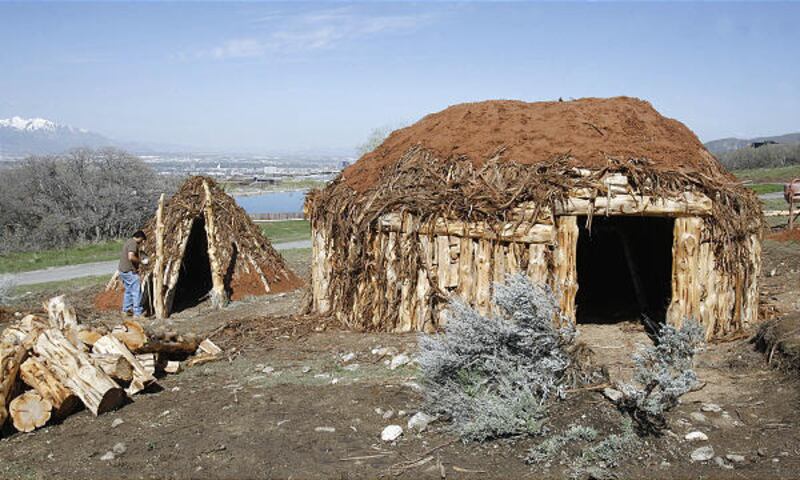

Nine green juniper timbers form the outline of the Navajo hogan at the base of the foothills on the east end of This Is the Place Heritage Park.
The dwelling is female, rounder and quite a bit larger than the teepee-shaped male hogan rising up a few feet away. She is almost finished now, her wood placed just so to emulate living trees. His roof reaches a point at the joining of three interlocked bowed timbers; hers resembles an upside-down bird's nest, the roof spiraling clockwise beneath its cover of red clay and hairy bark. Both doorways open to the east, to welcome the sunrise.
These structures are the first of what will be a larger Native American village. And nothing about the Navajo hogans — or the sweat lodge and shade house that will soon join them — is accidental. Those timbers, for instance, represent the nine months a woman carries her child before giving birth. Details are important to the man who has done most of the construction. And in Navajo culture, everything has gender. So Lorin Cummings was careful to put a male post, its wood twisting to the right, on the right, a female post on the left.
Cummings, who is one-half Navajo, divides work hours between handling the park's finances and building his small Navajo neighborhood.
The female hogan is about 20 feet in diameter, the male 15 feet. Most Navajos no longer live in hogans, but many ceremonies are still done there. Hogans can be home, or a place of worship and awakening, says Betty Begay. Her husband Roy Begay, a Navajo healer, will bless the hogans in a private ceremony preceding a public one May 23.
"It is a family unit and also a place where we go to pray," she says.
It might be in such a structure that a soldier, traumatized and fatigued by war, seeks ceremonies and blessings to renew his spirit and retune him to nature, she says. Ceremonies that take place in hogans and teepees can "restore life."
The Native American village, viewable starting May 15, has been a long time coming, says Lacee Harris, a northern Ute/northern Piute who is a mental health therapist at the Indian Walk-in Center in Salt Lake City.
"This is a continuation and completion of a dream that had started way back when" in the 1970s, says Harris, who served on an early committee to bring Native American scenes into the historic park. He'll also bless the site. The park exists to celebrate Utah's heritage from the years between Mormon pioneer arrival and statehood, telling the stories of all the inhabitants, including not only Mormons, but Navajo, Shoshone, Goshute, Piute and Ute tribes who were already here. Each has been invited to build traditional structures in the park. Soon teepees will trace the curve of the hillside.
Cummings was not always steeped in Navajo culture. He got his education in finance. A trained accountant, he was doing other things when his family and several others decided to build a Navajo Village in Page, Ariz. "We wanted to tell our own story."
Not long after, he was invited to help the Navajo Nation construct an American Indian village for the 2002 Olympics. He's done American Indian-related construction at the Grand Canyon, as well, so his name was familiar when park director Matthew Dahl sought someone to build hogans at the park. That it evolved to include a job in finance has been serendipitous.
Unlike those from all backgrounds who grow up taking their culture for granted, Cummings had to deliberately learn much of what he now teaches and demonstrates, asking for guidance from elders. His own early ties to a reservation were visits to see his grandmother, who does not speak English. He speaks no Navajo; his mother's generation is the bridge.
Becoming a father — he has four kids ages 2 to 9 — increased his hunger for history, to learn and honor the traditions of his elders, then to pass it all on.
It is in the details that meaning is built, says Harris, and it is important to share culture and tradition.
"These kinds of historical centers help us identify with where we came from and why we are who we are. Dwellings are part of the identity. One of the old men I knew folded up a leaf and as it folded, it formed into a teepee naturally. This shape helps us remember our ties to nature. It helps us to remember our spirituality. … That spirituality is the basis for everything we live for and deal with — our relationship with Mother Earth and the Creator who lives up above."
E-MAIL: lois@desnews.com