
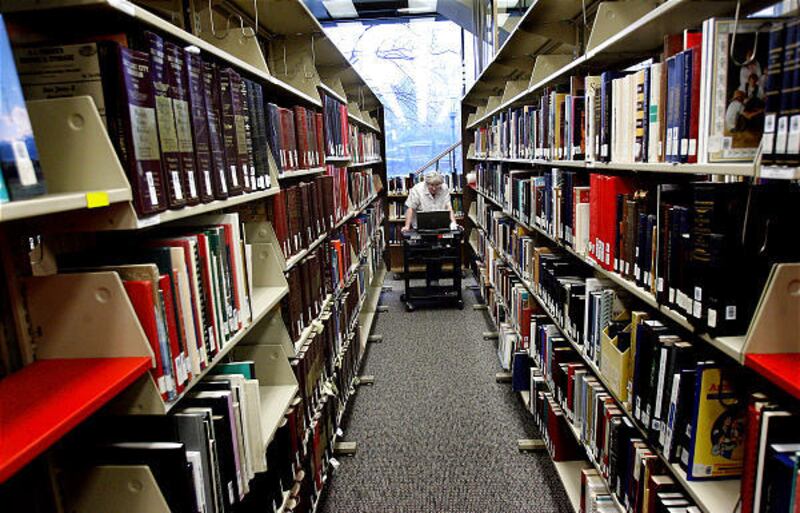
Mormons are "world champion record keepers" in the eyes of Phillip Barlow.
The Arrington chairman of Mormon History and Culture at Utah State University says LDS Church members, with all their journals, office records and genealogical information are unparalleled anywhere in the world.
Jan Shipps, professor emeritus of history and religious studies at Indiana University-Purdue University, agrees.
"The LDS keep better records than anybody I know about," she said. "They started keeping records from the beginning."
She figures The Church of Jesus Christ of Latter-day Saints would still be No. 1 in records, even without its world-famous family history system.
That's one reason why the church needs the new Church History Library, an entire five-story building with 230,000 square-feet at the northeast corner of Main and North Temple streets — just to store records.
For a church less than 200 years old to have so many records is surprising.
Elder Marlin K. Jensen, church historian and member of the Seventy, believes the new history building "will rival the great libraries of the world with its facilities and collections."
He believes it will become the "mecca of church history" and says the Lord places great value on church history.
Construction began in October 2006 on the building, which will be dedicated June 20.
The library's collection will include 270,000 books, pamphlets and magazines, as well as 240,000 original unpublished records. The library will house nearly 25 miles of shelving.
It will also have 23,000 audiovisual items, 13,000 collections of photographs and 3.5 million patriarchal blessings of LDS Church members.
Shipps said Mormonism was lucky in that it began at the start of a great literacy movement.
One reason Shipps said she's spent 50 years studying the LDS Church is because it has so many records available. There are also records by believers and non-believers.
Shipps said she's only scratched the surface reading church records. There are so many records out there, just of the LDS pioneer era, that you couldn't read them all in a lifetime.
There are Mormon records at many places, such as Yale and Berkeley. She is also impressed at the vast LDS collections at Brigham Young University, the University of Utah and even USU.
"There are Mormon records everywhere," Shipps said. "It's amazing."
She's not sure the church can continue to keep records at the same pace, because it has become so large.
"For a long time they stored everything," she said. "Now they tend to store things selectively."
The one thing Shipps worries about now is that the most modern of records in the LDS Church may only be on computer.
"They don't always print it out," she said.
Still, Shipps is very impressed with the church's openness with records in recent years and she believes public access will keep improving.
The Joseph Smith Papers effort not only illustrates church openness on history, but Shipps said it also highlights how much history there is — 30 or more volumes — just on one man's short lifetime to age 38.
She's not a member of the church, but said some things in the church do excite her. For example, in 1973 she recalls seeing some manuscripts by Joseph Smith.
"It was a thrill even if I'm not a Mormon."
Shipps also believes there are still some lost LDS records out there, in someone's attic or basement.
All church members have long been advised to keep a personal journal.
"Get a notebook, my young folks, a journal that will last through all time, and maybe the angels may quote from it for eternity," LDS Church President Spencer W. Kimball once said.
Marian Jensen of Centerville is one of those church members who faithfully keeps what she describes as "a quick diary." At least every other night on the computer, "I write down what I did," she said. This is printed and bound into a yearly personal history each January and she uses the information to compile highlights to send to family and friends at Christmas time.
"If I wasn't a church member, I wouldn't be doing this," she said, noting that as a longtime convert to the LDS Church, it stresses record-keeping — even on a personal level.
"When you write it down," Jensen said, "it has a lot of meaning to you."
Elder Jensen once said that the scriptures make clear that "remembering" is a fundamental and saving principle of the gospel. We keep records, he said, to help us remember.
For more information, go online to www.lds.org/churchhistory.
E-MAIL: lynn@desnews.com