



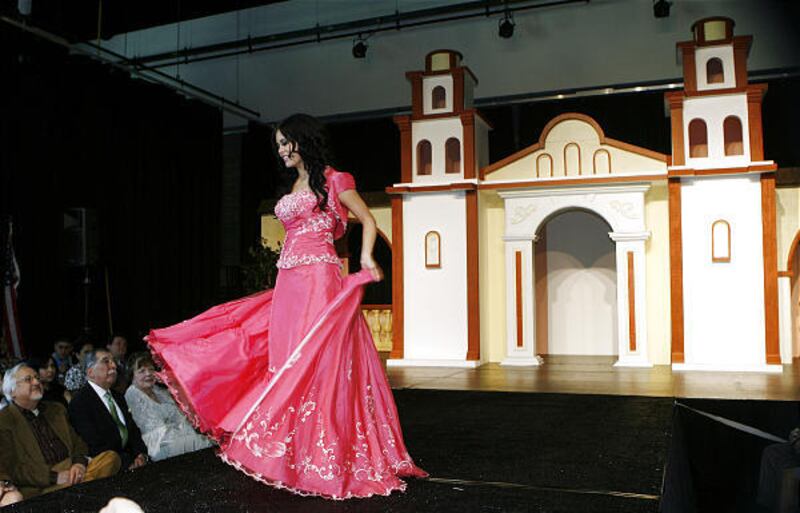


Certain coming-of-age rituals are givens. The weddings, the graduations and the sweet sixteen parties.
But, for a large and growing number of Utahns, there is another event that is bigger than any other birthday and more exciting than caps and gowns.
The quinceanera, or quinceanos, is a tradition deeply rooted in Latin American and, especially Latin American Catholic culture, that celebrates a girl's 15th birthday, her coming of age and her introduction into adult society.
Susie Porter, associate professor in the University of Utah Department of History and Gender Studies program, who also works in the Latin American Studies program, explained its significance.
"It's a widespread practice that's really important for the 15th birthday," Porter said. "Whereas in the States and the Anglo culture, you'd do the sweet sixteen. It's tied into the Catholic religious faith."
Porter said that it is a common practice for both active and lapsed Catholics to celebrate quinceaneras, which will include a Mass as well as rituals such as honoring the Virgin Mary with flowers or discarding symbols of childhood.
"There's a doll you throw … like a garter or a bouquet," she said. "The doll basically represents the last doll that you have as you move from being a girl to being a woman. You are between generations and marking that passage, throwing away a sense of childhood."
Porter said that the quinceanera has evolved, though.
It is now acceptable to choose to celebrate the sweet sixteen instead or celebrate the quinceanera regardless of religious affiliation. It is often more about the culture than the tradition.
"It's kind of about celebrating your culture and maintaining those rich cultural practices," Porter said. "How they celebrate changes."
Denise Lyons was born and raised in Mexico but celebrated her quinceanos in Peru. A practicing Mormon, she said her decision to have a quinceanera was a cultural one. The event has a large significance in the Latin American culture and symbolizes change in a young girl's life, she said.
"It's for a girl coming out to society," Lyons said, likening the event to old Southern debutante balls. "It means they have more responsibility."
While it may be similar to a sweet sixteen party, it is often on a much larger scale. Quinceaneras are large, glamorous and often-expensive affairs more akin to weddings than birthday parties. They feature elaborate dresses, rehearsals, fancy cakes, even a court.
"There's a whole court with your best friends and you dance the waltz with them," Lyons said. "There's also a chambelan, which is the guy you are dating, or any guy you choose to accompany you."
Lyons said quinceaneras take time and money to put together. Her own grandfather sold his car to fund his daughter's quinceanera. She said that sometimes, it will even take an entire village to pull one together.
"People go all out," Lyons said. "Even people without a lot of money. Sometimes everybody will help out. In little towns, they'll have the party in the street, and there are godfathers who can take care of the cake or the dress or the DJ. That happens a lot in the smaller towns."
Sandra Gonzalez, who is originally from Colombia, said that these godfathers, or padrinos, who finance parts of the quinceaneras, are more common in some regions than others but are an important and valued part of the celebration.
"It's different for Mexico and South America," Gonzalez explained. "In South America, parents pay for everything, while in Mexico the padrinos, or godfathers, help pay for specific things. It's a big honor to be asked to help."
Gonzalez said that, regardless of outside help, quinceaneras can easily cost as much as a wedding, which she estimated to cost approximately $20,000 to $40,000. She doesn't see this number waning much, even in the face of a struggling economy. When asked if the current economic condition would affect the scale of these celebration, she replied: "I don't think so."
"You have to understand that Latin Americans are used to being in crisis," Gonzalez said. "They're always having a hard time, and so they're used to it. They aren't bothered by the recession."
Planning ahead also plays an integral part in managing the cost. Gonzalez is already planning her 13-year-old daughter's quinceanera, saying such foresight is not uncommon.
"You start saving a long time in advance," she said. "The family starts planning and saving when they are very young."
Gloria Stallings, part-time faculty member at Brigham Young University, is also from Colombia. It took her six months to plan her daughter's quinceanera. The waltz alone can take three months of rehearsal, she said. Stallings also echoed Gonzalez's sentiments about cost. She said that these events are a matter of tradition, regardless of cost.
"We were born in countries without a lot of material things, but we save our traditions without money," she said. "We are used to being poor and working just to have the celebration. It takes a lot of money, but we need to keep the tradition."
According to Robin Saville, founder of BrideAccess.com, there is undeniably a strong, thriving market for these major celebrations in Hispanic culture. Saville's company recently hosted an entire event aimed at quinceaneras and weddings.
"This year there have already been 30-33 bridal fairs, but none has ever been geared to this community," Saville said. "We just looked at the money being put into it and saw that there was a need here, that this is very important (to this culture)."
Saville's company looked at raw statistics. The average cost of a wedding in Utah is $12,000. However, a wedding in the Latino community along the Wasatch Front runs approximately $28,000. They have wanted to tap into this community for some time.
"We've been talking about an event like this for three years, but we wanted to understand the culture and the traditions," he said. "It's the fastest growing community in Utah."
Fernanda Aguirre was at the BrideAccess.com event last month manning the table for Frenze Bridal. She said that there was a large amount of interest in the event itself, but especially for those planning quinceaneras. At age 14, she also falls into that group and she didn't hesitate to describe her ideal party.
"An amazing ballroom with a gorgeous dress, a cake and a waltz," she said. "Hispanic people go all out. They get expensive dresses, they'll fly things in from Mexico … I want to, but I don't know about my parents."
E-mail: emorgan@desnews.com