

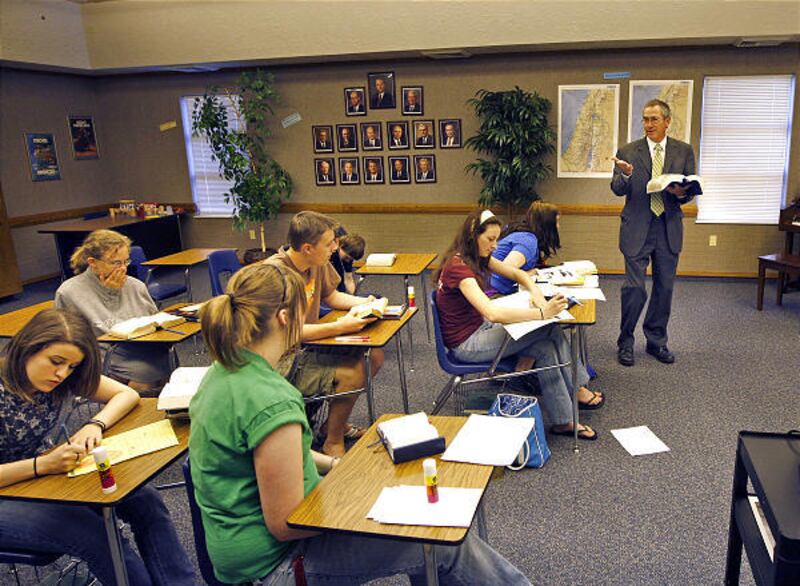

Never again will Granite High School students file across 500 East from the school to the Granite LDS Seminary for release-time religious education, as the final chapter closes on the inaugural seminary of The Church of Jesus Christ of Latter-day Saints.
With today's formal closing of Granite High, the Granite Seminary becomes an associated casualty, the final class conducted Thursday morning for a program whose graduates include former LDS general authorities President James E. Faust and Elder Neal A. Maxwell, former U.S. Sen. Frank Moss, columnist Jack Anderson, former Mormon Tabernacle Choir director Jerold Ottley, entertainer Robert Peterson and author-lecturer Dian Thomas.
No longer will Granite students arrive at the front entrance of the 15-year-old structure at 3328 S. 500 East, passing by an entryway plaque displaying a portion of a red brick salvaged from the original seminary building, built when Granite High students first blazed a similar school-to-seminary path in 1912.
"It's sad to know kids won't be in that building like they have in the past, but we knew it was going to happen eventually," said Donald D. Davis, the seminary principal and teacher.
"I was hoping for one more year," he added, mindful that most of the handful of the regular attendees were underclass students and that attendance in his ninth-grade seminary class at nearby Granite Park Junior High had quadrupled this year.
During his three-year tenure at the seminary, Davis had watched its potential-student enrollment dwindle from 170 to 70 to 25, the annual decreases mirroring Granite High's as it changed from a traditional high school to an "academy" offering. The seminary's enrollment reflects the community's changing demographics of fewer and fewer LDS student households.
The Granite Seminary history concludes just a couple years shy of a full century. Wanting to enhance religious education for impressionable teens, the Granite LDS Stake created a seminary program in the fall of 1912, with the Granite District Board of Education allowing "release time" for students to leave the high school and attend religious instruction.
Granite Stake President Frank Y. Taylor borrowed $2,500 on a note from Zions Savings Banking to buy the property and build the original residence-like building, which consisted of one large classroom, blackboards, an office/library, a cloak room, seats and a stove for heat.
Thomas J. Yates was hired that first year to teach, contracted at $100 a month.
Some 70 teenagers attended the first year, and within a half-dozen years, similar seminaries had been established in Brigham City, Mount Pleasant, American Fork, Lehi and Blanding as well as in Mesa, Ariz., and Star Valley, Wyo.
By 1923, the first seminary graduation exercises were held throughout the church's education system; by 1926, seminary instruction for secondary students expanded to a college institute of religion, the first at the University of Idaho in Moscow, Idaho.
While the high school seminary will discontinue, religious education will continue to be a primary use of the current building. Davis will retain his office as a headquarters while he continues to teach classes at the nearby junior high and alternative high schools and work with home-bound students.
And the church has set up one of the classrooms to host a first-year pilot program for seminary/institute instruction for deaf students using videoconferencing equipment to reach students in Utah and across the country.
E-MAIL: taylor@desnews.com