


The cross is the symbol of Christianity, so it is intriguing that Mountain of the Holy Cross — an immense natural formation of a perpetual cross — exists in Colorado, south of the Vail Mountain resort.
Mountain of the Holy Cross isn't just any mountain. It is one of Colorado's "14ers" (14,000-foot-peaks), of which there are 58.
The mountain used to be a national monument, and many Christians made rugged pilgrimages there in the early 20th century for its reputed healing powers.
How big is the cross?
Simply gigantic. The arm is about 750 feet across and its vertical length is at least twice that, at about 1,500 feet high.
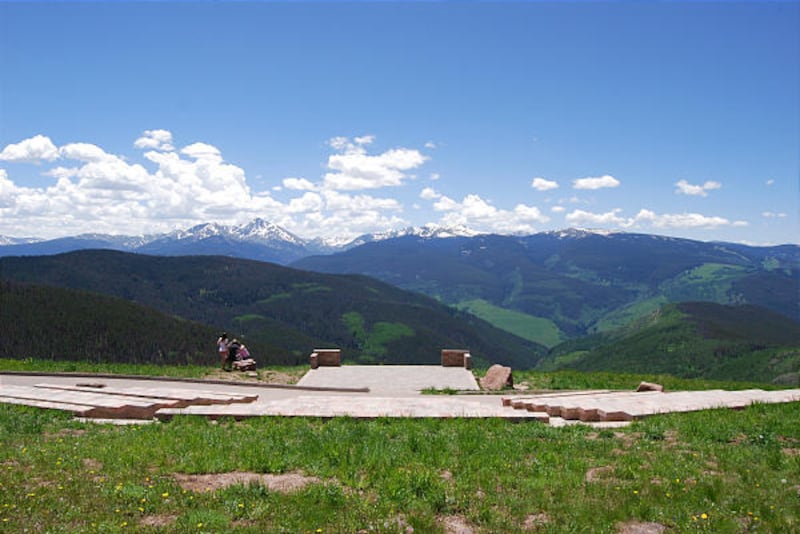
Ice and snow accumulate in a deep gully to form the shape of the white cross on the mountain's northeast face. Located in the Sawatch Range, the Holy Cross is also only about 15 miles from Vail Resort and visible from the 10,300-foot summit at the Eagle's Nest of Vail.
Today Vail Mountain Resort has a wedding deck that faces directly toward the Mountain of the Holy Cross.
"There are tons of weddings performed there during the summer," Katie Coakley, a spokeswoman for Vail Resort, said. "By Labor Day, you'll start to have times that it's not able to be seen, but it'll melt the next day. It's usually October or November when it's not visible."
A sunrise Easter morning service at Vail's Eagle's Nest is a regular religious event held annually.
There's also the Mount of the Holy Cross Lutheran Church in the Vail, Colorado Valley, named after the unusual mountain. Pastor Scott K. Beebe said pilgrimages to the cross were revived in 1976 as a Bicentennial event after a 37-year lapse. Since then, Holy Cross Lutheran has continued them. This year's trek is July 31-Aug. 1.
"Mount of the Holy Cross is indeed a majestic peak, which my wife and I had the privilege of climbing several years ago," the Rev. Beebe said. "It is a fascinating mountain with an intriguing history."
This mountain was just a legend that few believed really existed in the late 19th century. This obscurity was compounded not only by the mountain's remote nature — some 100 miles southwest of Denver — but also that many map makers of the era misplaced the formation by as much as 30 miles.
Sam Bowles was the first recorded visitor to see the cross, from Grays Peak, about 40 miles away, in the late 1860s.
He wrote in his 1869 book, "The Switzerland of America," "Over one of the largest and finest, the snow fields lay in the form of an immense cross, and by this it is known in all the territory. It is as if God has set his sign, his seal, his promise there — a beacon upon the very center of the continent to all its people and all its generations..."
By the 1870s, interest in the mountain was keen and Ferdinand Hayden of the U.S. Geological Survey, searched for the elusive mountain in the summer of 1873. Photographer William Henry Jackson, a photographer, took the first photograph of the unusual mountain as part of that expedition. He took that first photo from the summit of Notch Mountain, to the east.
A year later, Hayden did a return expedition and artist Thomas Moran went along to view the strange feature. He completed a seven-by-five-foot painting of the Holy Cross in 1875.
Jackson's photo and Moran's painting were both displayed at the 1876 Centennial Exposition in Philadelphia. Some Christians saw it as both a sign and promise by God.
As travelers searched for the mountain, a few claimed it would mysteriously disappear as they got close to it. Others believed it emanated restorative powers of healing, or that sins would be forgiven if you saw it.
In 1879, Henry Wadsworth Longfellow, who had been impressed by Jackson's photographs, wrote a sonnet about the mountain as a tribute to his wife.
The Rev. Beebe said the first recorded "pilgrimage" took place in 1912 when a party of Episcopalian priests and bishops climbed Notch Mountain for a communion service facing the "Cross of Snow."
In the 1920s a Protestant dentist from Eagle, Dr. O.W. Randall, and a Catholic priest from Glenwood Springs, the Rev. John P. Carrigan, conceived and conducted the first official pilgrimages up Notch Mountain. The first pilgrimage party of Boy Scouts and Campfire Girls was led by Randall in 1927. By the following year, the Denver Post began to promote the pilgrimages. They attracted thousands of people from all over the world.
The Denver Post reported in 1930 that some people afflicted with rare maladies were indeed cured when they saw the cross.
In 1934, the Forest Service built a new trail and shelter house for the pilgrimages on the south summit of Notch Mountain. The pilgrimages were discontinued in 1939 because of World War II.
The Mountain of the Holy Cross and the surrounding area received National Monument status by President Herbert Hoover on May 11, 1929. However, 21 years later that status was revoked when interest in the area decreased and the cost of a full-time staff there could no longer be justified. Also, the mountain cross' left arm eroded and landslides marred the image somewhat. Despite its somewhat warped left arm today, the cross remains inspiring.
Riding the Vail gondola is the easiest way to see the cross. The superior way to see the Holy Cross is hiking the Fall Creek trail from the Halfmoon Campground.
The even more difficult adventure is to hike to the mountain base and climb the cross itself. Technical climbers have scaled the cross itself since the 1930s. Today there are four routes to do that, all for experienced climbers.
The Eagle Bahn Gondola leaves Vail regularly each day through the end of August and climbs up Vail Mountain to a good side view of the Holy Cross at a designated lookout platform, complete with some spotting scopes. Signs there outline the cross and its history. A special twilight ride, Thursday through Saturday, 4-9 p.m., offers free rides to the public.
More information on the Mountain of the Holy Cross is available at: americanhistory.si.edu/collections/object.
e-mail: lynn@desnews.com