


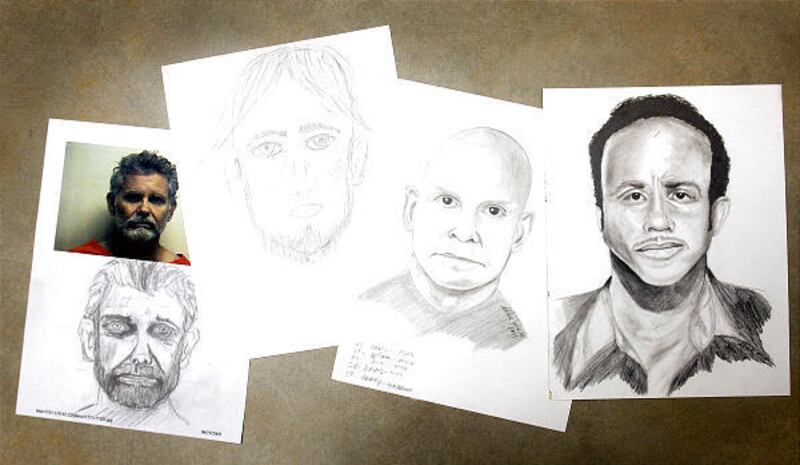

PROVO — Provo Police Sgt. Dan Dove is the first to admit he's no artist.
He still laughs at his first freehand sketch of a man's face, which shows an odd-shaped head, lopsided beard and hard-lined nose.
But after one day of forensic sketch-artist training, Dove's next face was very different.
"I did get the certificate for most improved," he says with a smile as he pulls out his second drawing, a pencil sketch of a bald man who looks like Mr. Clean.
But at least this time, the man has a proportionally correct face and piercing eyes.
"When they say the eyes are the window to the soul, I tend to believe it," Dove said.
For the past four years, Dove has been drawing on his weeklong training from Stuart Parks Forensic Associates, based in Coeur d'Alene, Idaho, to serve as Provo police's forensic composite sketch artist.
The traffic and parking supervisor doesn't get to draw suspects very often, but his skills have already paid off.
In March 2008, police captured a burglar several weeks after Dove's forensic composite sketch of a man wearing a baseball cap appeared on television and in newspapers and someone called with a tip.
"They say you will have finally arrived when you've arrested someone off your drawings," Dove said. "It's pretty rare, but it happens once in a while."
Getting a "hit" or a positive identification off a sketch is Karen Kido's favorite part of the job.
A certified forensic artist through the International Association for Identification — based in Minnesota with geographic divisions throughout the United States and internationally — Kido has spent 35 years with the Salt Lake Police Department analyzing fingerprints and crime scenes, and when needed, sketching potential suspects.
Unlike Dove, Kido started out as an artist, got FBI training and keeps doing the job because she loves to draw.
"It's just something I thought would be interesting," she said of forensic sketches. "It was a dream of mine that became a reality."
She's drawn suspects for homicides, robberies and even a few suspects in the Elizabeth Smart kidnapping case.
It's a small field, and Dove and Kido couldn't think of any other officers or artists in the state who work specifically with police as forensic artists.
But whether someone is a lifelong artist or a newcomer, both sketchers say they can't draw a good face without a good eyewitness.
To start, Dove has his witnesses pick out the best matching face shape, eyes, nose, mouth, hair and chin from the FBI's "Facial Identification Catalog," while he blends the features into a face that hopefully looks familiar.
He'll adjust eyes to be bigger, noses to be smaller or lips to be more mean, whatever the witness remembers.
"If you want me to completely erase the whole top half of their head, I'll do it," he tells the witness.
Frustration can't exist in this job, which Dove says often takes up to three hours.
Each composite sketch starts in a 6-inch-by-4-inch rectangle, representing the average head.
Then Dove measures where the eyes go, and how far down a nose sits. Mouths, often the most difficult to draw, are usually one-third of the way between the nose and the chin. The Stuart Parks training is very mechanical — that's how the 20-year police veteran with no art background could pick it up so fast.
"I don't claim to be an accomplished artist by any means," he says modestly. "But I'm more accomplished after the class."
Instructor Carrie Stuart Parks still remembers Dove and his improving skills.
The commercial artist and her husband, Rick Parks, both FBI forensic sketch-artist trained, have taught thousands of students since 1988. They convince people of the power of the pencil over computer programs through a series of computer-generated images of famous politicians or actors that most people can't recognize.
Yet when they pull out the human-drawn caricatures, there's a nearly 100 percent identification rate.
"To look at the drawing, we know it's not perfect," she said. "It allows the mind to hook around who it might be, as opposed to this (computer-generated) realistic face."
Kido's goal is to have her composite sketches look as real as possible, so that they could be the link police need to solve a crime.
"It's just an additional tool," she said. "Sometimes they just run out of leads and all you have is a memory of a witness. It's just a tool to get in the ballpark of finding somebody."
e-mail: sisraelsen@desnews.com