

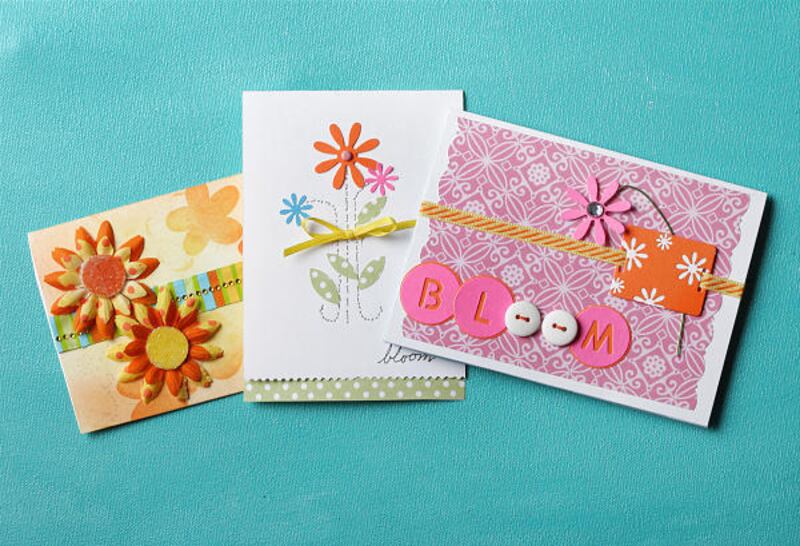
Cards
have always played an important role in my life. When I moved in third
grade, my entire elementary-school class made good-bye cards. I kept
them, and when I was feeling sad and alone, I'd read them and remember
that somewhere, I had some friends. I still have some of them in my
memory box that's tucked under my bed (waiting to be scrapbooked).
I
made my first card when I was about 3 years old. I know, because my mom
kept it in my baby book, which would now be called a scrapbook. My mom
has scrapbooked and journaled her whole life, and I'm grateful for it
because my own scrapbooking experience extends only to wishful
thinking. I can't get organized enough to scrapbook or journal. That's
why I turned to card-making.
Cards
have a small surface area. A 12-by-12-inch scrapbook page goes on
forever with endless possibilities and plenty of room to mess up. One
has to be organized enough to gather up family histories and photos and
present them on that big old page in a clever and artistic way. That's
not me.
Organization is not my
strong suit. I like to think I'm clever and artistic, but
realistically, those qualities last only for a certain time frame, and
with each minute that ticks by, my talents decline. When I get a flash
of inspiration, I have a small window of opportunity in which to be
creative, or I lose interest.
Scrapbooking
seems daunting — a project with no end in sight. Card-making appeals to
the laziness in me. It's finite. I like the instant gratification a
card project can bring. I can make a card in five minutes with little
effort, and yet my friends think I'm a thoughtful genius. During that
five minutes, my thirst to create is quenched.
I
don't believe scrapbooking versus card-making needs to be a polarizing
issue. I believe you can embrace and love both crafts equally. I know
people who can actually manage both — sometimes in the same day!
Many
of the supplies that are used in scrapbooking can also be used in
card-making. The wealth of embellishments developed for the
ever-popular scrapbooking industry are also a boon to those of us who
make cards. Thank goodness for the great numbers of scrapbookers who
have consistently demanded more and better tools and gadgets.
For
me, card-making is manageable, affordable and less of a commitment. I
can share my cards with a variety of friends. With a scrapbook, I have
to lure them to my house, sit them down and say, \"Look what I have
done!\" With cards, they can ooh and aah in their own homes (or at
least, I imagine that's what they're doing, and if they're not, at
least they don't have to pretend to be astounded.)
As my card-making buddy Bonnie recently told me, \"Your future is in the cards.\" I think she's right.
- Tips for handmade greeting cardsDon't worry about perfection. Realize
that any handmade card will be welcomed and unique. It is a gift of
your creativity and time. Cards are more personal than e-mail and allow
you to stay in touch and let your recipient know that you're thinking
of them. (You can show off a little bit, too!)
- Play.
It's only paper. You can paste over mistakes or use scraps of a card
that didn't turn out to make another. Don't feel you have to follow the
directions to the letter. Mix it up, use your own creativity and get
your hands and work space dirty. Card groups or exchanges are a good
way to force yourself to experiment. You can find them on the Internet
or the classifieds in the back of cardmaking or papercraft magazines.
Try using scraps and found objects to add to your card. You don't need
to buy expensive embellishments in order to make cards, but try to use
a good quality of card stock (available at all craft stores). This will
yield better results for very little money.
- Collect
sayings and quotes. Some cardmaking and papercraft magazines provide
quotes for your use. If you use a quote, be sure to credit the person
who generated the quote. There also are Web sites that feature quotes
and greetings. File them in categories in your computer, or if you have
no computer, an expandable folder. Print them out as needed on your
computer or hand-print. If your handwriting isn't perfect, don't worry.
It adds to the charm of a handmade card. Try printing your greeting
around a shape. Alphabet stamps also can be used for greetings, but
spelling each word out letter by letter eats up a lot of time. Alphabet
stamps are best used for one-word greetings or names. Rubber-stamped
and rub-on greetings also are good investments.
- Make
multiples. When you make a card you like, make some more with the same
elements or theme. You may not always have time to make a card as the
occasion arises so you'll have them on hand if you make extras. Keep
them filed in a card organizer, notebook or box with notes as to who
the recipient was for each card. This will keep you from sending the
same card multiple times to the same person.
- Envelopes.
Be sure you have an envelope that will fit the size of your card if you
intend to send it through the mail. Odd sizes will require extra
postage. Craft stores have prepackaged cards and envelopes, or you can
buy templates to make your own envelopes. Decorate your envelope with
scraps or die cuts or stickers that tie into the theme of your card.
E-mail: vparsons@desnews.com