



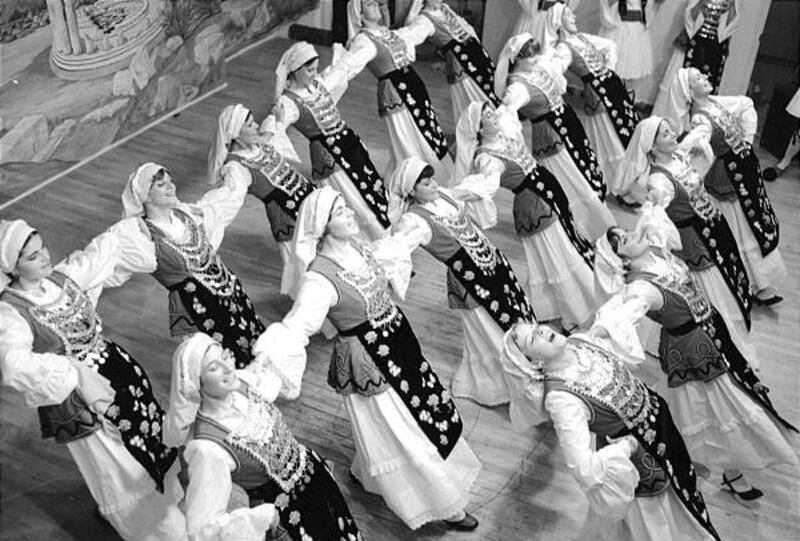


What started as a one-day bazaar held in a church basement in 1935 has blossomed into a four-day celebration of Utah's Greek culture.
Salt Lake City's annual Greek Festival, which wrapped up its 35th year Sunday at the Holy Trinity Cathedral of the Greek Orthodox Church, attracts tens of thousands of visitors intent on enjoying traditional Greek folk dances and eating as much baklava as they can.
The event traces its origins back to the annual bazaar sponsored by the church's Mothers Organization, which was held each year from 1935 to 1974. In 1975, the organization joined forces with the Parish Council to expand the event to two days. It was a hit. A year later, a third day was added to the event.
Over the years, the church has gradually expanded just for the festival, including a warehouse to help prepare for the annual event.
Now about 50,000 to 60,000 people attend the festival, and the church uses income from the festival to support local charities every year.
Deseret News photographers have taken hundreds of photos of the festival over the years, most of which have never been published. Photo researcher Ron Fox has culled many of these and other photos of Salt Lake's Greek community from the newspaper's archives, and they can now be seen at www.deseretnews.com.
The festival offers a friendly glimpse into the state's Greek culture. Initially, Greek immigrants who came to Utah to work in the mines and on the railroads received a cold welcome.
Deseret News staff writer Rose Mary Pedersen, in a story in the Sept. 11, 1976, Deseret News, detailed the trials of the young Greek immigrants who arrived "with empty pockets and suitcases full of dreams."
"They had heard that America was a land of opportunity — a place where they could make their fortunes overnight," Pedersen wrote. "Not every street turned out to be paved with gold, however, and not everyone welcomed them with open arms.
" 'We had hard times … happiness, too,' said 86-year-old Anast J. Chipian, one of the most revered members of Salt Lake's sizable Greek Community."
Chipian, who came to the United States from Stadiam, Greece, in 1907 when he was 17, was representative of an army of Greek men who left the poverty of their home country seeking prosperity, often working as strike breakers in the mines of Carbon County and rail yards of Salt lake City.
The 1900 census lists only three Greeks in Utah. Five years later, the community had swelled into the thousands, and a Greek Orthodox church was built on 400 South between 300 West and 400 West. A thriving "Greek Town" was established, with its hub along 200 West between 200 South and 500 South.
Constantine Skedros, a West High School history teacher who would eventually chronicle Utah's Greek Orthodox Church in his book "100 Years of Faith and Fervor," told Pedersen about his experiences growing up in Greek Town.
"Quite an assortment of establishments lined the streets of Greek Town at its height — barbershops, coffee houses, markets, saloons, private residences, bakeries," Skedros said. "When I was a young man, I used to go to a Greek place called Politz Confectionary for ice cream."
In 1920, the Greek community took steps to build a larger church, and the Holy Trinity Cathedral was consecrated on Aug. 2, 1925.
"Greek Town" disappeared after the 1920s, as Utah's Greek population integrated with the rest of the state's population.
In 1992, the Hellenic Cultural Association opened the Hellenic Museum in the basement of the Holy Trinity Cathedral. The museum became the first Ethnic Greek Museum in the United States. It attracts many visitors throughout the year, especially during the annual festival.
e-mail: mhaddock@desnews.com