


Editor's Note: Lee Benson's office has been his bicycle the past week as he traveled the byways and backways of northern Utah looking for columns. This is the final column from his journey.
GREAT SALT LAKE — Imagine the least likely place to find a world-renowned work of art.
Now imagine taking a wrong turn getting there.
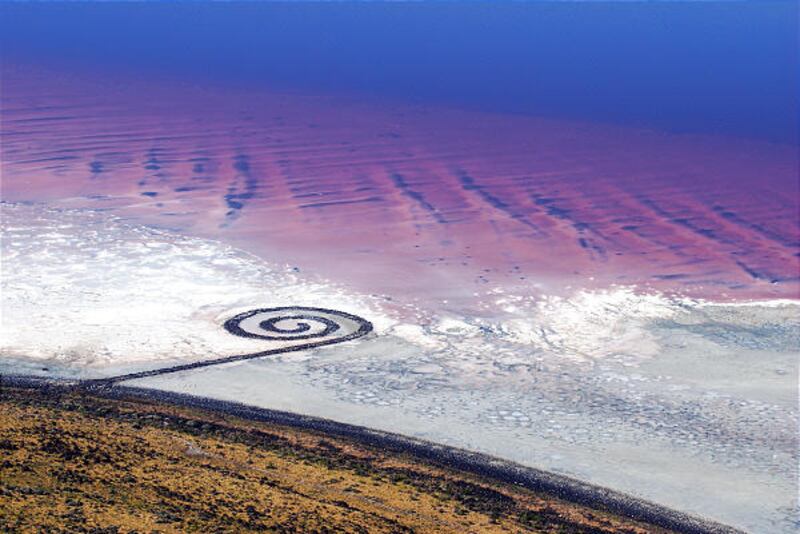
Welcome to the Spiral Jetty.
The jetty can be found out here just off Rozel Point on the north shore of the Great Salt Lake, 100 miles from the Wasatch Front and about a million miles from the nearest Manhattan art gallery, existentially speaking.
Technically the jetty is in the lake, although "in" right now shouldn't be taken literally because the lake is in one of its shrinking phases. The jetty currently sits like a marooned sailor in a baked mud seabed a good football field from any actual salt water.
I know this because I personally laid eyes on the Spiral Jetty to end my bike tour across northern Utah. Finishing lines aren't supposed to be easy to get to and this was no exception. First you have to make it to the Golden Spike National Historic Site, which is itself the last stop on a dead-end road. (Strange but true. The point that in 1869 completed the transcontinental railroad and connected the country is now the end of the line.)
After the pavement ends at the visitors center, it's 16 miles of rough dirt road to the forgotten edge of a forgotten lake.
The remoteness, of course, was what drove Robert Smithson to Rozel Point in the first place. That and the red water.
In 1970, Smithson was an up-and-coming superstar artist from New York who wanted to do something so big and so out there that it couldn't possibly be hung on an art salon wall.
He seized on the upper arm of the Great Salt Lake because the algae, brine shrimp and bacteria in the salty water often conspire to color the lake blood red. A lover of spirals — curlicues to the layman — Smithson bulldozed thousands of the black basalt rocks that litter the shoreline along Rozel Point and organized them at the edge of the water in a counter-clockwise spiral 3 feet wide, 15 feet deep and 1,500 feet long.
Critics immediately proclaimed it "one of the most famous artistic earthworks in the world." Art aficionados around the world beat a path to the lake shore.
At least they did until the Spiral Jetty disappeared. For nearly a quarter of a century, from 1971 through about 1996, the lake level rose so high that it completely submerged the jetty, rendering it a real hidden gem.
But then the lake went back down and the jetty re-emerged, beckoning a whole new generation of earthwork art pilgrims.
I approached the famous sculpture with my son Tanner, who I should mention is 14. At the Golden Spike we'd switched from road bikes, which we'd ridden from Tremonton, to mountain bikes. After an hour and a half or so of riding the mountain bikes he got to the point first, making a last hard 90-degree right-hand turn to finally see what we'd been looking for.
As I rode up I looked at Tanner as he leaned over his bike and gazed at the jetty, wondering what thoughts he must be thinking, just him and the horizon and that world-famous work of art.
He looked over at me and said,
"We rode 16 miles for this? Looks like a pile of black rocks to me."
I turned my attention to the jetty. He had a point. It did look like a pile of black rocks — totally forlorn at that, like they'd tried to dive into the lake and missed.
Although in fairness we did catch the jetty on a hot, dusty afternoon when the water wasn't even red.
This certainly contrasted with the terrific views my friend and former Deseret News colleague Ray Boren has captured with his camera. Last month he exhibited his one-man show "The Spiral Jetty" at the Utah Artist Hands gallery. You can still see his photos on display at Cafe Molise on 100 South.
I called Ray, who has visited the jetty at least 20 times, and told him I figured we must have hit the jetty when it was having a bad air day.
"What fascinates me is that it's always different," said Ray. "It's a perfect example of landscape art undergoing change over time. It's a unique, quirky piece of art."
Tanner and I couldn't agree more. And one more thing. It is way out there.
Lee Benson's column runs Monday, Wednesday, Friday and Sunday. Please send e-mail to benson@desnews.com