



As your garden makes the gentle transition from summer to autumn, the ornamental grasses show their beauty. This is their time to move from the wings to center stage.
I contacted Clifton Smith, the garden manager at the Conservation Garden Park in West Jordan, for tips on growing these plants. I asked him why they used so many ornamental grasses in their gardens.
"We have found ornamental grasses to be some of the most versatile plants for water-wise landscapes," he said. "Their fine, slender leaves provide a very desirable texture to any landscape. And, when blown by the wind, they provide a pleasant-sounding swish.
"Ornamental grasses come in many shapes and sizes and add form to the garden, especially during the winter, when the landscape would look quite bare without them. On top of all of their desirable ornamental characteristics, they are fairly low-maintenance and require only small amounts of irrigation to keep them looking good."
All of the grasses featured here are not stage hogs but are willing to stay in their place.
For most landscape uses, I strongly recommend that you plant only clump-type grasses in your landscape. Running grasses that spread by horizontal stems — either above or below ground — never want to share the spotlight with other plants. And they often take over and become weeds.
While there are many different kinds of grasses, some of them are great performers that will add to your landscape. They are all perennial in northern Utah.
"We have used many ornamental grasses, and Ravenna grass or hardy pampas grass is one of our all-time favorites," Smith said. "It is very large, so it needs to be planted in a space with plenty of room to grow. However, because of its size, it makes an excellent backdrop. In late-summer to autumn, it is topped with purplish-silver plumes that turn tan in winter."
Ravenna, or hardy pampas grass (Saccharum ravennae), has light green, white-ribbed foliage tinged with purples and oranges with attractive purple-tan seed heads in late summer. It tolerates wet or dry soil and reaches 12 feet or more in height. Grow it in full sun.
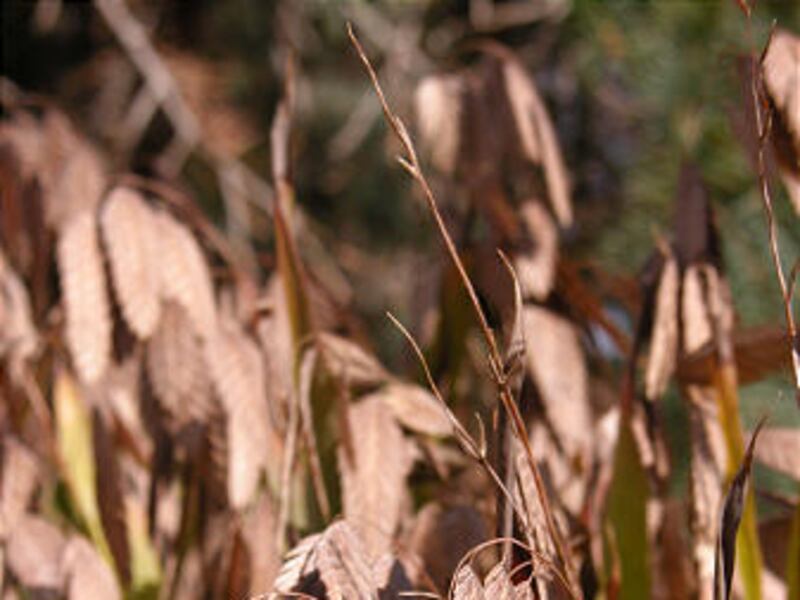
Northern Sea Oats (Chasmanthium latifolium) is a most interesting clump-forming grass that is native to North America. Its main ornamental feature is the flat seeds that make interesting patterns in the landscape.
Right now, the seeds are getting their purplish-bronze fall color, but they will turn tan when the temperature drops below freezing. One great feature of this grass is that it tolerates either sun or shade. And because it naturally grows along streams, it requires moist, well-drained soil.
Feather reed grass (Calamagrostis x acutiflora) is a very popular landscaping plant. It has a very upright growth and arching green or striped leaves, and it spreads very slowly.
Karl Foerster is one very popular cultivar. It will usually grow 4 to 6 feet tall, and the soft, yellow-bronze seed heads turn a tan color in late fall and winter. It prefers full sun and has good drought tolerance.
Overdam is another popular cultivar.
As a group, the Miscanthus genus are great garden performers. They are hardy from zones 5-9, are reasonably drought-tolerant and grow in full sun to part shade. They are easily recognized this time of year by the feathery, multi-plumed seed heads that appear in the fall.
Morning light maiden grass (Miscanthus sinensis) is one of the showiest grasses in this group. It has creamy yellow leaf margins. Gracillimus is a similar cultivar. Zebra grass (Miscanthus sinensis) has yellow, horizontal bands along the green leaves and will grow up to 8 feet. It has pinkish seed heads.
Another prominent group belong to the genus Panicum. Heavy metal switch grass (Panicum virgatum) is a stunning grass that gets its name because the green leaves turn a metallic bluish-gray later in the season.
Grasses in this genus have a finer textured, much more open and spreading seed head. Their showy display lasts throughout the winter because the snow does not weigh them down as much as many grasses. They do best in full sun but may tolerate some shade.
Smith offered a few care tips on the grasses.
"We really don't do much with our ornamental grasses until early spring," he said. "Our ornamental grasses do best being watered about once a week in the summer. Once colder temperatures hit, they go dormant and turn different shades of tan.
"In early spring, before the new green shoots appear, we cut them back to about 4 to 12 inches, depending on the species. That is about all that we touch them in a year. Occasionally, one will start to die out in the middle or get too big around for the space it is in. When this happens, we will dig it out and divide it. One of the pieces will go back where it came from, and we spread the rest around."
Don't miss out on these great plants! Visit the Conservation Garden Park and select your favorites to plant in your landscape.
Larry A. Sagers is a horticulture specialist for the Utah State University Extension Service at Thanksgiving Point.