



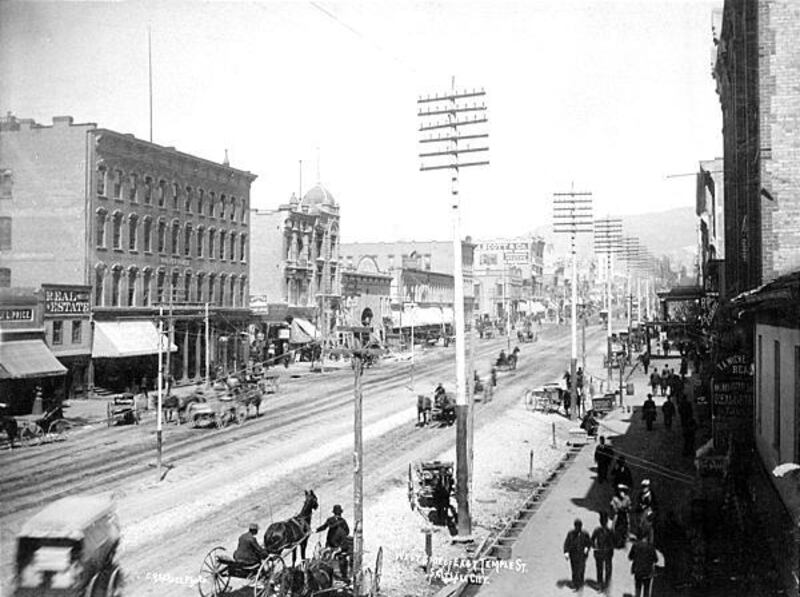

The West's early photographers were practitioners of a developing art — capturing images of pioneer life and industry that preserved the era with a clarity the world had never witnessed before.
For decades, these photographers traveled dusty back roads in wagons loaded with delicate glass plates and pungent chemicals, set up tent studios that doubled as dark rooms, and used massive box cameras to make crystal-clear images of stern-faced men, women and children. Through their lenses, the concept of a family portrait was born.
They also captured priceless images of historic events and the early development of Utah's cities and towns.
By the time Kodak introduced the Brownie in 1900, making photography available to the masses, these intrepid artists had documented a generation.
Names like C.R. Savage, George Edward Anderson, George Beard, J.W. Shipler, Elfie Huntington and Joseph Daniel Bagley stand out in the history of Utah photographers.
Photo researcher Ron Fox has assembled a collection of photos that represent the remarkable work of the early photographers, which can be seen at the newspaper Web site at deseretnews.com.
C.R. Savage probably captured the best-known Utah image of the era when he photographed the linking of the first transcontinental railroad at Promontory, Box Elder County, on May 10, 1869. His story is typical of many of Utah's early photographers.
Born in Southampton, England, in 1832, he joined the LDS Church at the age of 14 and emigrated to the United States in 1856 after serving missions to Switzerland and England. He first settled in Nebraska, then Council Bluffs, Iowa, where he established his first studio. In 1860, he traveled to Salt Lake City with his family. Savage influenced many early Utah photographers.
George Beard, known better for his paintings, was also an LDS convert who settled in Coalville and who learned the elements of photography from Savage.
Beard's daughter, Edna Beard Taylor, recalled that her father "was untiring in his photography. He would wait for hours for certain light and cloud effects."
Savage also taught G.E. Anderson, who set up a studio in Salt Lake City at the age of 17 with his brothers, Stanley and Adam. He finally settled in Springville, where in addition to studio portraits, he took thousands of documentary portraits in homes, barns and businesses.
He also trained the team of Elfie Huntington, a deaf photographer, and her business partner Joseph Daniel Bagley. Together, they followed in the footsteps of their early teacher and traveled throughout central and southern Utah documenting the lives of hundreds of Utah residents.
One of the first non-Mormon photographers in Utah was J.W. Shipler, who closed his studio in McKeesport, Penn, in 1887 and moved west, setting up shop in Denver and Great Falls, Mont., before founding Shipler Commercial Photographers in Salt Lake City in 1890. He established a photographic dynasty that endured through four generations until 1989. About 100,000 Shipler glass-plate and film negatives survive in the archives of the Utah State Historical Society.
e-mail: mhaddock@desnews.com