





The two old military veterans — one Army, the other Air Force — have long since retired from active duty. Time, which once passed by in years, now flies by in decades.
These two soldiers — both with a strong spiritual side and religious nature — never made it to any overseas conflicts, but they did support and nurture others who spent time with them in Utah at Fort Douglas and Hill Air Force Base.
The aging vets still find themselves getting gussied up for special events, looking their best for weddings, funerals and other ceremonial occasions. But they're being invited to participate in such things less and less. And few visitors nowadays stop in to say "hello" and listen to stories from days gone by.
And yet, the two don't fit the adage about old soldiers fading away. They've endured. They still stand tall, proud and ready to serve at a moment's notice.
So give a salute for old time's sake to the two spiritual giants of Utah's major military sites — the Post Chapel of Fort Douglas and the Hill Field Chapel.
HILL FIELD CHAPEL
Ogden's Hill Field (since renamed Hill Air Force Base) dates back to just prior to World War II, and the Hill Field Chapel wasn't far behind, constructed in late 1942 to building specs common at the time for Air Force chapels.
The chapel suffered considerable growing pains its first decade, with fire forcing a renovation just three years after it was built and another remodel project carried out in 1948.
Hill's growing population prompted a new, larger chapel in 1964 — more families mean more children, and more children mean needs for more space and more Sunday School classrooms.
With the replacement, the original Hill Field Chapel continued to serve — not as a house of worship or spiritual sanctuary, but rather as an educational building and makeshift office space.
Two decades later, the Hill Field Chapel was destined for demolition before the Aerospace Heritage Foundation stepped in and funded the chapel's 1984 relocation to the Hill Aerospace Museum complex on the base's northwest corner.
Once there, the chapel was restored to its World War II layout and appearance. Rededicated in 1989, it stands surrounded by the museum's Memorial Park.
Visitors who stop on a Saturday during the spring or summer (or who have arranged a special appointment in advance with the museum staff) can enter the chapel to stroll respectfully between memorial-laden pews and under the flag-draped ceiling.
They also can listen to the stories and trivia tidbits from 91-year-old James Chastain, a retired Air Force photographer who for the past half-dozen years has assumed tour-guide duties and is the self-described "church ding-a-ling" who rings the bronze bell in the chapel belfry on special occasions.
That bell is one of special features provided decades ago by the 384th Bomb Group, which, under the direction of Nathan Mazer — a World War II group captain and later a colonel when he finally retired at Hill — took the chapel under its proverbial bomber wing.
Learning to fly the Boeing F-17 Flying Fortress bomber in 1943 for action in Europe during World War II, the 384th was one of 18 groups training during the war at the Wendover Army Air Field in western Utah, Hill being its parent base. For its European operations, the group was based at USAF Station 106, near the English village of Grafton Underwood and the town of Kettering.
In post-war reunions, airmen from the 384th Group donated identical inscribed bronze bells — one resides in the Hill Field Chapel belfry, the other in the Parish Church of St. Peter and St. Paul in Kettering.
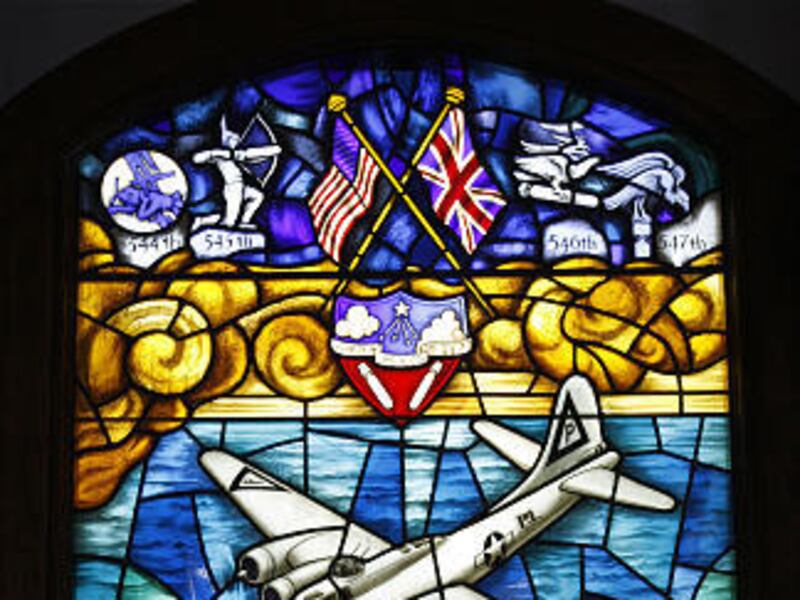
But the 384th's most stunning dual-donation gifts were the large, stained-glass windows given to the Hill Field Chapel and to Grafton Underwood's Parish Church of St. James the Apostle.
In addition to the window depicting squadron numbers, crossed U.S. and British flags and a pair of white doves in flight symbolic of peace, the focal point created in stained glass is a B-17 Flying Fortress approaching the white cliffs of Dover — a welcome sight for the 384th's planes during World War II, signifying they had returned safely from the latest bombing raid over Nazi Germany.
POST CHAPEL
Fort Douglas — originally christened Camp Douglas by Abraham Lincoln in honor of his presidential-election opponent, Illinois Sen. Stephen A. Douglas — was established in 1862 to help protect the protect the western telegraph lines and Overland Mail Route. Its east-bench location overlooking Salt Lake City allowed garrison leaders — who were uncertain of the Mormons' Union loyalties — to keep a watchful eye over the valley.
Any early religious meetings there would have been done in a tent, but that changed in the early 1880s when post commander Col. Alexander McDowell McCook, a devout Presbyterian, ordered Fort Douglas solders to construct a permanent chapel.
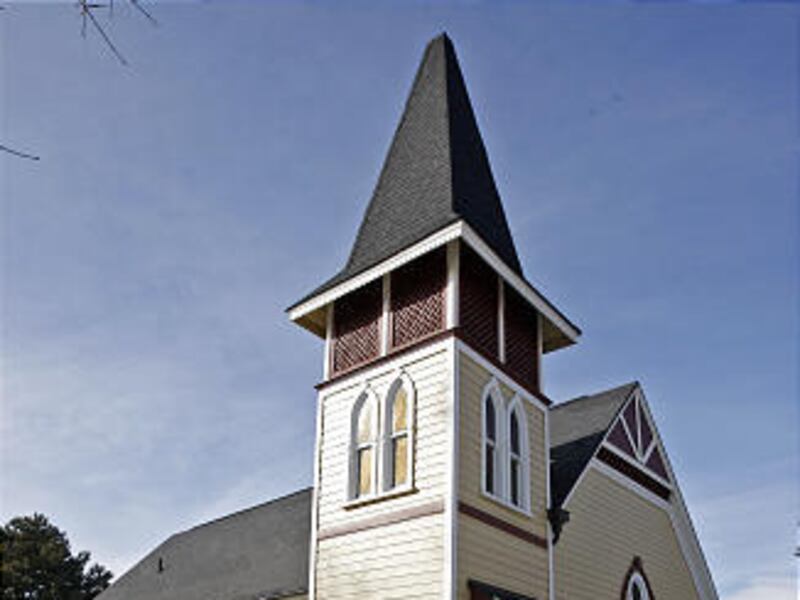
Rather than the standard chapel design used at military posts at the time, the Post Chapel featured Gothic-Revival architecture, stained-glass windows and a stone foundation. Completed in 1884 at a cost of $4,500, the chapel's wood construction differed from Fort Douglas' other sandstone buildings.
Community members regularly joined the military to worship at the Post Chapel up through 1991, when Fort Douglas was closed and much of it — including the chapel — was deeded to the University of Utah.
Until the '91 transfer, the Post Chapel was said to be the nation's oldest continually operational, multidenominational military chapel.
By then, the Post Chapel was showing its age, and there was talk of tearing it down. However, restoration efforts at a cost of nearly $1 million gave the chapel new life, including a site for interfaith services for Olympians staying at the Athletes Village at the University of Utah/Fort Douglas during the 2002 Winter Games.
Leading the funding for the restoration efforts were the Frederick Q. Lawson Foundation, the Janet Q. Lawson Foundation, the Episcopal Diocese of Utah and the university's Interfaith House of Worship. The Very Rev. Rick Lawson is dean of the Cathedral Church of St. Mark Cathedral and Janet Lawson is his late mother.
Both the Hill Field Chapel and Post Chapel can be arranged for weddings, receptions, meetings, funerals and other special events or made available to interested visitors by contacting in advance the Hill Aerospace Museum or University Guest House, respectively.
e-mail: taylor@desnews.com