

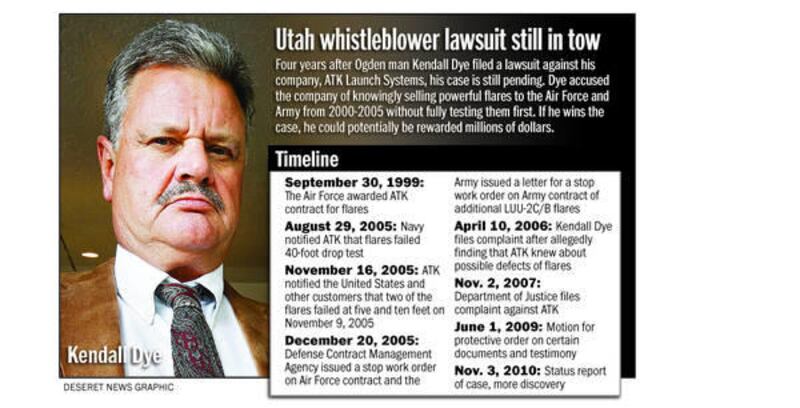

OGDEN — It's been four years since a North Ogden resident filed a whistleblower lawsuit against a giant defense contractor based in Brigham City. His trial is still at least a year away, but he could potentially be awarded millions of dollars.
The whistleblower is an ATK Thiokol employee named Kendall Dye, who claims he discovered his company was knowingly selling possibly faulty powerful flares to the U.S. Army and Air Force without fully testing them first. According to documents filed in federal court, Dye was allegedly told to keep quiet about his supposed discovery. The government joined his lawsuit and is now suing the manufacturer for millions of dollars. The case is still pending.
But a just-decided case against a pharmaceutical company shows that in larger suits, whistleblowers, like Dye, can take a reasonable chunk of settlement money. Under a 20-year-old federal law, whistleblowers can file lawsuits against their companies that may have defrauded the government and win up to multimillion-dollar awards.
Recently, a former quality manager of GlaxoKlineSmith, Cheryl D. Eckerd, became $96 million richer after her company settled outside of court for $750 million. Her case had been pending since 2004. Eckerd accused GKS of knowingly manufacturing, distributing and selling products — Paxil CR, Avandamet, Kytril and Bactroban — whose strength, purity and/or quality fell below the standards required by the FDA.
Utah received $500,000 of the settlement money.
"I think it's good that someone did step forward," said Paul Murphy, with the Utah Attorney General's office. "If my parents or my children or anyone I know was taking these drugs, I would want to know about this. It's important to protect people, and this whistleblower did a great job in reporting this."
Dye and Eckerd both filed under the Federal False Claims act, enacted during the Civil War to address fraud against the government. It was modernized in the late '80s to motivate individuals with knowledge of fraud against the government to come forward. Under the act, an individual or company can be brought to court who "knowingly makes, uses, or causes to be made or used, a false record or statement to get a false or fraudulent claim paid or approved by the Government."
Matthew Howell, one of Dye's attorneys, said the government has not listed a specific amount in damages. On court documents, the government has listed payments made to ATK, which exceed $80 million. It will also be seeking reimbursement for attorney costs and is asking for up to three times its total damages.
Dye filed his claim in April 2006 after allegedly finding that the company he worked for, ATK Thiokol, later renamed ATK Launch Systems, a Delaware corporation headquartered in Brigham City, was knowingly selling faulty flares to the government, according to documents filed in federal court. The flares help identify terrain at night, as well as enemy targets and are able to burn through metal.
Dye, an engineer, was named program director of the company's LUU Flare Program. Not long after, the Navy told him that the flares were failing a 40-foot drop test. While this kind of drop-test was not required for sale of the flares, Dye started investigating.
According to court documents, Dye allegedly found that the flares were also failing a 10-foot drop test, which is required for sale, and that his company had not conducted this test since the redesign of the flare in 2000. This test was designed to make sure that the flares, some of which weigh 36 pounds and are three feet long, did not explode near those carrying them or in shipment, which according to court documents could "pose a significant health and safety threat to military personnel and equipment." He also allegedly found that workers at the company knew that this was a potential problem. Attorneys say Dye found that the flares could possibly ignite if dropped from as little as 11 inches.
When notified of the potential problem, the company made adjustments to the product and later sent letters to its customers notifying them.
Lawyers for ATK said the company believes it did everything it was supposed to.
"We supported and worked with the Air Force," said Michael Larson, an ATK attorney in Salt Lake City, "and the product worked very well for them for five years with never a mishap. ATK values its role and relationship as a defense contractor and continues to work closely with governmental agencies as a supplier."
He said attorneys are still in the midst of discovery, and ATK is still aggressively defending its position. A trial is set for late next year.
Just two months ago, another whistleblower in Utah received $150,000 in back wages, interest, damages and attorney fees after being discharged from UTA for raising security concerns about access to railroad controls and switches for signals and tracks. The employee had been fired for bringing up these concerns, but the U.S. Occupational Safety and Health Administration ordered that UTA rehire the unnamed employee and pay the money.
While the amount of money some whistleblowers could possibly receive may seem quite hefty, Hassan Zavareei, a partner at a D.C. law firm that specializes in these types of cases, said whistleblowers have saved the government billions of dollars. And he also said some whistleblowers can even end up without any money.
"Whistleblowers perform a valuable service to all taxpayers," Zavareei said. "We have seen over the years an amazing amount of fraud on the government by dishonest corporations who are taking advantage of government programs to line their own pockets. We as a society rely on the honesty and ethics of good, patriotic Americans to put career, jobs and even safety on the line to report when their employer is engaging in unlawful behaviors that is costing the taxpayers money."
Zavareei said recently his law firm has been dealing with a lot of healthcare and Medicaid whistleblowers. He said they receive about 12 calls a month and usually take on about two cases since the wordage of the law is specific about what qualifies as a Federal False Claim act, and sometimes, he said, the issue is already under investigation.
e-mail: slenz@desnews.com