

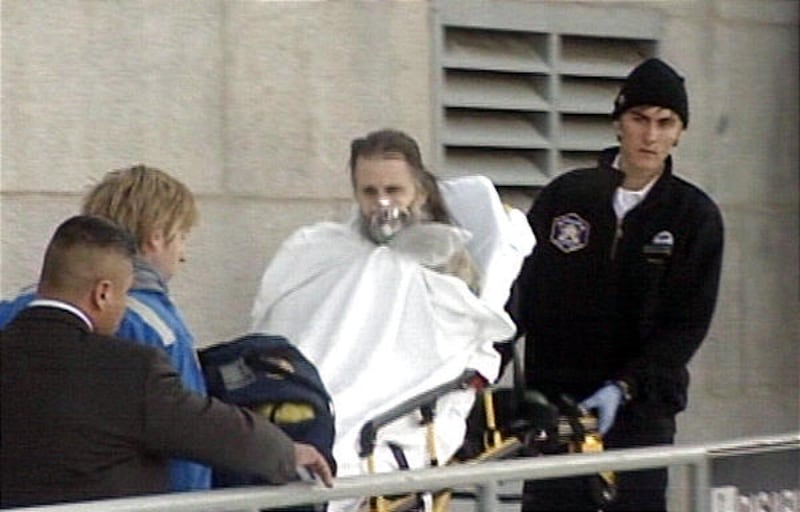
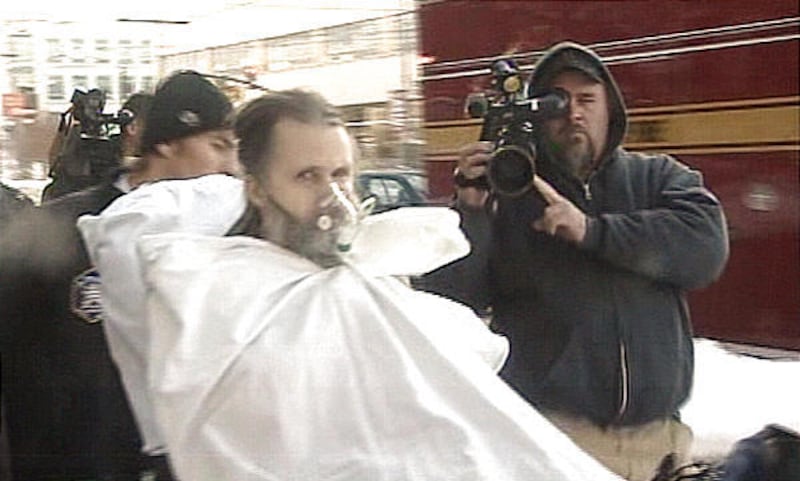
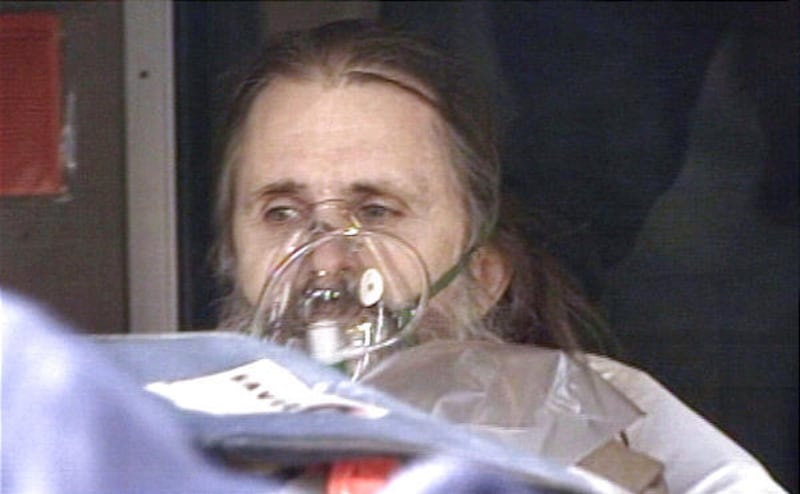
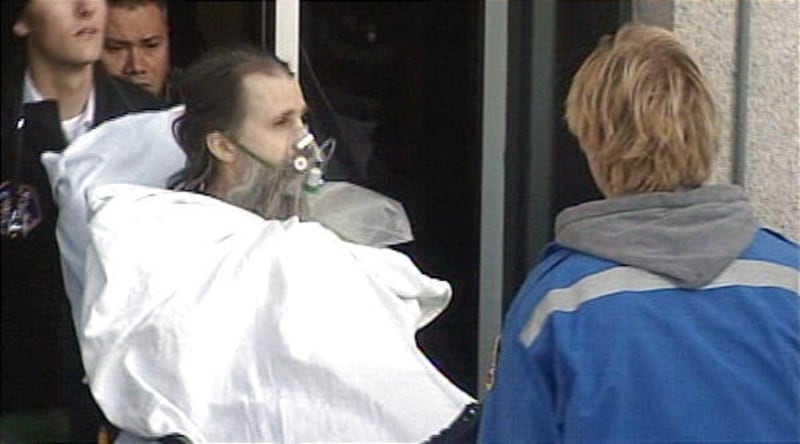
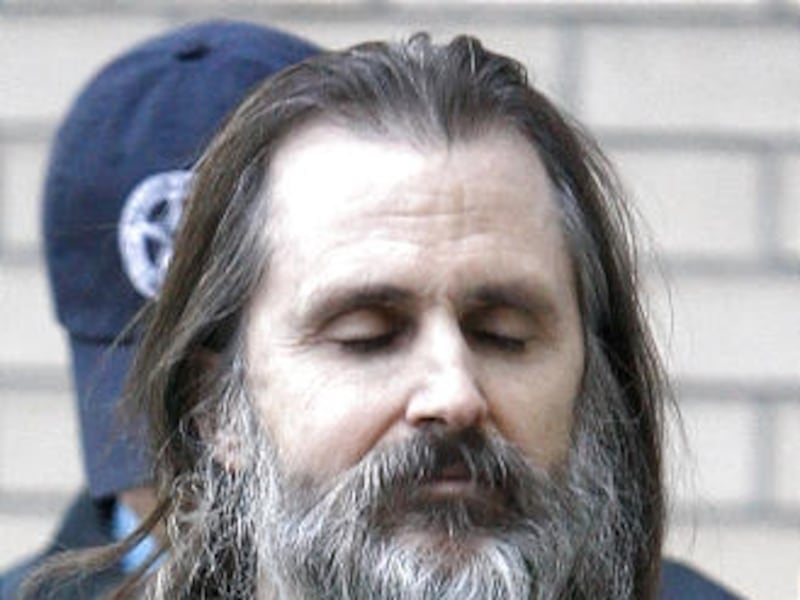

SALT LAKE CITY — Brian David Mitchell, accused of kidnapping Elizabeth Smart, suffered an apparent seizure Tuesday just as court was starting and had to be rushed to the hospital.
Court was adjourned for the day. But Tuesday afternoon, Mitchell's defense team notified the court that they would be ready to resume at 8:30 a.m. Wednesday.
Defense attorney Robert Steele told the Deseret News that Mitchell would be back in court Wednesday and everyone would be ready to proceed as normal. He said Mitchell was back in the Salt Lake County Jail Tuesday afternoon. Steele said he could not talk about how long Mitchell was at the hospital, what doctors said or when he was returned to jail.
He noted however, that from his own observations and from what medically trained people in the courtroom who helped Mitchell have said, "it was definitely a seizure."
Mitchell was believed to have been taken to University Hospital, but a spokeswoman at the hospital said she could neither confirm nor deny he was there. Mitchell was awake when he was being loaded into the ambulance.
Mitchell was sitting between two of his attorneys, Parker Douglas and Wendy Lewis, and singing Christmas songs when he suddenly stopped. His head slumped, appearing from behind as if he might be reading something in front of him. About one to two minutes later, Mitchell turned his head to the left and let out a loud crying moan as if he were in pain.
Lewis then said, "Judge, I think he's having a seizure."
Douglas and a U.S. marshal pushed chairs and the attorneys' table aside and laid Mitchell on the ground, while he was still in shackles.
Douglas later said he was reading over court documents when the apparent seizure occurred.
"The last thing I heard was his cry out," he said.
When he laid Mitchell on the ground, Douglas said Mitchell was shaking.
"It was terrifying," he said.
Steele said Mitchell went "rigid." Lewis was visibly shaken by the events.
Dr. Noel Gardner, who was in the courtroom as a possible expert witness, assisted the others with Mitchell. He did not cry out again once he was on the ground and appeared to have his hands clenched in fists.
An ambulance was called and Mitchell was taken away on a stretcher with an oxygen mask over his face. He seemed to be awake and alert when he was loaded into the ambulance.
Both Douglas and Steele said from all indications, it appeared as though their client suffered a seizure. They said the incident was real and not some act by Mitchell.
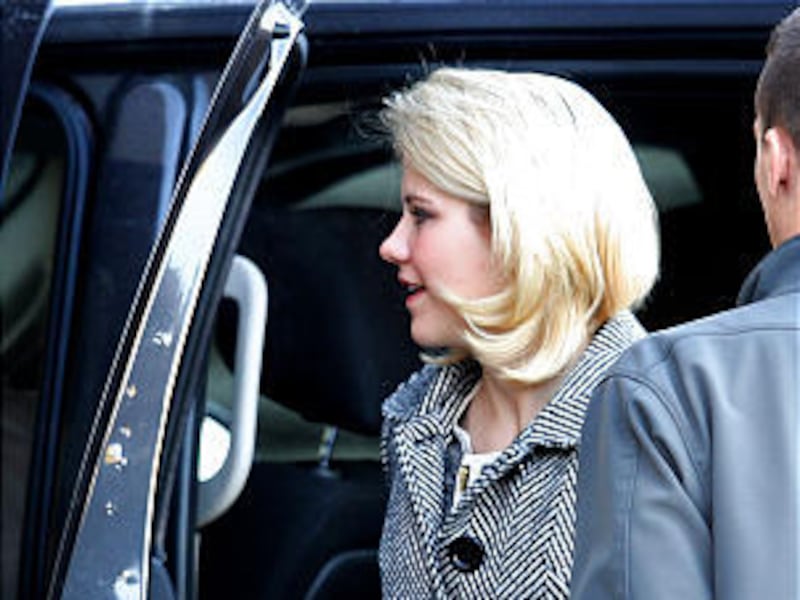
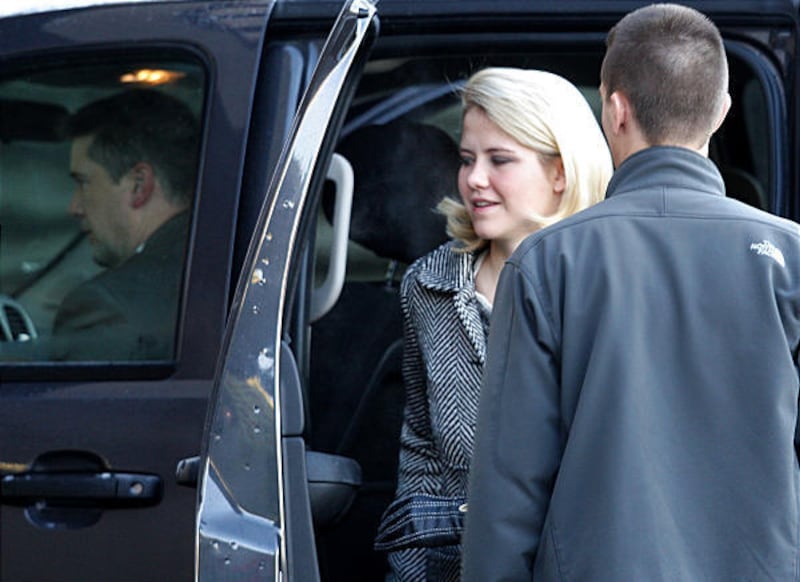
Smart and her parents, Ed and Lois Smart, were in the courtroom when the apparent seizure happened. After court was adjourned for the day, both prosecutors and defense attorneys were seen talking with the family.
Outside the courtroom, Mitchell's stepdaughter, Rebecca Woodridge, said her stepfather had been suffering seizures every few months while incarcerated for about the past year, but refuses to take any medication for it.
Woodridge had entered the courtroom just after her stepfather's apparent seizure and after he was lying on the floor.
"My heart was racing. I just wanted to help, but there was nothing I could do," she said.
Neither Woodridge nor Mitchell's attorneys believe Mitchell was faking his condition Tuesday or was attempting to purposely disrupt the court proceedings.
Administrators at the Salt Lake County Jail said Mitchell was being held in an area of the jail used for medical and mental health observation, but also noted that that wasn't something uncommon. Many prisoners are held in that area for "routine issues."
Salt Lake County Sheriff's Lt. Michael Deniro said he was prevented by federal privacy laws from releasing any medical information about inmates. All he could say about Mitchell was that staffers at the jail "are strongly committed to the health of our population, and any medical issues prisoner Mitchell has, have been addressed by our medical staff."
When Elizabeth Smart testified earlier this month, she talked about a day when Mitchell suffered a seizure while she, Mitchell and his wife Wanda Barzee were in California. During her cross-examination, Steele asked Smart if Mitchell ever lost consciousness during the nine months she was held captive.
"Yes. We were in California at the time. He was in the middle of raping me and he experienced a seizure," she said.
"That was the only time you saw anything like that?" Steele asked.
"Yes."
The jury was just about to be led into the courtroom for the day when the seizure occurred. The jury did not witness Tuesday's event, nor were they told what happened. When the jury was sent into the courtroom, after Mitchell had been removed, U.S. District Judge Dale Kimball explained to them: "Some issues have come up. We're unable to proceed today."
The jury was then dismissed for the day and court was adjourned.
Because Mitchell has apparently been communicating somewhat with his attorneys, both the prosecution and defense agreed it would be best if Mitchell was given the option of being able to hear all the proceedings against him rather than moving on with the case without him. Both sides seemed confident Tuesday that court would be able to resume as scheduled Wednesday morning.
Kimball, who is concerned about the trial ending on the projected date of Dec. 10, asked attorneys how they believed they were doing concerning time and how Tuesday's events might change that.
"We have every expectation that we can proceed tomorrow," Steele said. "We also have every expectation that we can finish by the 10th."
The defense was expected to rest their case Wednesday. That would now be pushed to Thursday. Prosecutors said they expected to have five days worth of rebuttal testimony after that.
Before the jury was adjourned Tuesday, Kimball read an explanation to them about what a "stipulation" was. A note had been passed by the jury to the judge asking for a clarification of the word "stipulation," of which there have been several this trial. Kimball told jurors that a stipulation was an agreement between the prosecution and defense that certain facts are true.
When the trial resumes, another stipulation is expected to be brought up, this one concerning Mitchell's competency during his state court proceedings and his time at the Utah State Hospital.
During his testimony Monday, Dr. Paul Whitehead, the clinical director of the forensic unit at the Utah State Hospital, the jury was told about Mitchell's prior declaration of being mentally incompetent to stand trial for his state court proceedings, an issue that the prosecution and defense both agreed before the trial should not be brought up.
Whitehead and his team were responsible for Mitchell's treatment while he was at the Utah State Hospital from August 2005 until October 2008. They were not allowed during that time, however, to forcibly administer anti-psychotic medication.
Whitehead was expected to resume his testimony Wednesday.
On Monday, Whitehead and Greg Porter, Mitchell's therapist at the hospital, testified that they initially were skeptical of the former street preacher having a mental illness. They noted that he was highly functional.
After listening to his ideas about religion and observing his mannerisms, however, they determined that Mitchell suffered from a delusional disorder, but was also a narcissist and showed "an extreme lack of empathy" for others.
Porter said that he did not find Mitchell to be a "master manipulator," as prosecution witnesses have characterized him, instead comparing Mitchell to more of a bumbling Inspector Clouseau character than a James Bond.
Additional expert witnesses were expected to take the witness stand after Whitehead, including possibly Dr. Richart DeMier, who examined Mitchell at the federal prison in Springfield, Mo., when Mitchell was first transferred into federal custody and an initial competency evaluation was ordered.
During Mitchell's competency hearing in 2009, DeMier said he believed Mitchell was incompetent to stand trial. In his report, DeMier classified Mitchell's writings as "grandiose" and wrote, "certainly, his beliefs are in conflict to the mainstream LDS Church."
Also seen in the courtroom Tuesday were two of the prosecution's possible expert witnesses, Gardner and Dr. Michael Welner, a renowned forensic psychiatrist from New York City whose comprehensive report on Mitchell combined with his testimony during the competency hearing was credited (in addition to Smart's testimony) as being the key to Mitchell being found competent to stand trial.
e-mail: preavy@desnews.com TWITTER: DNewsCrimeTeam