

LARAMIE, Wyo. — In many homes, there is a place set aside for memory: steamer trunks and shoeboxes filled with photographs, letters and postcards that reach across time, giving people crucial links to heritage and history. Like individuals, places also have history.
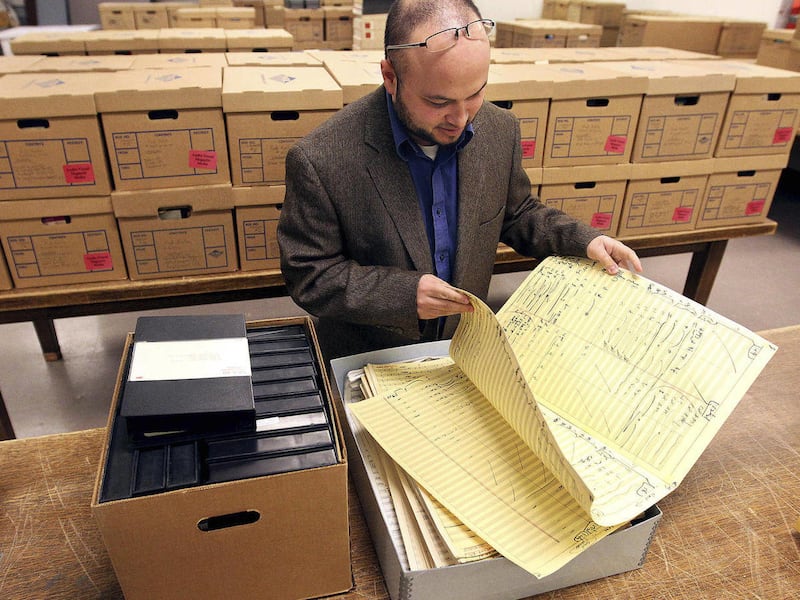
For Wyoming, a crucial caretaker of its legacy is the University of Wyoming American Heritage Center, where people like archivist Matt Francis are working to preserve Wyoming's history, researching and collecting it to share with others.
"To make an archive of our size work, a lot of us wear many hats," Francis said. "Writers and journalists is one aspect of my job. I'm also a processing archivist, which means I help make the collections available to people when they come in."
It's a job that brings Francis into close contact with a broad scope of Wyoming history, from the well-known Teapot Dome scandal to the obscure Project Wagonwheel.
"That was a project in the 60s and 70s where some people outside of Wyoming thought it would be a good idea to help gain access to natural gases in Western Wyoming by detonating a nuclear device underground," Francis said. "That was a fascinating thing to read about."
Francis preserves the history of such events by contacting politicians, authors and journalists whose work can provide insight into the past. It's a process that requires a great deal of research.
"Before I approach anyone, I have to put in a good amount of research in determining if they might potentially have material that would fit our archive," Francis said. "I have very rough guidelines I use in selecting possible candidates to approach, and they include stuff like impact, the uniqueness of the materials compared to what we already hold, the longevity of their career, awards won. There's no real checklist, these are just general things that help inform."
The archives are more than just collections of information, however; Francis said collections are representational of esteemed lifelong careers.
"There's an obvious emotional connection. It's people's lives we're collecting, essentially," Francis said. "A lot of times when you approach someone, they aren't fully aware of what archives do, or even if they are, they're not sure why an archive would want their particular papers. You have to talk to them about the significance of their work and what we do, so there's some education involved with it, and then people are generally flattered and supportive."
But Francis and other archivists at the AHC don't just collect history in order to keep it safely tucked away. Instead, they gather history in one place in order to share it with anyone who's interested, from international researchers to undergraduates at UW.
"One of the core tenets of our institution is we really, really believe in accessibility. A lot of archives do, but we kind of take it to the next level. We really engage with the undergrad students on campus and try to get them in. The center also runs the Wyoming State History Day program so we also bring in grade school students to research in our materials," Francis said. "We welcome anyone and everyone to come in and take a look at our materials. That's the reason we collect, that's the reason we work so hard, so that people who are interested in it, for whatever reason, can look at it and research it."
Archiving may sound as simple as collecting and stacking boxes filled with paper, but the magnitude of what archiving actually requires is astonishing. Collections are stored in a highly secure area with precision climate controls where automated shelving whisks back and forth, opening up one area while closing another. When center staff get a request, they'll walk row after row of neatly organized, catalogued and sorted boxes to find a needle in a haystack of names. One can't help but compare the sight of the area to the final shot in "Indiana Jones and the Raiders of the Lost Ark."
"A lot of people say that," Francis said.
Wyoming is not the only focus of the American Heritage Center either. Names on boxes Cliff Hansen, Milward Simpson, Whoopi Goldberg, Stan Lee are so varied and incongruous that they almost seem at times the beginning to a joke.
"We have a very large archive on a variety of topics," Francis said. "We have over 250 collections that we list as journalists and 400 collections that are listed under writers. The majority of those are Wyoming or regional, but we also have quite a few national ones: Hugh Downs, Irene Kuhn and Richard Tregaskis, who are big foreign/war correspondents in the 20th century. For writers, we have Owen Wister, C.J. Box, Jack Schaefer, who wrote Shane.' We really focus on the Wyoming aspect, but a lot of times our content scope leads us to writers who aren't from here."
The center is able to gather the life's work of such prestigious individuals because of its reputation as a first-rate archive and its focus on accessibility, Francis said.
"This past year, the Society of American Archivists, which is the governing body for our profession, awarded the American Heritage Center its distinguished service award, which is an award that's not even given out every year, just when there's someone they consider worthy," Francis said.
But for Francis, the profession isn't about accolades or even the material, really. Instead, he said, it's about serving to connect people with the past and help provide them a better picture of how the present came to be.
"I kind of consider this job as being on the front lines of history. It's a terrible military analogy, but it really is like the front lines for us. We're going out and making decisions about what's worth bringing in, and then we go out and actively bring it in. Once we do that, we're working to make it accessible. We may not be the internationally renowned scholars, but they wouldn't be able to do the research without the grunt work that we do," he said.
Information from: Laramie Daily Boomerang - Laramie, http://www.laramieboomerang.com