


Last week's column covered harvesting Christmas greens to decorate your home.
It might seem like we had the cart before the horse, but we now is a good time to look at your landscape and decide where you might want to add some color, texture or shape to your garden.
I must admit to a fascination with some of the dwarf conifers that are available in local nurseries.
Why dwarf conifers you ask?
It is simply a matter of size and economics.
When I teach landscape classes, I often hear participants say, "It doesn't matter what kind of tree I plant because we do not plan to stay in this house that long."
Not to be a purveyor of doom, but they often regret that decision.
In each class I ask who has just paid to get a large tree removed from their landscape and how much it cost.
Answers range from several hundred to several thousand dollars per tree.
Ironically, many participants thought they would never be in the house long enough to worry about the tree getting too large.
Once you are convinced that dwarf conifers make more sense in your landscape, you must look at what the word means in landscape situations.
Dwarf does not mean a specific size — it only means that the plant is not going to be full size.
Never confuse dwarf conifers with younger, smaller plants of genetically larger plants. These grow faster and ultimately get much larger.
Conifers can be grouped into three sizes. Pygmy forms are one-twentieth the size of normal plants at maturity, dwarf forms are one-twentieth to one-quarter the size of normal plants, and compact forms are one-third to one-half the size of normal species.
Do research before you shop.
Tree tags are useful, but they do not have room for much information. Find the names of specific cultivars (cultivated varieties) and determine if they are going to be the right size and shape when they are mature.
Looking for something with exceptional interest?
Dwarf conifers are not just plain green but come in many shades of that color, they also show wonderful shades of blue to silver, yellow and variegated foliage.
Add the shapes that range from narrow, upright forms to pyramidal forms or globular shapes.
Others have stunning, weeping or prostrate trees that add a whimsical look to a landscape.
Even the textures add interest. Some, like the junipers, have tight scales. Many spruces have short, open needles, and others have dense, pointed needles. Add to these the long-needled pines to get additional beauty from these plants.
Make certain that the trees you select are cold hardy to your zone. Most of the Wasatch Front is a safe Zone 5, but with adequate winter protection you can get a few less hardy ones to survive.
One of the most common dwarf conifers is the dwarf Alberta spruce.
This is a mutation of the white spruce that was discovered in Alberta, Canada.
The plants grow very slowly but can eventually get 10 feet tall and 3 feet wide, but there are many cultivars that stay much smaller.
These have clusters of short needles and an upright conical shape. Plant them where they are protected from intense winter sun, which burns the needles, and watch for spider mite infestations.
A bird's nest spruce is a miniature Norway spruce. It has short needles and a low growing spreading habit. Its slow growth rate means the plant is going to be 2 feet tall by 3 feet wide after 20 years. That makes is a good alternative to faster-growing plants that must be constantly pruned.
Weeping Norway spruce grows to an irregular shaped, weeping tree. It eventually gets 10 feet to 15 feet tall with terminal branches that grow horizontally and begin to weep.
It is a nice specimen tree for an attractive landscape.
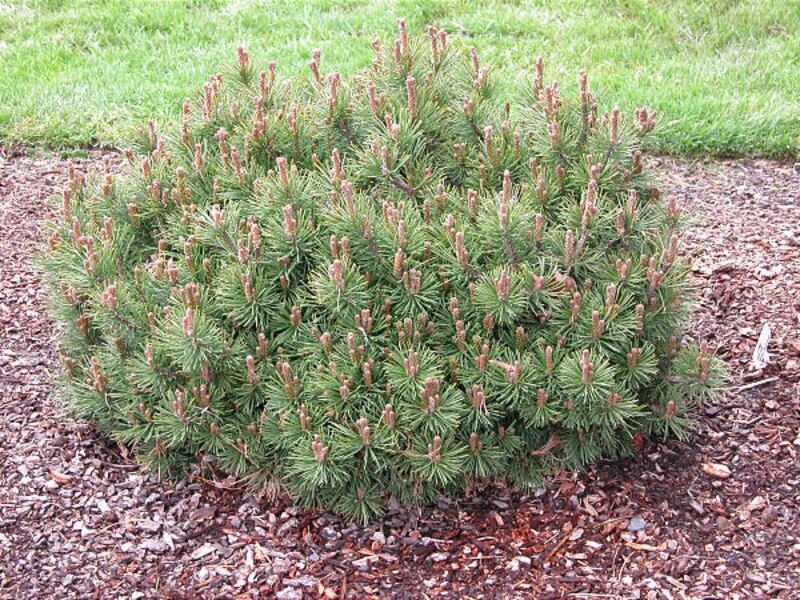
Mugo pine is a slow-growing evergreen that is widely grown in our area.
It will grow to be 10 feet tall by 15 feet wide, so select the dwarf cultivars to prevent them from getting too large.
Several cultivars make excellent landscape shrubs.
"Mops" makes a dense globe with straight, green needles and eventually it will grow to 2 or 3 feet tall with a similar width.
"Sherwood Compact" makes a globe-shape plant 3 feet to 4 feet tall with the same spread.
"Slowmound" has a concise, mounded outline and grows slowly to a 3-foot height and spread. Other interesting types are "Donna's Mini," "White Bud," "Enci" and "Gnom."
Dwarf conifers are plants that you can literally enjoy for a lifetime.
They might be more expensive than standard-size plants because they grow slowly, but the payoff comes with great plants that will add years of beauty to your landscape.
For more descriptions and information on many different dwarf conifers, go to plantfacts.osu.edu.
This website is done by Ohio State University and is helpful in providing size information and growing needs of specific plants.
Another excellent reference for these plants is the "Sunset Western Garden" book. It is widely available at most nurseries and local libraries.
Larry A. Sagers is a horticulture specialist for the Utah State University Extension Service at Thanksgiving Point.