

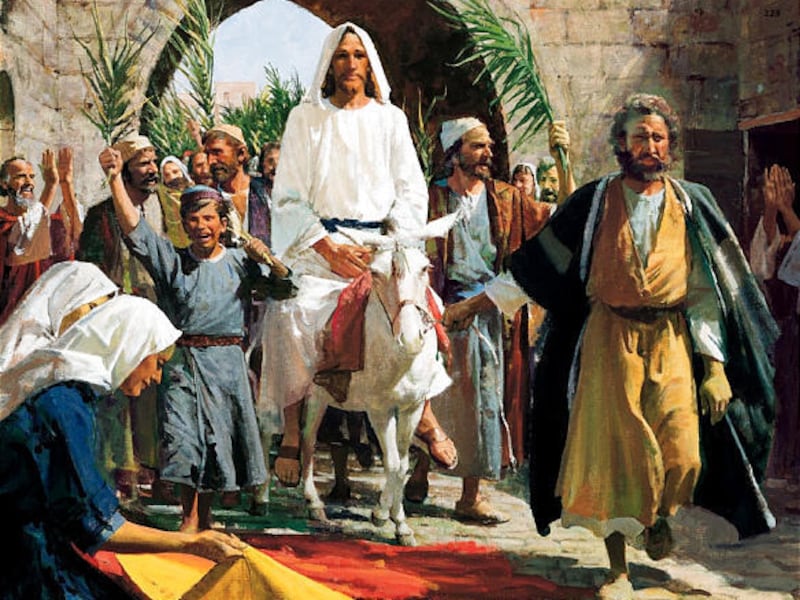
To celebrate Palm Sunday is to rejoice in the Lord's willingness to obey God and surrender himself to Jerusalem, where he predicted he would be "lifted up from the earth" on a cross days after his arrival.
Palm Sunday, the beginning of Holy Week, is celebrated by Christians around the world on the Sunday before Easter. The holiday commemorates Christ's triumphant entry into Jerusalem.
Some events, and indeed whole eras, in the Bible seem glossed over by hurried descriptions. But New Testament authors, who had traveled hundreds of miles with their Lord, appear to have slowed down in their narration of the short journey to Jerusalem. The Four Gospels spend 45 verses, roughly a dozen each, describing the morning's awe.
The event was important to the apostles. They longed to be accepted. They wanted nothing more than for others to accept their Master and his message. And at no other time in the Four Gospels does this desire appear more apparent, and Jesus more received, than during this humble moment.
The excitement of Christ's procession spread quickly among locals and pilgrims visiting Jerusalem for Passover.
Perhaps few spectators understood Zechariah's messianic prophecy playing out before their eyes: that instead of mounting a stallion in royal pomp or military might, their Savior would come to his people lowly, riding a symbol of peace, a donkey.
The Old Testament said Jews would rejoice greatly, to shout at the Messiah's coming. They did.
The crowed cried "Hosanna," the Greek term for "save us now." Although the phrase appears other places, notably in Psalms, the word itself occurs nowhere else in the English Bible. Its usage is indicative of true believers.
In reaction to their euphoric adoration during the reception, the people laid down palm branches in Christ's path. Their Jewish ancestors paid similar homage to the Maccabee army when it returned to the city from a triumphant battle against Greek warriors. These "goodly trees" were critical to the existence of those living in the Middle East and therefore held sacred. Jews carved numerous palm illustrations into doors and walls in Solomon's Temple and many appear on excavated ancient Jewish synagogues.
People took off pieces of clothing, radically more precious to them than ours are to us today, and also laid them in the path.
"Ride on, ride on, in Majesty!" the hymn says. "In lowly pomp ride on to die."
He did ride on. When when he rounded the hill's northward shoulder, the city of a thousand memories burst into his view: "He beheld the city, and wept over it."
We don't read of a single tear being shed during all the mockery, anguish and torture Christ would suffer five days later, but his compassion for those who would forsake him caused him to weep, to lament: "If thou hadst known," he cried
Christians celebrate Palm Sunday by displaying and carrying palm boughs, especially in church. Your local florist likely sells palms for the occasion, somewhere around $2 a frond. Other common branches are also used.
It's customary to read passages about the triumphant entry (Matthew 21:1-11; Mark 11:1-11; Luke 19:28-44; John 12:12-19) and sing Easter hymns, especially "Come, O King of Kings," "The Spirit of God" and "Come Rejoice."
Thousands of Christians gather at Jerusalem each year to wave palms and sing while walking the Lord's path of entry.
Instead of worrying that celebrating Palm Sunday might overshadow the importance of Easter, think of honoring the day for what it is: a beautiful prelude to the most important event in history.
e-mail: jhancock@desnews.com