

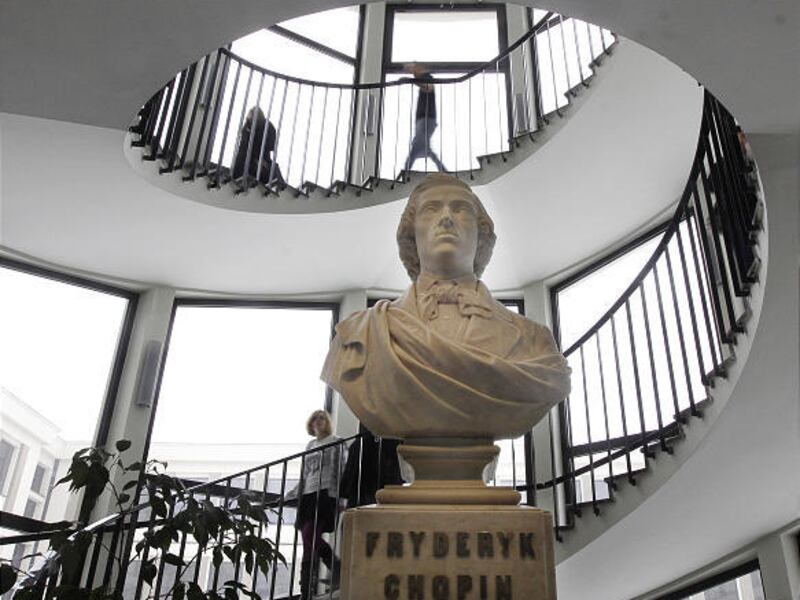
Burdened by ruinous health his entire life, Frederic Chopin often appeared like an apparition. But it is his music that is ghostlike. Two hundred years after his birth in 1810, more pianists and listeners than ever are chasing those ghosts and loving every moment of it.
"Chopin's music came out of nowhere," says pianist Byron Janis, one of the world's authorities on the great Polish composer. "There is nothing that preceded it. He was truly unique. With Beethoven, you can hear it came out of Mozart. Not with Chopin."
Pauline Rovkah, head of the piano program at Chatham University in Pittsburgh, said Chopin's music possesses a seductive quality. "It's magical, irresistible — it can transport listeners to another world."
Chopin (usually pronounced "Show-pan") was born near Warsaw Feb. 22, although he later claimed March 1, and he quickly displayed a prodigious ability on the piano.
He played his first concert at age 8. In the 1830s, he departed Warsaw for Vienna, not realizing that he would never return to his beloved homeland again (the reason was political, not personal, as Poland was annexed by Russia).
Chopin found success in Vienna but opted to join his emigre friends in Paris, where he would live the rest of his life. It was there he met Franz Liszt and also the cross-dressing novelist George Sand, with whom he was romantically involved for years. Through his public recitals, salon concerts and publications, Chopin became a celebrity in Paris, but he would never overcome his frail constitution and reoccurring tuberculosis. He died in 1849 at only 39.
But in such a short life he made a remarkable impact. Chopin wrote only about 180 works — almost all for the solo piano and many less than 10 minutes in length — but he rarely struck out.
"His batting average was so high," says David Allen Wehr, who holds the Geltz Distinguished Piano Chair at Duquesne University's Mary Pappert School of Music. "He is top five among composers of all time in that percentage."
Most of Chopin's works — nocturnes, preludes, waltzes, mazurkas, polonaises, ballades, scherzos and sonatas — never left the concert repertoire, and they keep Chopin near the top of recording sales today.
His music also continues to appear in popular culture. There are older pop songs, such as Perry Como's "Till the End of Time" from 1945, based on Chopin's "Heroic" Polonaise, and Barry Manilow's "Could It Be Magic," based on the C-Minor Prelude of Op. 28. But recently Chopin's "Raindrop" Prelude was the dramatic backdrop for a commercial for the video game "Halo 3," and Alicia Keys' album "As I Am" opens with her playing an adaptation of his Nocturne No. 20 in C-sharp Minor.
"I have to believe that what makes Chopin's music endure is the same thing that makes all great composers' music endure: his precious ability to tell the truth on the page," says pianist Enrique Graf, artist lecturer at Carnegie Mellon University's School of Music. "This is a difficult if not impossible thing to analyze, but people always know it when they hear it."
Chopin's music has ineffable aspects, but there is one tangible quality that has buoyed its continued success: his exquisite, haunting and sometimes simply fun melodies. "They touch people's hearts and souls, and there is nothing that would make music more popular than that," Janis says.
"There is a darkness as an undercurrent in a lot of his music," Wehr adds. "There is no piece of Chopin that is pretty without having the undertow and mystery to it."
Much of these emotions stemmed from Chopin's profound homesickness, but Janis also thinks that the particular Polish word "zal" provides a window. "It means 'bittersweet melancholy,' but it also has the paradoxical meaning of 'anger' and 'rage,' " he says.
"Chopin's music has anger in it. He has cannons buried in flowers, said (Robert) Schumann," Janis says.
Chopin's influence on history and connection to listeners and audiences represent a major part of his enduring legacy. But just as significant is performers' and students' continuing adoration.
"His music has never fallen out of favor because he makes the piano sound so good," Wehr says. "The writing flatters the piano. Chopin was the first to overcome the fact that the piano is a percussion instrument." Strike a key and a hammer hits a set of strings, not conducive to the connective playing (legato) that a violinist's bow can provide.
"The best pianists are magicians, trying to cover up the fact that they are playing a piano," Wehr continues. "He was the first composer who really figured out how to use the pedal."
Rovkah agrees. "He established a unique link between instrumental and vocal quality — of getting the piano to 'sing' against its percussive nature," she says. "Chopin revolutionized the sound, concept of touch and approach to the piano. He first recognized that each finger has a distinct character and personality. That was totally new — before him the concept was to equalize fingers."
His fingerings were totally unorthodox, says Janis, including the enhanced use of the thumb.
Chopin's pioneering efforts also led him to develop a favorite tool of pianists, rubato. For Chopin, this flexible approach to tempo had a strict definition: "The left hand is like the conductor of an orchestra and the right hand is free," says Janis. But the elasticity that Chopin allowed, and the fact that he never played a piece the same way twice (sometimes performing the polar-opposite dynamics), have led to a tradition of performance in which his entire works are interpreted with Romantic freedom.
"I almost always physically feel that his music touches my inner strings and moves me the way no other composer does," says Rovkah. "As a performer, I know I will connect with the audience and will make them feel it, too. No other composer brought that much poetry into piano music."
Students, too, benefit from Chopin as a teacher.
"Students, who can master Chopin's works with all their complexity and extreme difficulty, can also develop creative imagination and sophisticated technique," she says.
"Chopin said that his calling was to appeal to the heart and soul," Janis says.
And he is still appealing, 200 years and counting.
Distributed by Scripps Howard News Service, www.scrippsnews.com.