


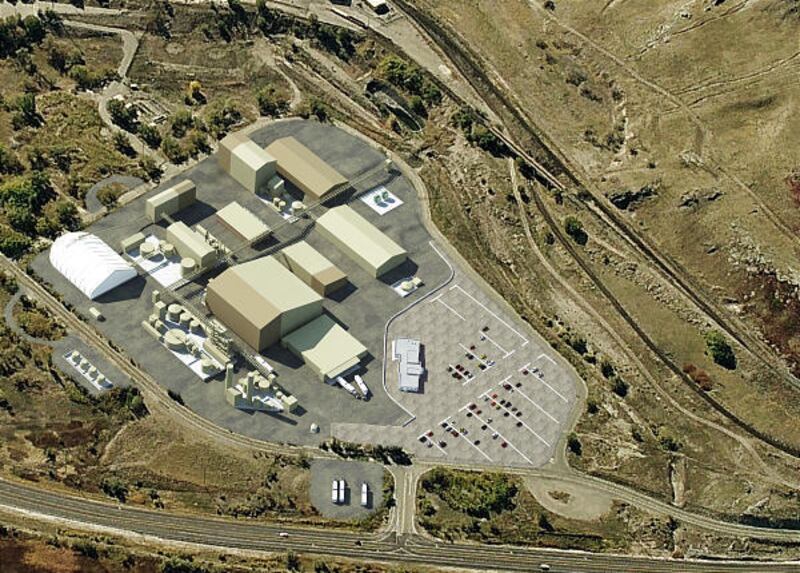

SOUTH JORDAN — Kennecott Utah Copper will soon process the molybdenum and rhenium it pulls out as a byproduct of its Bingham Canyon Mine copper production, instead of hiring someone else to do the job.
And that means more jobs, more efficiency and the potential to extend the life of the mine.
Rio Tinto, Kennecott's parent company, said Wednesday night from Australia that it will build a $340 million molybdenum autoclave process, or MAP, facility in Magna.
The facility, slated to be finished in 2012 and operating in 2013, will allow the company to more efficiently recover the silvery-white metal that's used primarily to strengthen steel and other metal alloys. It's also part of oil-refining catalysts used to remove sulfur from fuel and improve air quality, according to the company.
The facility will be used for Kennecott's existing operation, from which it extracts 30 million to 40 million pounds of "moly" a year, said project manager Doug Stauffer.
"We produce a concentrate that we ship to a third party for roasting to process it to a final, saleable product," he said. "This means we will do that here and sell it directly to end-use customers."
It will be sold as a powder that buyers will convert to metal, he noted.
The facility, which has extensive energy conservation features built into the plan, will mean 50 new jobs when second-phase construction is completed. Stauffer and Kennecott spokeswoman Jana Kettering note that the construction itself also will create jobs.
The company produces about 8 percent of the world's molybdenum. And it plans to expand the new facility in 2015, about the time it reaches a section of the existing mine that has a higher moly content. At that point, Stauffer said, they expect to retrieve about 60 million pounds of moly a year.
The concentrate also contains rhenium, which is even more rare and is used as an alloy in jet engine turbines, allowing manufacturers to turn the engines at a higher temperature and speed and create more fuel-efficient engines, Stauffer said. Kennecott will produce about 9,000 pounds of rhenium a year, which will increase in 2015. The average price in the last three months was $2,000 a pound.
None of that counts the vast field of molybdenum below the mine floor, which the company has been evaluating since discovering it. Should they decide to tap into that field, believed to have even higher moly content than the existing mining operation, the processing plant will already be in place. "This will certainly make that opportunity more attractive," Stauffer said.
As for conservation, because it's an autoclave, the facility will produce heat that will be used to generate steam that's needed for crystallization that turns the moly back into solid form. The company will be able to use recycled energy for about 40 percent of its energy requirements, he said.
Kennecott has been producing copper, gold and silver since 1903 and molybdenum since the 1930s. "Now we'll have rhenium in our suite of products," Kettering said.
It's of note, Stauffer said, that Kennecott developed the technology to recover rhenium in the 1960s.
What they are
Molybdenum is a silvery-white metal used mainly to strengthen steel alloys. Most of it comes from China. It has the sixth-highest melting point of all elements and will not burn below 1,112 degrees Fahrenheit.
Rhenium is one of the rarest elements and has the third-highest melting point, behind tungsten and carbon. Rhenium is used primarily in the manufacture of jet engines.
Source: Wikipedia
e-mail: lois@desnews.com