





The railroad changed everything for Utah.
It ended the Mormons' self-imposed isolation and marked the end of the pioneer era by providing safe, reliable transportation for members of The Church of Jesus Christ of Latter-day Saints gathering to Zion. It also opened the door to the state for many "gentiles."
The rails increased commerce, made mines more profitable, and tied communities throughout the state together. Before highways, rail lines running from Provo to Ogden helped define the Wasatch Front.
Because of their central role in the state's economy and transportation, Utah's railroads have been the focus of countless news stories, and hundreds of photographs. Photo researcher Ron Fox has assembled several photos from past issues of the newspaper, which can be seen online at the gallery at right.
Of all the Utah train photos, the iconic image captured by A.J. Russell on May 10, 1869, at Promontory Summit stands out as one of the most famous photographs in American history.
A story in the May 19, 1869, Deseret News by an unidentified reporter captured the moment in the language of the day:
"The last tie has been laid; the last rail is placed in position, and the last spike driven, which binds the Atlantic and Pacific ocean with an iron band. The electric flash has borne the tidings to the world and it now devolves upon us, the favored eye-witnesses of the momentous feat, to enter our record of the facts.
"Never before has this continent disclosed anything bearing comparison with it. The massive oaken-hued trains of the Central lies upon their iron path, confronted by the elegant coaches of the Union Pacific. A thousand throbbing hearts impulsively beat to the motion of the trains as the front locomotives of each Company led on majestically up to the very verge of the narrow break between the lines, where, in a few moments was to be consummated the nuptial rites uniting the gorgeous east and the imperial west of America, with the indissoluble seal of inter-oceanic commerce …
"The excitement of this moment of victory was intense, cheers were given for the officers of the Central, followed by cheers for the officers of the Union Pacific; cheers for the Star Spangled Banner, for the President of the United States, for the engineers and contractors and for the laborers that have done the work."
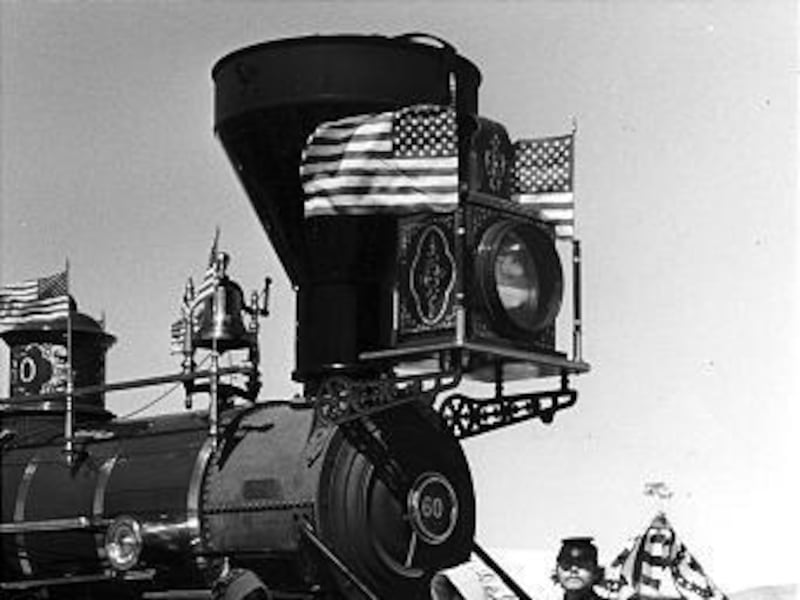
The moment has been re-enacted often at the Golden Spike National Historic Site, 32 miles west of Brigham City. For information on the site, visit www.nps.gov/gosp.
In the coming years, many empire builders would lay tracks through the Beehive State.
The Union Pacific was the first railroad to build within Utah's borders, followed by the Central Pacific as both rail lines built towards the Promontory Summit meeting point. The route, which skirted the Great Salt Lake to the north bypassed Salt Lake City, and established Ogden as the state's major rail city. Within the year, a rail line from Ogden to Salt Lake City was complete, connecting the state's capitol to the national rail system.
Other prominent rail lines in Utah include the Oregon Short Line, the Utah and Pacific Railroad, the Utah Western Railway and the Denver and Rio Grande Western Railway — all before the start of the 20th century. All played a crucial role in the development of the state.
As Carma Wadley, a Deseret News staff writer, wrote in a Sept. 21, 2009, story about the 100th anniversary of the Union Pacific Depot in Salt Lake City, "The glory days of the Union Pacific Depot, like the glory days of passenger rail travel, lasted for about half a century."
Those wishing to experience the romance of early rail travel, the Heber Valley Railroad is perhaps the best Utah experience. It runs between Heber City and Vivian Park on a line listed in the 1889 incorporation of the Rio Grande Western as one of many planned branches. Construction on the line was completed in 1899. A schedule for the train can be found at www.hebervalleyrr.org.
2 commemorative events
The Golden Spike National Historic Site will present two special events this week in recognition of the Golden Spike's 141st anniversary.
The "Driving of the Last Spike" will be commemorated on Monday with a full day of events. On May 10, 1869, the transcontinental railroad was completed at the site.
The visitors center opens at 9 a.m. There will be music and dance prior to the traditional program, which will begin at 11:30 a.m. The keynote speaker will be Kyle Wyatt, historian at the California Railroad Museum.
In a separate event, Dennis Lewin, a retired Union Pacific railroad telegrapher, will be presenting a program on the use and history of the telegraph on Saturday.
Lewin was hired in 1954 as a Morse Code telegrapher by the Union Pacific Railroad.
He will focus on the application of the telegraph as it was used by the railroad. The program will be held at the visitors center interpretive shelter, with the first demonstration at 10 a.m. and others continuing throughout the day until 3 p.m.
Golden Spike National Historic Site is located 32 miles west of Brigham City via Highways 13 and 83.
For more information, visit www.nps.gov/gosp/ or call 435-471-2209, ext. 29.
e-mail: mhaddock@desnews.com