

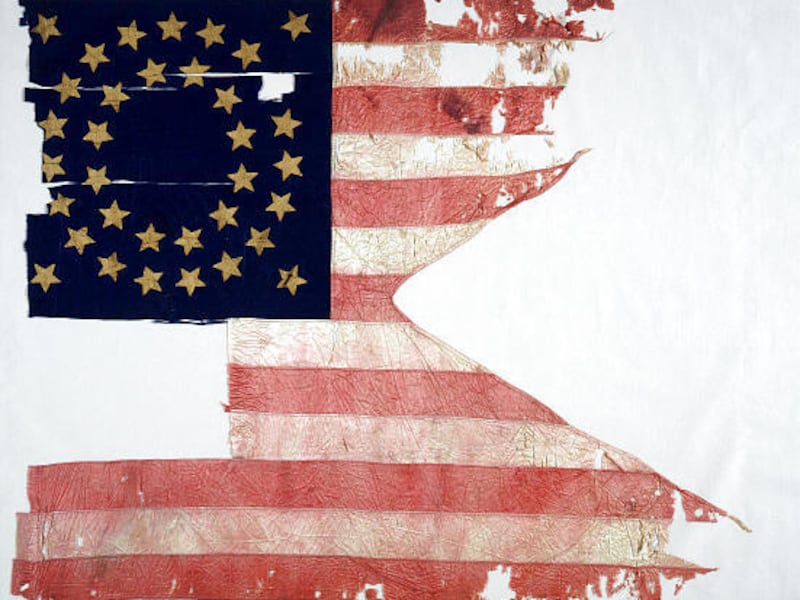
DETROIT — On June 25, 1876 — 134 years ago — Gen. George Armstrong Custer, the pride of Monroe, led the 7th Cavalry into battle against the Lakota Sioux and Northern Cheyenne near the Little Bighorn River in Montana.
It was not, shall we say, Custer's finest hour. All 210 men under his immediate command died in the massacre. So did Custer.
As a burial detail surveyed the carnage a few days later, Sgt. Ferdinand Culbertson discovered a tattered swallow-tail American flag, known as a guidon, hidden beneath a dead soldier. He picked it up, folded it and squeezed it into his pocket. Four years later, according to an 1895 Free Press report headlined "Memento of a Massacre," the first written document of the flag's history, Culbertson gave it to Rose Fowler, whose husband was a military man.
After Mr. Fowler died, his wife married another soldier and retired to southwest Detroit.
Rose Fowler Riedel sold the flag to what then was the Detroit Museum of Art in June 1895 for $54 — $50 came from a board member and $4 was raised in a public campaign. Now, 115 years later, the Detroit Institute of Arts has decided to sell Custer's Last Flag at auction this fall at Sotheby's in New York.
The estimated price it is expected to fetch? $2 million to $5 million.
So, why would Sotheby's think that anyone would pay millions of dollars for a 19th-century silk flag that, unlike Custer and his charges, survived the Battle of the Little Bighorn?
And why would the Detroit Institute of Arts decide to sell it now after 115 years?
Let's start with the second question. In 1895, the museum was still something of a cabinet of curiosities, including mounted animal heads and model racing sloops. Despite the historical significance of the 27-1/2-by-33-inch flag, it's no longer considered a work of art, and money from its sale could be put to better use buying something of true aesthetic value.
"It's a standard-issue military flag," said David Penney, the art institute's vice president of exhibitions and collections strategies. "The only thing distinctive or unique about it is its story. And the fact is we don't have the context or expertise to properly display and interpret it."
For decades, museum leaders have intended to sell the flag — "de-accession" it, in art world parlance — but other priorities kept it on the back burner. But with the museum in the midst of a sweeping five-year review of all 60,000 pieces in the collection, the flag's number has come up.
The museum's financial troubles have nothing to do with the decision.
Selling art to pay operating expenses violates every ethical code in the museum world. The fundamental principle is that museums hold art in the public trust. Since the flag was formally accessioned by the art institute, the museum is following the same deliberate rules that bind it when selling any work of art.
The codes allow the museum to sell a work for scholarly reasons — if it's of inferior quality, a duplicate or something the museum is unable to take care of. But all proceeds must be funneled back into acquiring other art or maintaining the collection.
Thanks to a healthy pot of money restricted by law to buying art, the Detroit Institute of Art spends as much as $3 million a year on growing the collection. If the Custer flag splits the difference of its $2 million to $5 million presale estimate, it would roughly double the annual acquisition kitty.
The flag's imminent sale is not universally celebrated.
"It's disappointing news for anyone from Michigan," said John Gibney, director of the Monroe County Historical Museum, home to one of the country's largest permanent exhibitions devoted to Custer, a bona fide Union hero in the Civil War, who considered Monroe his hometown.
"This is Michigan and this is Custer, one of the greatest heroes Michigan has produced, so the possibility that this flag could end up somewhere where you might never see it again is just horrible."
Records suggest the flag hasn't been displayed much since the late 1890s. It was on view at the Little Bighorn Battlefield National Monument in Montana from 1952 to about 1963, and since 1980 has been loaned twice to historical institutions, including the Gerald R. Ford Museum in Grand Rapids, Mich.
Sotheby's multimillion-dollar estimate for the flag reflects a confluence of factors, including Custer's iconic status in American mythology, the flag's direct witness to one of the best-known battles in American history and the way the story connects to broader historical currents, notably the nation's troubled relationship with American Indians.
"It is one of the most famous stories in American history, and here you have one of the most important symbols of that story that you could possibly have," said David Redden, a vice chairman of Sotheby's and head of the special projects department.
Redden said the flag's provenance was impeccable. In addition to Free Press articles from 1895 that document its journey from battlefield to museum, the flag is referenced in books, and the art institute has a letter acknowledging payment and acquisition. It remains in relatively good condition; even the fact that sections had been cut away as souvenirs in the 19th century remains a testament to the awe in which it was held in its day.
Only one other 7th Cavalry guidon survived the battle, the so-called Keogh guidon, housed at the Little Bighorn monument.
But its condition is so poor that it rarely gets displayed, said Ken Woody, chief of interpretation at the monument. (The Keogh guidon went on public view Thursday for the anniversary of the battle but will return to storage after Friday.)
Since no direct comparables to the Custer flag are in the auction record, estimating a price involves a bit of hocus-pocus and intuition.
A personal Custer guidon sold for about $900,000 three years ago. Four Revolutionary War flags sold for a combined $17.4 million in 2006 (including Sotheby's commission) with one commanding about $12 million on its own. Redden said the buyer of the Custer flag likely will be a private collector since its price is probably out of reach of most institutions.
Still, he said, the flag has a good chance of ending up on loan to a public institution.
In the end, the allure still comes back to Custer, an enormously complex figure — ambitious, flamboyant, eccentric. His legacy, the subject of endless books, has been in continuous evolution since his death at 36, seesawing from gallant warrior to military fool to racist symbol of anti-American Indian hatred.
In the course of reviewing Nathaniel Philbrick's newly published "Custer, Sitting Bull and the Battle of the Little Big Horn" last week in The New York Times, author Bruce Barcott noted that Custer's name continues to evoke an entirely over-romanticized era of the American West.
"By all rights he should be a footnote," Barcott wrote. "That he enjoys the glory of single-name recognition is a testament to the power of personality, show business and savvy public relations. Custer wasn't just an Indian fighter. He was one of the first self-made American celebrities."
Distributed by Gannett News Service