

SALT LAKE CITY — Kevin O'Connor knows well what the order of business will be when the NBA's summer free-agency market opens at 10 p.m. Wednesday.
"When the first big fish falls then everything else starts to go," the Jazz general manager said. "I don't have to tell you who that first big fish is."
No, he does not.
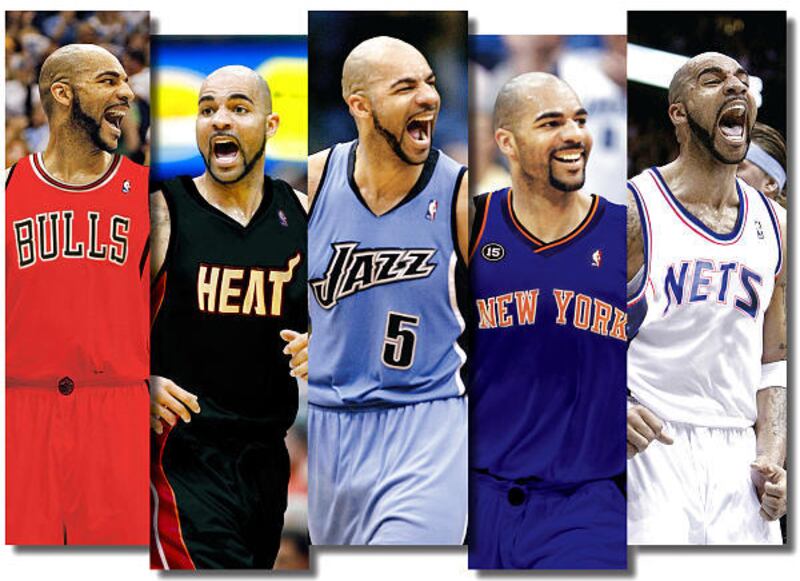
Chasing LeBron James, however, is the worry of other NBA teams — namely New York, New Jersey, Chicago, Miami, his own Cleveland Cavaliers and even the Los Angeles Clippers.
O'Connor's concern: keeping on hook a smaller fish from a smaller pond.
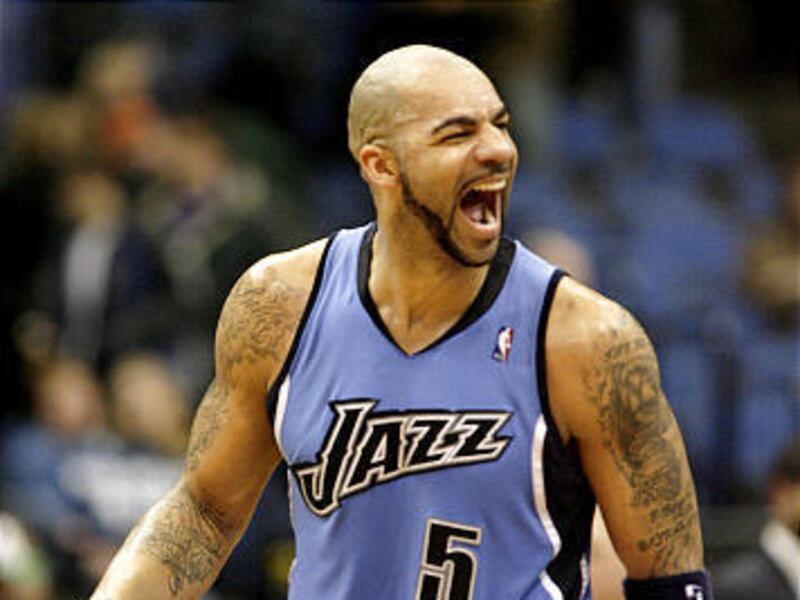
Retaining two-time NBA All-Star power forward Carlos Boozer is the Jazz's chief charge of the offseason, and it's no tiny task.
Widespread expectations around the league are that Boozer is in all likelihood out of here.
But O'Connor said keeping their leading scorer and rebounder from 2009-10 "absolutely" is top priority later this week.
"So it's gonna be a matter of waiting to see, and trying to fill out a roster and looking," he said. "We've said we wanted Carlos back in."
At what cost, though? The man who made $68 million over the last six years in Utah presumably is looking for a deal that will pay even more than the $12.66 million he made this past season.
"I think you evaluate, you try and keep yourself in a position to where you're looking at somebody and see what his price is, and you move on from there," O'Connor said Friday.
The Jazz can't offer Boozer more than $10 million or so next season without facing the NBA-imposed luxury tax on teams that engage in excess payroll spending.
But other NBA teams can, and one or more with oozing with salary-cap space — perhaps Miami if Toronto free agent power forward Chris Bosh doesn't go there, New Jersey, Chicago or New York — might.
When the Jazz's 2010 postseason ended with a second-round loss to the eventual NBA-champion Los Angeles Lakers, Boozer readily admitted he wasn't sure if the Jazz would be able to afford him.
"I'm sure they have some challenges ahead of them, and they probably have been preparing for it all season — whatever their plans may or may not be," said Boozer, who has spoken openly in the past about wanting to play in Miami and Chicago. "Some things might be a surprise for them. But they'll do a good job of whatever they're supposed to do for this franchise."
Whether keeping Boozer truly is in the franchise's best interest is open to debate.
The Jazz have made it past the second round of the playoffs only once with him, and have never beaten the Lakers in the postseason with him.
His defense frequently is more detrimental than helpful, and his presence means fewer minutes for backup Paul Millsap, who is heading into his second season on a four-year, $32 million contract.
Furthermore, he's missed 28 percent of his games during six seasons in Utah due to injury — including the Jazz's most-important of their '09-10 regular season, the finale, a home loss to Phoenix, due to a strained oblique muscle.
But O'Connor suggested neither that nor Boozer's age (28) would preclude the Jazz from offering him a long-term contract, saying, "It's tough to get a 20-(point), 10-(rebound) guy."
Everyone from management to head coach to at least some players suggest that they without Boozer can't do nearly as well as they have.
"He's 20 and 10. It's that simple," small forward C.J. Miles said when the season ended.
"He does a lot for our team. (His leaving) would definitely make guys have to step up ... but hopefully he's back and we don't even have to worry about it."
The 6-foot-9 Boozer really does have support, especially that from head coach Jerry Sloan.
Sloan — who publicly critiqued Boozer's defense during his first season with the team — passionately takes issue with the knocks, especially the one about his play away from the offensive end.
"How many guys are perfect defensively? I mean, there are a lot of times he does a terrific job on people," Sloan said.
"I think that has to do with size. You know, Karl Malone sometimes ran into trouble trying to guard people — and he's one of the best power forwards ever defensively that maybe played. When you have to go out on the floor and you have to cover Larry Bird? That's a tough matchup.
"So hopefully (Boozer) makes it up on the other end, which he did a lot of times," Sloan added. "There's give and take there."
O'Connor, who engaged in contract extension talks with Boozer's camp that went nowhere, doesn't buy the notion that there's not enough roster room for both Boozer and Millsap.
"They've played awfully well together," he said.
The Jazz GM also defends Boozer's play against a Lakers team that dominated Utah inside during the postseason.
"I don't think you ever judge one player by a series. I don't think that's fair to do," he said shortly after the series sweep ended. "And the other thing was we really didn't have our starting small forward (injured Andrei Kirilenko), who is 6-9 or 6-10 almost, and we didn't have our center (injured Mehmet Okur).
"So that put a lot more burden on (Boozer). I don't think it's fair to equate that. You don't base it off four games. I mean, we played 100 games. ... I thought he played very well this year. His defense improved. His assist-to-turnover ratio was good. He had a lot of assists."
Added Sloan: "And whenever we asked him to do the work to try to get better, I thought when he was on the floor and was working with us he was a very coachable guy and tried to do everything we asked him to do."
Boozer seems to sincerely appreciate Sloan having his back.
"Coach has always been a straight shooter. He tells you how he feels," Boozer said. "And it's great to have a guy like that in your corner."
Even Sloan, though, knows financial realities will play a part in whether the Jazz keep or lose Boozer.
"The parameters we work under, people understand. I mean, we've never thrown money around. That's when (deceased owner) Larry (H. Miller) was here," he said. "It's easy for me to say I like this guy and this guy and that guy, but these are the people who are here. And we do it as an organization — not as me against Kevin (O'Connor), or anything like that. We try to work it out and make it work.
"That's why I didn't leave this franchise when I first had a chance. It's more important for me to work for a franchise where there's stability, when we make a mistake it's not 'his fault' (but) 'it's our fault.'
"It can be a mess sometimes. Yeah, there's some controversy once in a while. But it's pretty good working conditions to be under, and I don't have any fault with anybody," the longtime Jazz coach added. "It's their money, and I'm not gonna spend it the way I want to. ... And I have no problems whatsoever with that."
e-mail: tbuckley@desnews.com