
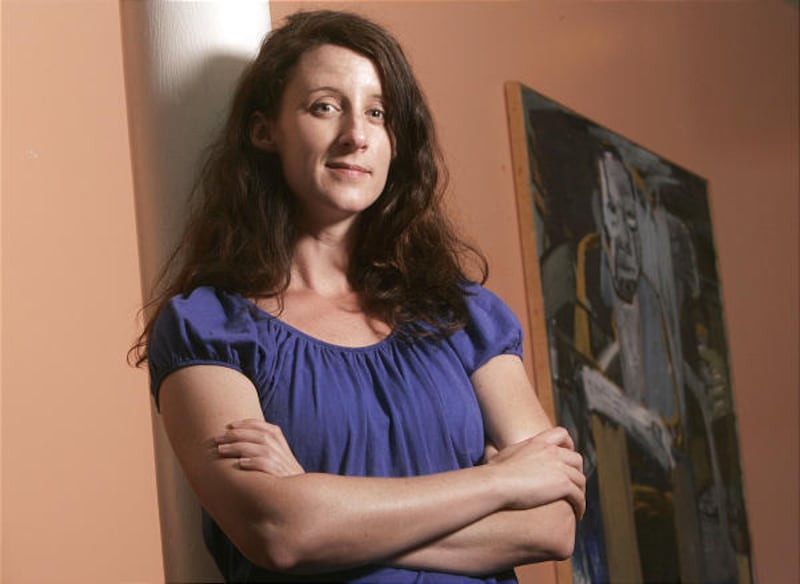
KANSAS CITY, Mo. — When Christie Hodgen learned that her new book had drawn enthusiastic early reviews, she was ...
Ecstatic? Celebratory?
"More of a relief," said the novelist and assistant English professor at the University of Missouri-Kansas City. "I'm not so much someone who hopes for praise, but I worry about getting kicked in the stomach."
In the Kansas City metro area are a few of the country's award-winning contemporary fiction writers. Hodgen, 36, is one of these. Her literary honors include two Pushcart Prizes and an award for short fiction from the Association of Writers and Writing Programs.
Booklist recently said this about her second novel, "Elegies for the Brokenhearted": "Hodgen's magnificent, heartbreaking journey with its moving finish is an unforgettable novel, a must-read."
In fact, reviews of Hodgen's work over the years have been almost perfect. But her "kicked in the stomach" comment is interesting, because it serves as a reference to a topic in her fiction: Life will rough you up.
Like most of us, Hodgen has endured a few of life's stomach blows, but they haven't been as brutal or as frequent as those experienced by her luckless characters in "Elegies." To be blunt, they get kicked in the stomach, and then they die.
It's not called "Elegies for the Brokenhearted" for nothing.
In the novel, Hodgen follows her main character, Mary Murphy, from girlhood to adulthood, not through a linear narrative but through Mary's bare-knuckled elegies of five crucial relationships in her life.
They include a young, ne'er-do-well uncle, a college roommate who dooms her own academic chances, and her dazzlingly beautiful mother, who marries five times.
The setting is a dying town in the Northeast, patterned after her hometown of Worcester, Mass. Hodgen describes in the book what the inhabitants were up against:
"By the time we came along, generations of decay later, the place was falling down, a third of its population jobless and walking the streets, drunks and drug addicts, crippled veterans, raving lunatics. We were poor, our lives filled with the stupid things that poor people did, the brutalities we committed against each other, the violence, the petty victories we claimed over one another, crabs topping each other in a basket instead of trying to climb out of that basket ..."
The setting isn't so autobiographical, however. Hodgen grew up in a middle-class neighborhood inside a loving family.
Her father, John Hodgen, a teacher at her high school, was her AP English instructor. That arrangement wasn't too uncomfortable, she said, except on nights before a writing assignment was due. She knew he knew why she was up at 3 in the morning.
John Hodgen is a well-respected poet with his fourth poetry collection, "Heaven & Earth Holding Company," due out in August. He also has won an AWP Award. They are perhaps the only father-daughter duo to do so.
As a father would be, he's proud of his daughter's hard work, her empathetic temperament and her natural and honed talents, including a "phenomenal" memory and her careful watching.
"It's a case of her constantly X-raying the heartache of the world," he said. "She really feels the need to bear witness."
But John wasn't a hands-on writing mentor for his daughter. Her first brush with serious fiction-writing came as an undergraduate at the University of Virginia, when she won a writing contest, and a professor invited her to enroll in his fiction-writing course.
It's more of a DNA connection with her father, she said.
"We feel we have the same voice," she said. "I don't think that was training. I think it was genetic."
They do share a shyness about their lives and work, including a disdain for self-promotion, and a certain wryness: "We're both sort of embarrassed to be alive," she said.
From the University of Virginia, Hodgen went on to earn a master of fine arts in creative writing at Indiana University. Afterward she worked at a Heine Brothers' Coffee shop in Louisville, Ky., for two years. That's when she wrote "A Jeweler's Eye for Flaw," the short story collection that won the AWP Award.
Hodgen left the coffee shop and pursued her doctorate at the University of Missouri-Columbia and wrote her first novel, "Hello, I Must Be Going," about the aftermath of suicide as told by the victim's 9-year-old daughter. Like a lot of people, Hodgen said, she's drawn to life's big questions.
"Why do people choose suicide?" she said. "And why do other people choose not to live even though they are still alive?"
Hodgen is at heart a short story writer who continues to develop her skills at longer narrative, the ability to "keep more plates spinning."
In "Elegies for the Brokenhearted," Mary Murphy's story develops through the tales of five people, Mary's elegies to them. That structure suited Hodgen's storytelling, and it reflects the way many people experience their lives—in chunks: the growing up years, the college years, the young adult years. Key people occupy chunks of our lives, and they leave a lasting influence, she said.
"Hopefully they don't have to die for us to appreciate them," she said.
Hodgen acknowledged the melancholy in the book, that Mary experiences much loss, and that while more than a few situations are darkly humorous, there's never a "tap-dancing triumph." Ultimately, though, Mary carves out an interesting place in life.
"If the effect of reading about loss helps people pay more attention to what they have, that would be nice," Hodgen said. "We can make the mistake of living our lives retrospectively."
Hodgen includes herself in that "we."
"I spend a lot of time struggling and reflecting," she said. "I have wished a thousand times that I was more like a friend of mine, she's blond and boisterous, and she'd bite a head off a chicken and eat it. I love being in her company."
For Hodgen, her big stomach blow, so to speak, came in 2003, when she was pregnant with her daughter Grace, who is now 7.
Hodgen went into labor four months into the pregnancy, then spent 105 days in a "waking coma," pumped full of chemicals to stop contractions and save the baby.
In her Pushcart Prize-winning story "Tom & Jerry," Hodgen provided details of the ordeal through a fictional narrator, who tells the story in the second person:
"You are four months pregnant and have gone into preterm labor, you are completely effaced, you have been drugged senseless in an effort to stop contractions but the efforts are thought to be futile. You are waiting to deliver what you have been told will be a stillborn, or at the very best a baby that will gasp for an hour in your arms before dying, the baby being, in the strictest medical terms, the size of a potato and too small to save: any day now, you're told."
Clancy Martin, novelist and associate philosophy professor at UMKC, has known Hodgen for several years and admires that she identifies with people who struggle—it's her "spiritual place in life"—and how her "tremendous" writing illuminates the theme.
"She seems like this flower trying to grow under all these shadows but refuses to give up," he said.
Anyone who knows Hodgen, Martin said, knows about her "astonishingly unlucky" moments.
For instance, the winter before last, she fell on her icy driveway and impaled the palm of her hand with her car key. Her hand swelled around the key, which at least limited the bleeding. Last winter she fell again and required emergency spine surgery.
The result has been serious: She can't sit down, except briefly. Now her writing area at her home in Kansas City is a stand-up station in the kitchen.
"I'm accident-prone," acknowledged Hodgen, who is hopeful her back improves with time. "I've had some bizarre medical adventures."
Michelle Boisseau, poet and English professor at UMKC, noted that in life and in her stories, Hodgen can find the humor in painful incidents and can work language to reflect it.
"Christie knows how to turn a phrase and then how to turn it a few more notches," she said, "and it can be side-splittingly funny."
Like Chekhov, one of Hodgen's favorites, she excels at creating "unimportant" characters and following the choices they make, choices that take them in directions they hadn't expected, Boisseau said.
"It's not enormous, there are no Vatican secrets, no magic brooms," Boisseau said. "But it's the inner secrets of the soul. She has a wonderful, dark imagination."