

SALT LAKE CITY — In coming weeks, deals could be inked and shovels could be digging into the ground, beginning the first two transit-oriented developments (TODs) owned in part by the Utah Transit Authority.
Plenty of developers over the years have built mixed-use centers of housing, office space and retail near UTA railroad tracks, but on Friday, UTA's Board of Trustees gave staff the go-ahead to negotiate contracts using UTA-owned land.
One TOD will be in along the Mid-Jordan TRAX line. It is slated to open next year at roughly 8600 South and 3200-3500 West.
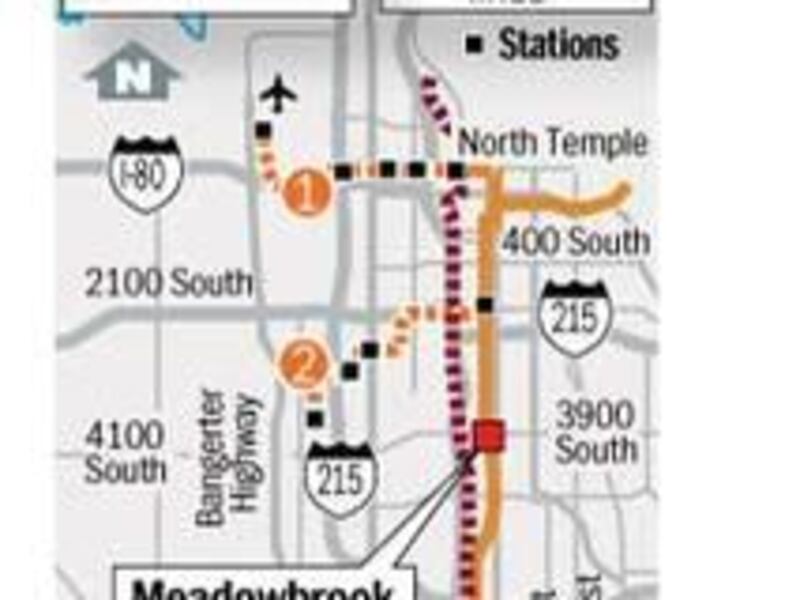
The other is at the Meadowbrook Park-and-Ride lot at 3900 South along an existing TRAX line that connects downtown and Sandy.
The Jordan development is the first that could see shovels as soon as this fall, said Kathy Olson, who works in TOD for UTA.
The first structure to be built is a three-to-five-story parking garage, which will serve shoppers, residents and others who want to "park and ride." In the spring, the developer is expected to start building residential units.
The developer that UTA is talking to is Boulder Ventures LLC — owned by Jeff Vitek of San Diego, who also president of Foursquare Development Inc. — owner of Jordan Landing and the company interested in building a controversial TOD with UTA along a future FrontRunner South line in Draper.
The proposed plans for the 36-acre Jordan Valley development show 1,400 to 1,600 residential units, a combination of market-rate and low-income apartments. Eventually, when real estate turns around, condos will be offered for sale, Olson said. There is also office space.
"It could be eight or nine phases," said Bruce Jones, UTA general counsel and president of government resources.
The proposed Meadowbrook development, on the other hand, is smaller at 7.6 acres.
UTA is negotiating with Centerville-based Ascent Construction Inc., owned by Brad Knowlton. If negotiations are successful, construction could start in the spring, reconfiguring parking and a bus loop. Then, work would start on a 60,000-square-foot Salt Lake Community College classroom/office building slated to open for classes in fall 2011.
SLCC would lease the building. The college currently has a building on the opposite side of the tracks. It is unclear whether that building would stay open.
"We're always in the business of promoting student access and success," said SLCC spokesman Joy Tlou. "Anytime there is an opportunity, we're going to explore it."
In addition to the college building, the proposed development would have 7,000 square feet of retail and 88 housing units that would probably be rentals, Jones said.
The proposed contracts that UTA is negotiating are complex.
For Jordan Valley, UTA would contribute $6.5 million, the value of the land. Boulder Ventures' initial capital contribution would be $1.6 million. The value of the investment would be $200 million, so the balance would be in loans that Boulder Ventures would obtain.
When the development is open and generating rent and lease money, the first obligation would be to pay third parties such as architects, the management company and utilities. Second, UTA would receive 5 percent as a sort of interest payment for the collateral. Third, Boulder Ventures will then be paid a developer fee. Remaining profits are to be split 50-50, Olson said.
UTA would not be responsible for the loans in either development, other than the collateral provided in the land. If a developer goes belly-up, Olson said, UTA could try to find another development partner before the banks or investors take ownership.
With the Meadowbrook development, UTA is negotiating for an 8 percent fee. UTA's contribution in land, plus $400,000 in federal grants, is $2.4 million. Ascent's initial contribution would be $607,000. Ascent will borrow the remaining $17 million, Olson said.
In March, the Utah Legislature allowed UTA, through SB272, to enter development partnerships but limited the authority to five.
UTA has about nine potential TODs in the works, and the ones that will come to fruition are the ones that are most "ripe" for development, have support of cities, which will have to rezone for high density in most cases, and the most ridership potential, Jones said.
e-mail: lhancock@desnews.com TWITTER: laurahancock