

SALT LAKE CITY — The 2010 ACT scores for Utah's high school students are in, and it's status quo again.
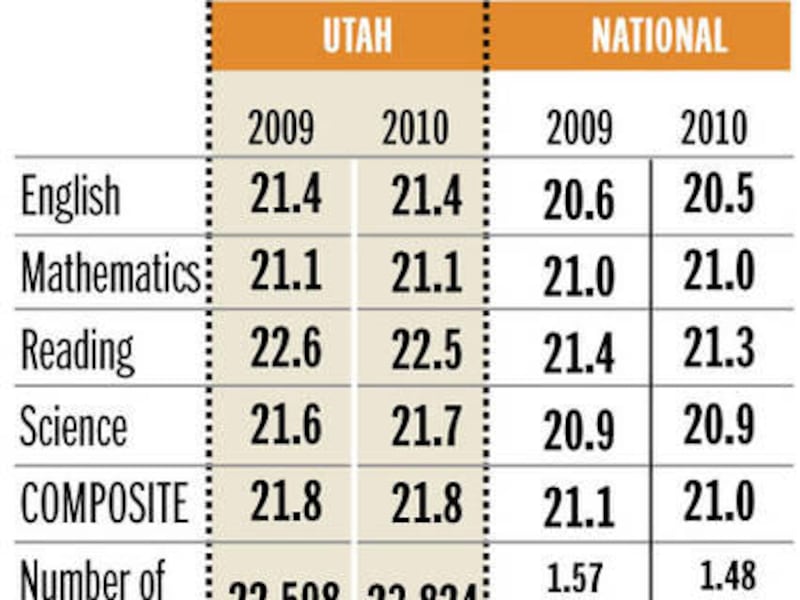
The average composite score of 21.8 on the college entrance exam has remained essentially unchanged the past five years.
That's slightly above the national average of 21 on the test's scale of one to 36, and Utah's high school students also shade their national peers in each individual category: English, math, reading and science.
Still, the state's scores in math (21.1) and science (21.7) are below the benchmarks — 22 for math, 24 for science — that would indicate the students are ready for entry-level college coursework. That means more remedial education once students are on campus, possibly pushing back their graduation. Utah's graduation rates have sagged in recent years into the bottom third of states.
The pressure to provide remedial education is a challenge and a distraction for colleges, said William Sederburg, Utah's commissioner of higher education. Two-year schools such as Salt Lake Community College are required to subsidize remedial education, but four-year colleges have to charge students the full cost, giving the schools a moneymaker they don't necessarily want.
"It's a major area of frustration for everyone involved," Sederburg said.
But the problem, he said, is often not poor preparation in high school but a time lag between secondary and postsecondary class. Many students in Utah finish their math requirement by junior year of high school, ease through a relaxed senior year schedule and then are allowed to put off college math until they feel like taking it.
Sederburg said the high number of students who serve missions for The Church of Jesus Christ of Latter-day Saints exacerbates the need for remedial education.
Earlier this month, Utah became the 35th state to adopt common core curriculum standards in an effort to boost college readiness.
Nationally, average ACT scores inched downward this year, yet slightly more students who took the test proved to be prepared for college. The findings sound contradictory. But the exam's authors point to a growing and more diverse group of test-takers — many are likely scoring lower overall, but more are also meeting benchmarks used to measure college readiness.
Three in four test-takers likely will need remedial help in at least one subject to succeed in college, ACT officials said.
To measure whether students are ready for college, the ACT sets minimum scores in a subject area test to indicate a 50 percent chance of getting a B or higher or about a 75 percent chance of getting a C or higher in a first-year college credit course. The courses include English composition, algebra, biology and introductory social science courses like Psychology 101. The ACT report found a combined total of 43 percent of test-takers met either none (28 percent) or only one (15 percent) of the four college readiness benchmarks.
A record 1.57 million students, or 47 percent of this year's high school graduates, took the ACT. That's a 30 percent increase from five years ago. In Utah, 24,824 students, or 71 percent of 2010 graduates, took the ACT.
Because some states mandate the ACT but others don't, state-to-state score comparisons can be misleading. States requiring all students to take the ACT typically see average scores go down, at least initially.
The average composite scores for Hispanics dipped slightly to 18.6 this year after holding steady at 18.7 the previous three years.
The SAT remains the most common college entrance exam, though the rival ACT has nearly caught up in popularity. Most colleges accept either, and a growing minority no longer requires either one. SAT results are due out Sept. 13.
Contributing: Associated Press
e-mail: pkoepp@desnews.com