


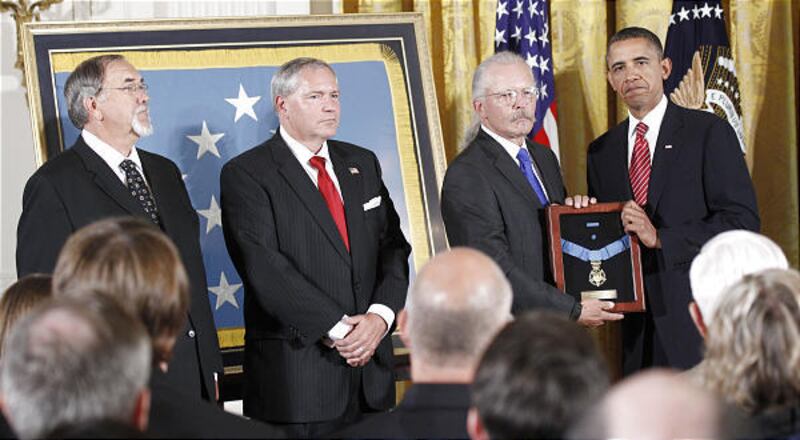
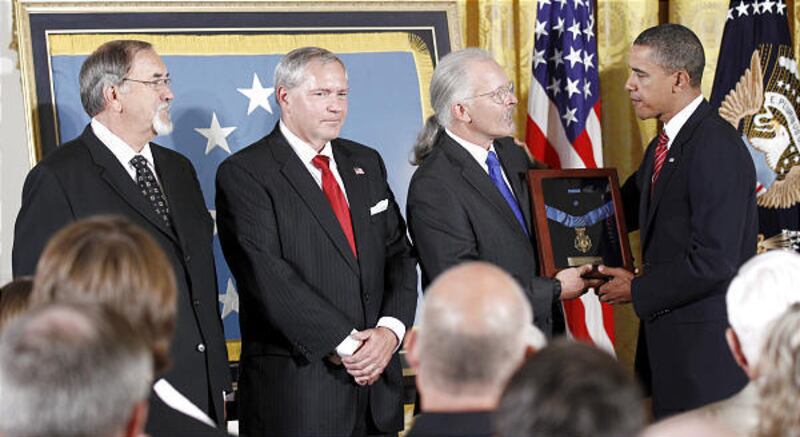
WASHINGTON — Saying it is "never too late to do the right thing," President Barack Obama presented the nation's highest military honor Tuesday to the sons of an airman who was killed in 1968 during a top secret mission in Laos.
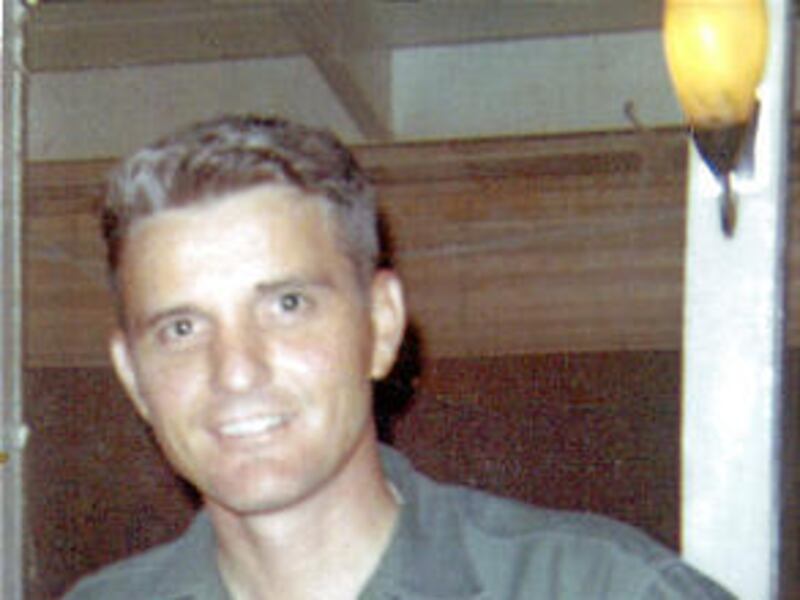
Utah State University professor Rich Etchberger of Vernal accepted the award, along with his brothers, Cory Etchberger and Stephen Wilson, on behalf of their father, Chief Master Sgt. Richard L. "Dick" Etchberger, at a ceremony in the East Room of the White House.
"Today your nation finally acknowledges and honors your father's bravery," Obama told Etchberger's sons. "Because even though it has been 42 years, it's never too late to do the right thing."
Rich Etchberger, who was 10 when his father died, said his father would have been "very humbled to be standing next to the president."
"At the same time I think part of him would have said, 'That's what my job was,'" Etchberger said. "That's the kind of guy he was."
In March 1968, the small mountaintop radar base in Laos that Dick Etchberger and 18 other hand-picked airmen were manning was attacked by thousands of North Vietnamese soldiers. One by one the airmen were wounded or killed until Etchberger was "the only man standing," Obama said.
Etchberger had no formal combat training, the president said, and hadn't even been issued an M-16 until shortly before the attack. Still he was "the very definition of a (non-commissioned officer), a leader determined to take care of his men," Obama said.
Etchberger fought off the attackers and called in airstrikes that landed within yards of his own position. Then, when a helicopter finally arrived in the morning to lift the men from the mountain, Etchberger carried three of the wounded to the helicopter, repeatedly exposing himself to heavy enemy fire, according to the White House.
"Of the 19 men on that mountain, only seven made it out alive," Obama said. "Three of them owe their lives to Dick Etchberger."
Etchberger was fatally wounded as he was being lifted by rescue sling to the helicopter. He died before reaching base.
Rich Etchberger described his father as "a very talented person" and a "really great guy."
"He was a humble person who believed you do your job and for him, over the years, doing his job was taking car of his men," Rich Etchberger said.
Etchberger said his parents met while his father was stationed at Hill Air Force Base. He remembered that no matter where the family lived in the world, his father was always visiting the base hospital to invite injured airmen home for Thanksgiving or Christmas dinner.
"Whenever one of his guys had something they needed, dad was there to take care of them," Etchberger said.
Dick Etchberger was initially recommended for the Medal of Honor shortly after his death, but President Lyndon B. Johnson refused to confer it because of the secretive nature of his mission. At the time the United States still refused to admit that it had troops operating in Laos.
The Etchberger family was initially told their husband and father had died in a helicopter crash. They were called to the Pentagon, where they received his Air Force Cross, the Air Force's highest honor, in a secret ceremony.
"The boys were told their father was a hero," Obama said Tuesday. "They weren't told much else."
Thirty years later, the Air Force called the family again to tell them the mission that had claimed Etchberger's life had been declassified.
"That's when they began to learn the true measure of their father's heroism," the president said, adding that Etchberger's wife, who died in 1994, had known all along about the nature of her husband's mission but had been sworn to secrecy.
"She kept that promise to her husband and her country for all those years," Obama said, before paying tribute to the sacrifices made by military spouses.
Rep. Earl Pomeroy of North Dakota was among those who pushed for the reconsideration of Etchberger's Medal of Honor nomination, adding language to a 2009 bill that waived the statute of limitations for awarding the medal in Etchberger's case. Recommendation for the medal must typically be made within two years of the act of bravery for which it is being awarded.
"Chief Etchberger was denied the Medal of Honor because he was serving his country on the wrong side of a geographic barrier," Pomeroy said in a statement issued Tuesday. "But heroism knows no boundary."
Rich Etchberger said, as a teacher, he hopes his father's story and his family's experience can be a lesson for others.
"I'm hoping that other folks will learn about this and that it will provide some inspiration for folks, particularly military folks, so that we don't forget when people make these sacrifices," he said.
e-mail: geoff@ubstandard.com