


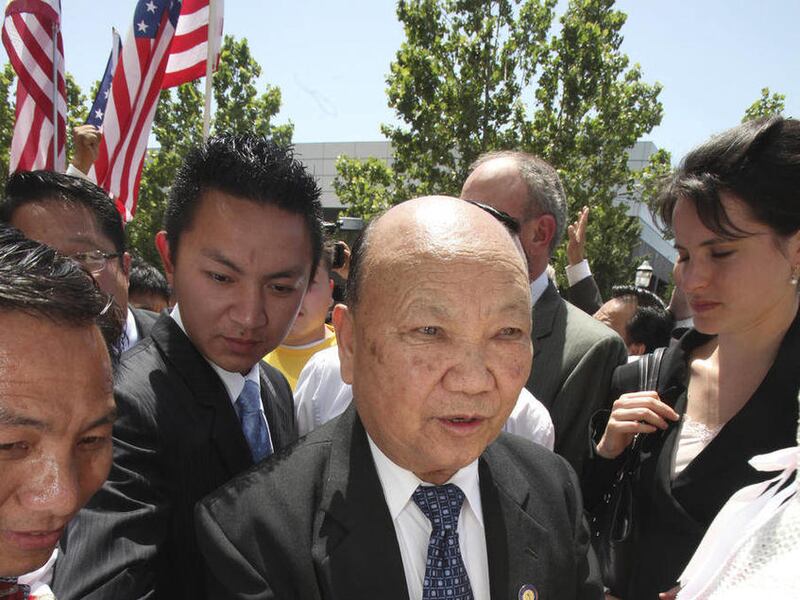
FRESNO, Calif. — Vang Pao, a revered former general in the Royal Army of Laos who led thousands of Hmong guerrillas in a CIA-backed secret army during the Vietnam War, has died. He was 81.
After immigrating to the United States once the communists seized power in Laos in 1975, Vang Pao was venerated as a leader by the Hmong refugee populations who resettled in California's Central Valley, Minneapolis and cities throughout Wisconsin.
Vang Pao died Thursday after being hospitalized for about 10 days, said Michelle Von Tersch, a spokeswoman for Clovis Community Medical Center.
As a teenager in World War II, Vang Pao fought the Japanese, who were attempting to take over Laos.
In the 1950s, he joined the French in the war against the North Vietnamese who were dominating Laos and later worked with the CIA to wage a covert war there.
Former CIA Chief William Colby once called Pao "the biggest hero of the Vietnam War," for the 15 years he spent leading a CIA-sponsored guerrilla army fighting against a communist takeover over the Southeast Asian peninsula.
After his guerrillas ultimately lost to communist forces, Vang Pao immigrated to the U.S., where he was credited with brokering the resettlement of thousands of Hmong, an ethnic minority from the hillsides of Laos.
"He's the last of his kind, the last of the leadership that carries that reference that everyone holds dear," said Blong Xiong, a Fresno city councilman and the first Hmong-American in California to win a city council seat. "Whether they're young or old, they hear his name, there's the respect that goes with it."
Xiong was at the hospital with a growing crowd. He said he spoke briefly with family members, but had no details on what caused Vang Pao's death.
Regarded by Hmong immigrants as an exiled head of state, Vang Pao made frequent appearances at Hmong festivals and major events across the nation and was often asked to mediate disputes or solve problems.
In 2007, he was arrested and charged with other Hmong leaders in federal court with conspiracy in a plot to kill communist officials in his native country. Federal prosecutors alleged the Lao liberation movement known as Neo Hom raised millions of dollars to recruit a mercenary force and conspired to obtain weapons.
Even after his indictment, he appeared as the guest of honor at Hmong New Years celebrations in St. Paul and Fresno, where crowds of his supporters gathered to catch a glimpse of him as he arrived in a limousine.
Don Thompson in Sacramento contributed to this report.