

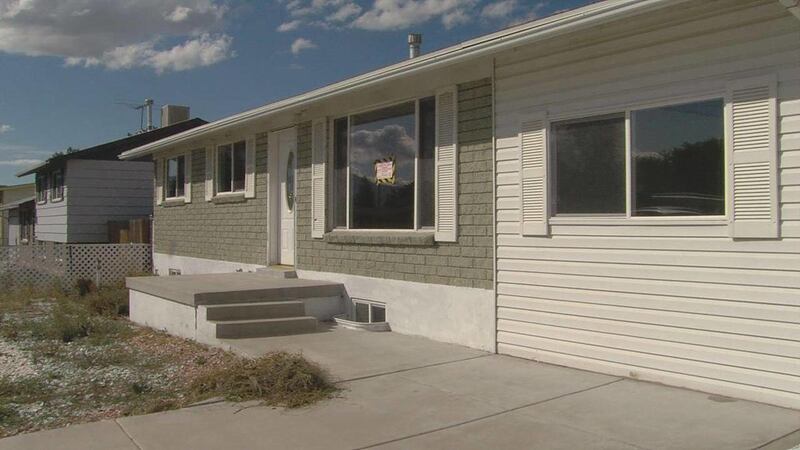


WEST VALLEY CITY — A couple is warning other homeowners that the state’s current methamphetamine disclosure laws may not go far enough in protecting new homebuyers.
Joshua Pace and his fiance Linnette Harms found that out the hard way.
After purchasing a foreclosed property in August, the couple went to work to get the home ready for them to move into.
"(We worked) every single night after work, and every single weekend for a solid month — everything we could do, every time we had we were here," Harms said.
The couple spent nearly $5,000 for materials and put in a lot of sweat equity.
“We were a weekend away from moving in,” she said. “We had drywall left to do downstairs and some carpet left to do.”
During that time, Harms became ill with upper respiratory problems. That's when a neighbor warned them that they should test the home for meth. They hired a decontamination specialist to test the house and results came back at levels so high the Salt Lake Valley Health Department condemned the house.
“How could they see this? How could somebody not know that this house was contaminated? Why didn't they disclose it before we signed the papers?” Harms asked.
“(The decontamination specialist) recommended that all the drywall that we’ve redone and painted be completely torn out. They have to use a HEPA vacuum to clean all of the walls all the way down to the concrete pretty much, which would consist of redoing all of the drywall. Everything is trashed at this point.”
Frustrated, Harms said she began digging into the home's sordid past.
She discovered a 2008 West Valley police report detailing the arrest of two suspects for investigation of possession of a controlled substance with intent to distribute and possession of drug paraphernalia.
“If we would have known, we would have never signed for it in the first place,” Harms said, showing the couple’s initial home inspection report that did not detail any signs of meth contamination.
Citing state legislation passed in 2004, West Valley Police Sgt. Mike Powell said there is a mechanism for law enforcement to report to the health department the existence of a meth lab. But when officers responded, they did not find such an operation inside the house.
“There was no indication of manufacturing or the operation of a clandestine drug lab. Obviously, there was some drug usage that occurred and some type of drug distribution that occurred at the residence,” Powell said.
“Did it rise to the level of needing to notify the health department? Not at that point.”
Rep. David Litvack, D-Salt Lake, authored HB123 that requires law enforcement agencies to report the discovery of a meth lab to the health department. He said his intent was to include any suspicious activity that might lead police to believe there could be a meth lab operation.
“We wanted to create a process that we could say to the public, 'This house is contaminated,'” Litvack said.
In this case, he said there is no easy answer. Harms said she doesn’t have one either.
“I've been frustrated, angry, sad, all the way to how can we fix this?” she said.
But Harms and Pace are determined to fix the problem. They intend on cleaning the house rather than let the home foreclose.
Right now, the couple is relying on the proceeds from yard sales and donations to try and raise the money needed to repair the damage to the home. To decontaminate the house, it will cost an estimated $8,500. Then to replace the drywall, carpet and appliances, they will have to pay another $35,000.
Donations are being accepted at any Utah Central Credit Union under the name of condemned house or contaminated meth house.
"I'm too strong. I'm just going to keep going until it's resolved and my kids have a nice, comfortable, clean house to live in,” Harms said.
E-mail: lprichard@ksl.com