

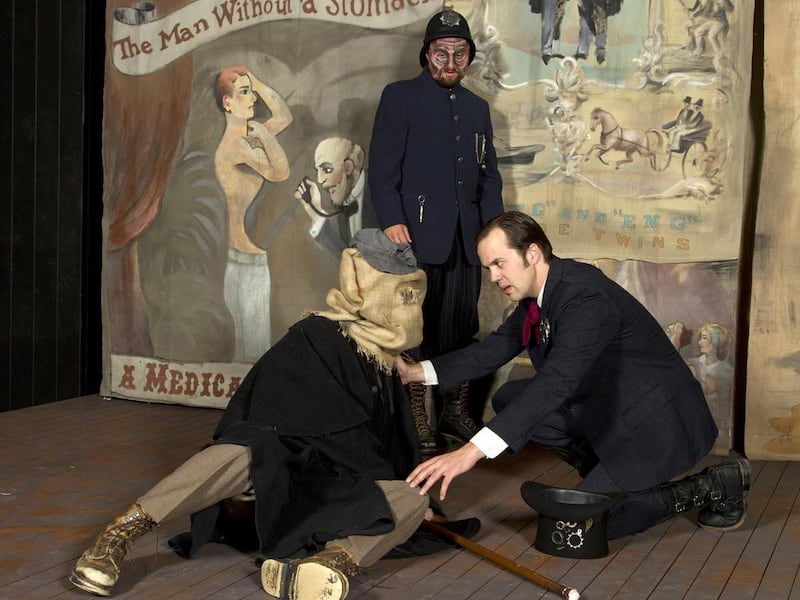
Audiences can judge if the addition of the masks aids in the understanding of Pomerance's play about disability and exploitation. Yet viewers are surely left wondering why Treves is not similarly disfigured.
“The Elephant Man” by Bernard Pomerance; BYU Department of Theatre and Media Arts; Margetts Theatre; through Nov. 19; 801-422-4322 or byuarts.com/tickets
PROVO — The tragic true life story of John Merrick, a deformed man given a dignified life after enduring his youth as a freak show attraction in Victorian England, is most commonly known through the atmospheric 1980 David Lynch film. But Bernard Pomerance’s “The Elephant Man” won a 1979 Tony award for best play and received a major Broadway revival in 2002.
For the staid BYU production, director David Morgan draws upon these two stagings but adds his own variation. With the exception of the two main characters, Merrick and Fredrick Treves, the gentleman doctor who rescued him, the actors are given a grotesque mask that disfigures all but the mouths of their faces.
Although masks are not mentioned in the study guide by dramaturge Wade Hollingshaus that is included in the program, the director had explained that the intent of the masks was to reverse the traditional portrayals of beauty and ugliness. According to press information, the masks “reveal the strength of character necessary to see beauty in unexpected places.”
Audiences can judge if the addition of the masks aids in the understanding of Pomerance’s play about disability and exploitation. Yet viewers are surely left wondering why Treves is not similarly disfigured. The traditional use in the early scenes of a burlap sack over Merrick’s head with a hole cut for the actor’s eye (another mask) adds another hurdle to comprehending the artifice.
With both masked and unmasked actors on stage, the devices also limit the audience’s involvement with these partially obscured characters and hinder the ability of the actors, given similar directorial advice as the non-masked actors, to make a strong emotional impact.
Yet the moving performances of the lead actors and the elegance of Pomerance’s script are the reasons to see this handsomely staged “Elephant Man.” It’s an engaging look into the challenging life of John Merrick.
While the film employed elaborate prosthetics for Merrick’s disfiguring congenital disorder, the stage play has an actor of normal physique contort himself without makeup or any other theatrical devices.
Graham Ward’s portrayal of Merrick is sensitive and engaging. The sideshow-freak-turned-medical-wonder becomes a remarkable man, capable of both charming and confronting society. Ward’s speaking is labored by the disfigurement he enacts but never incomprehensible. He rises to the challenge of making Merrick’s humanity evident, projecting warmth, wit and pained disillusionment.
As the doctor who shelters Merrick in a London hospital, Darick Pead gives a solid performance in an enormous role. Pead deftly creates a prim man of medicine whose own inadequacies are revealed. Gabrielle Cunningham plays a famed actress who gives Merrick his first conversation with and intimate glimpse of the opposite sex. After she unmasks, Cunningham is able to portray an appealing and sympathetic confidant.
The other cast members take on multiple characters and capably present roles from a sideshow pinhead to an elegant duchess, and a benevolent bishop to an intensely cruel manager. Peter Layland and Mariah Proctor deserve individual recognition for their skilled performances.
Setting the play on a carnival stage was an inspired choice, revealing how Merrick’s hospital “home” was yet another venue for his captivity and public display. A backdrop of vintage sideshow posters is drawn away to reveal a muslin curtain on which shadow figures are illuminated. Scenic designer Carter Thompson and costumer designer Maria Schulte make strong contributions to the play’s visual success.