

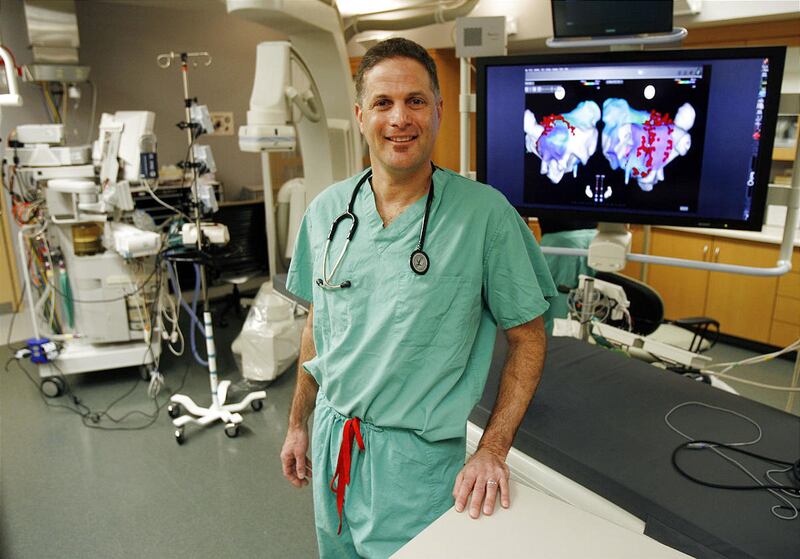

SALT LAKE CITY — You are sitting at your desk, yet you notice your heart pounding. It feels like it's beating faster than it should. Perhaps it goes away or maybe it turns into sweating, dizziness or shortness of breath. Either way, both are symptoms of a more serious heart condition.
A racing, fluttering or sluggish heartbeat could be the signs of a heart arrhythmia. Heart arrhythmias, or heart rhythm problems, occur when the electrical impulses in your heart that coordinate heartbeats don't function properly. The result causes the heart to beat too fast, too slow or irregularly.
In the United States alone more than 850,000 people are hospitalized for arrhythmias each year. Heart health and arrythmia risk are among the issues to be discussed during Saturday's Deseret News/Intermountain Healthcare Hotline. You can call 1-800-925-8177 and talk to Dr. Pete Weiss, a heart rhythm specialist, and Dr. Kent Meredith, cardiologist, both at Intermountain Medical Center. You can also post a question on the Deseret News Facebook page during hotline hours. If there is a high volume, select questions will be answered. The hotline runs Saturday between 10 a.m. and noon.
A normal heartbeat is somewhere between 50 to 100 beats per minute. An arrhythmia can occur if the heart rate is less than 50 or faster than 100 beats per minute. Some heart arrhythmias may cause bothersome and sometimes even life-threatening signs and symptoms.
"Heart rhythm specialists are like the electricians for the heart, whereas, cardiologists are like plumbers for the heart," said Dr. Peter Weiss, one of five heart rhythm specialists at the Intermountain Health Center in Murray.
Irregular heartbeats are caused by short circuits that people are born with or develop later in life. Arrhythmias may be caused by different factors including, but not limited to, coronary artery disease, changes in your heart muscle, injury from a heart attack, healing process after heart surgery and electrolyte imbalances in the blood. However, irregular heart rhythms can also occur in healthy hearts. Everyone should be aware of their own heartbeat and what it is doing.
The most common fix to heart rhythm problems is a procedure called an ablation. Ablations are done by inserting a catheter into specific areas on the body that then read the heartbeat. Special machines direct energy through the catheter to small areas of the heart muscle that causes the abnormal heart rhythm. This energy can be used to disconnect the pathway of the abnormal rhythm. Ablations usually cure the problem all together. There are no incisions involved with an ablation and the patient can leave after a day or two with just a couple band-aids.
Heart arrhythmia treatments can often control or eliminate irregular heartbeats. Because troublesome heart arrhythmias are sometimes caused by a weak or damaged heart, adopting a heart-healthy lifestyle may reduce your arrhythmia risk and can also help prevent arrhythmias from worsening.
Other solutions to heart rhythm related problems include pacemaker and defibrillator implantation and other electrophysiology procedures.
Health hotline
The Deseret News/Intermountain Healthcare Hotline will focus on heart health and arrhythmia Saturday from 10 a.m. to noon. Dr. Peter Weiss, a heart rhythm specialist, and cardiologist Dr. Kent Meredith, both of Intermountain Medical Center, will take phoned in questions. The number is 1-800-925-8177 or 801-236-6061 on the Wasatch Front. You can also post questions during that time on the Deseret News Facebook page, www.facebook.com/desnews, and the doctors will answer them during the hotline.
e-mail: kcox@desnews.com