

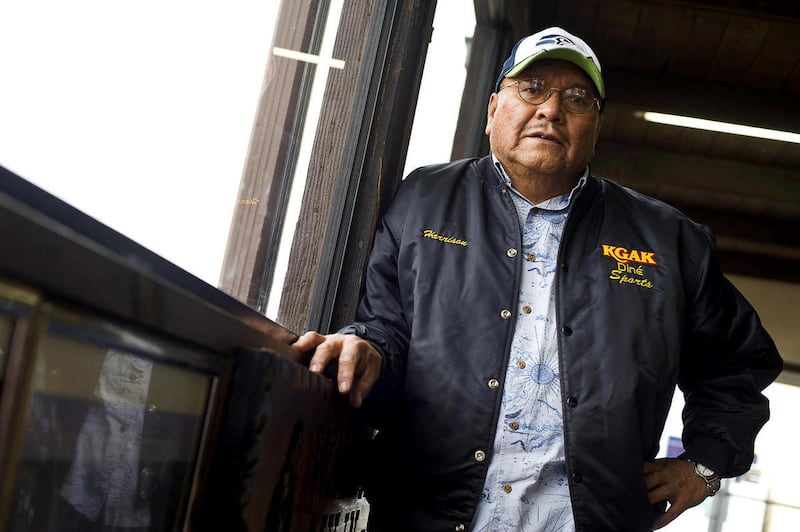
GALLUP, N.M. — Harrison Dehiya's voice travels across the Navajo Nation every morning and reaches hundreds of Navajo families, some in remote places where there's no electricity or running water — and where no word in English might be spoken for days, sometimes weeks at a time.
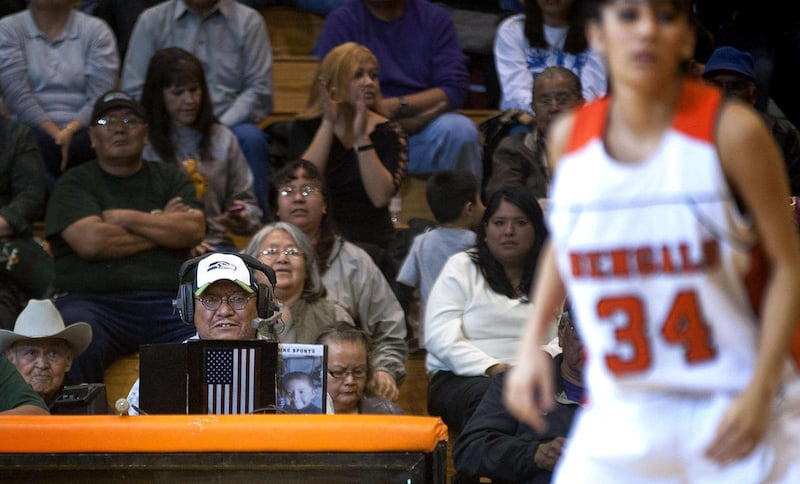
A radio announcer with KGAK, Dehiya has become so popular for his vivid and entertaining description while broadcasting news and sports in his native Navajo that last month he was featured in Sports Illustrated. He was praised for his talent broadcasting basketball and football games and for keeping a once-forbidden language alive.
Not surprisingly, when the unpretentious man in his mid-50s walked in the Ellis Tanner Trading Store recently, young attendants asked for his autograph.
"He is a legend," said 22-year-old Sherilyn Livingston. "They all have different styles but he is the family name. Since I was a child, I wake up every morning feeling that he is there. His voice gives you comfort."
Dehiya was at Ellis Tanner to promote Dine Speak, a free 15-minute community radio announcement program that goes on the air at noon every day except Sunday.
In a matter of minutes and with a fast tongue, which Dehiya jokingly calls "sheep tongue," he announced chapter news, community events and the funeral arrangements on behalf of a Mariano Lake family.
It is hard to tell how large Dehiya's audience is, but KGAK in Gallup covers a 5,000-watt radius and his programs can be heard as far west as Steamboat, Ariz., and Albuquerque in the east.
And Navajo families in rural areas with no electricity, where most plug their boom boxes to car batteries or solar panels, listen to Dehiya to connect with friends and relatives and to stay in tune with what goes on around the Navajo reservation.
Dehiya is that bridge between the modern world and the forgotten, maintaining a language that for many years was forbidden in boarding schools for elders who are still holding on to the Navajo tradition, according to KGAK station manager David Singer.
And he is also the reason some fans prefer to follow local basketball and football games from home.
"That's why I don't go to the games," said 60-year-old Freddie Wero. "I'd rather listen to him."
KGAK account executive Pat Jarvison said the Navajo language is "guttural," so rich in nouns and poetic at the same time that it gets lost in translation. That's why it makes sense that those who know the language would rather listen to Dehiya.
"He has the gift of tongues," she said.
Dehiya has been broadcasting for the same station for almost 15 years but his career goes back to the late 1970s, when he got his first radio job by chance.
Like most Navajos at the time, Dehiya grew up herding sheep and climbing the red rocks of Coolidge, his hometown.
"We played with empty sardine cans," he said. "We'd string them and pull them like little trains."
He attended Thoreau High School, where he played basketball, and later attended junior college in Muskogee, Okla. He returned to the Gallup area in 1977 and like most young men his age, he knocked on doors while looking for "any jobs, from dishwasher to janitor, anything," he said.
After a long day of job searching, it starting pouring rain as he was walking to the bus station, where he was supposed to catch his ride to Coolidge. He found shelter inside a random building, which happened to be KGAK. He met the right person, was offered a job announcing chapter meetings and news in Navajo, and the rest is history.
In the 1980s, Dehiya worked for KTNN in Window Rock, Ariz., for six years. There's a gap in his career because he struggled with alcohol for some time, but he has been sober for more than 14 years.
If he has someone to thank, Dehiya said it is "my wife, who stuck to me throughout all these years."