


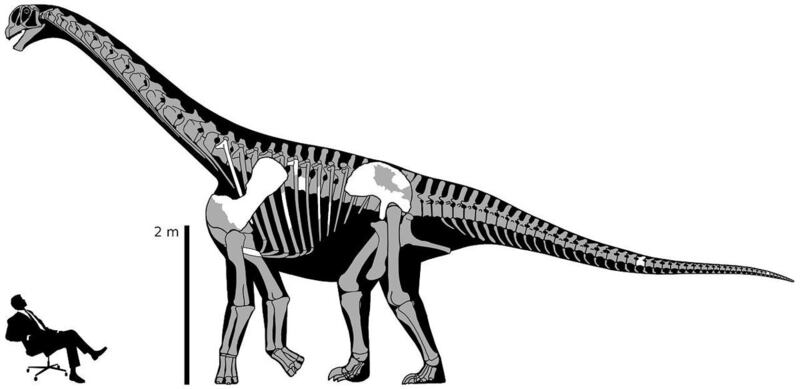
SALT LAKE CITY — Fossil remains of an athletic sauropod with a potentially mighty kick found in eastern Utah offer a rare bounty of clues into how four-legged herbivores thrived, according to a new study of the discovery.
The results, published this week in the British journal Acta Palaeontologica Polonica, show that an unusually large hip bone compared to other sauropods could mean that the Brontomerus Mcintoshi had powerful hind legs to kick away predators, such as raptors.
"This is a very exciting discovery, because a majority of sauropods were known to have lived during the Jurassic period, but these fossils show us that they lived well into the early Cretacious period," said Mathew Wedel, an assistant professor of anatomy at the Western University of Health Sciences in Pomona, Calif.
The fossils were excavated by American scientists in the mid-1990s.
Wedel worked on the project with a team of scientists that included Richard L. Cifelli, curator of vertebrate paleontology at the Sam Noble Oklahoma Museum of Natural History, and Mike Taylor, a researcher in the Department of Earth Sciences at University College London.
The rib, hip, shoulder, vertebrae and fragment fossils of an adult and a juvenile Brontomerus Mcintoshi, now held at the Sam Noble Museum, were originally found by excavators in 1994 at a quarry that had been looted and damaged.
Wedel said further research, not published in the paper, showed ridges on the shoulder blade of the animal, which is uncommon for sauropods and could mean it had powerful front legs in addition to its hind legs.
The word Brontomerus means "thunder thighs."
Jim Kirkland, a state paleontologist who works with the U.S. Geological Survey and helped with the excavation, said it is an exciting new discovery but more excavation on the original site is required to fully understand the fossils.
"With such sites, bones of many different animals can be found in one area, so it's difficult to say if all these findings belong to one or two dinosaurs," Kirkland said. "I was hoping they would go back to site once they knew that they had made a new discovery."