

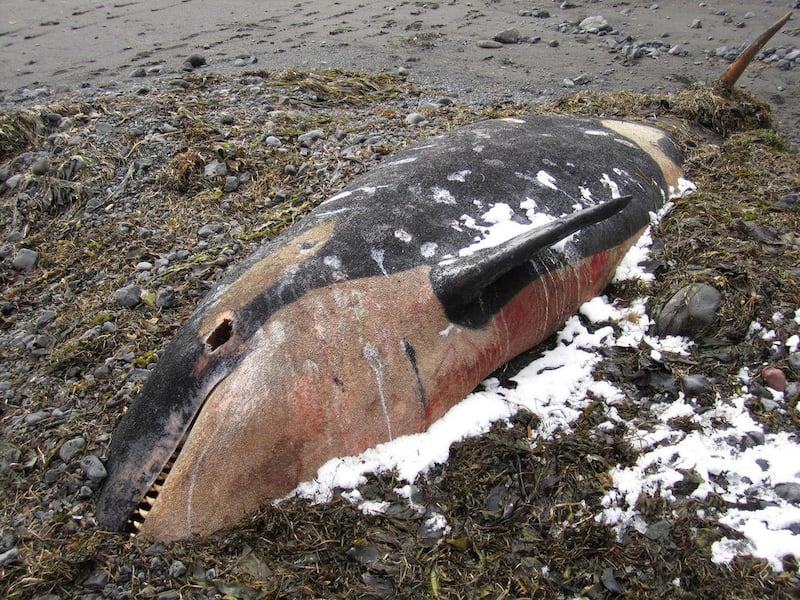
SITKA, Alaska — A team of scientists and volunteers from Sitka and throughout the region gathered on a Kruzof Island beach last week to dissect a killer whale found washed ashore days earlier.
Samples from the necropsy were sent off to a number of laboratories to learn more about the 3- to 5-year-old male, including the cause of death. There are also plans to give Sitka students the opportunity to "rearticulate" the skeleton this summer as an education project at the Sitka Sound Science Center, said marine biologist Jan Straley.
A group of Sitka kids and adults spotted the carcass while hiking at Inner Point on March 13. Sitka High senior Graeme Campbell reported the find to Straley, a member of the Alaska Marine Mammal Stranding Network, which responds to stranded marine mammal reports in the Alaska region.
Straley passed on the report to the National Oceanic and Atmospheric Administration authorities who pulled together the team for the necropsy. Straley said they all recognized the opportunity.
"It's a pretty rare event," Straley said.
The necropsy drew 16 volunteers, students and other members of the science community.
Stephen Raverty, veterinary pathologist and head of pathology with the Animal Health Center in Abbotsford, B.C., said tissue samples will be studied by the National Institutes of Health, National Oceanic and Atmospheric Administration in La Jolla, Calif., University of California at Davis Wildlife and Health Department, and a private veterinary pathology lab in Anchorage.
Raverty, reached Tuesday at his office in Canada's Ministry of Agriculture, said the cause of death was not obvious from an initial examination of the carcass. He noted the whale had "good body condition" and was not suffering from obvious nutritional deficiencies.
He said no evidence was found of pneumonia, which has been showing up commonly in a database and study of 250 killer whale deaths worldwide. Raverty noted evidence of peritonitis and a low-grade infection in its stomach cavity. The killer whale had half of a claw or toenail and hair among its stomach contents, Straley said.
Raverty said there are several reasons to study the dead killer whales.
"We can look at it to determine the cause of death," he said. "There is an intrinsic value of the whale, and it is held in high regard by many First Nation peoples. As a predator, it is a good indication of the health of our ecosystem. From an individual perspective, it's of value to see what contributed to its mortality."
Raverty noted that besides humans killer whales are the most widely distributed mammal in the world.
"We can start to appreciate the impact of global warming, urbanization and other anthropogenic impacts on the environment," he said.
Scientists and other volunteers removed as much flesh as possible from the skeleton, took it apart and put the bones into containers to be brought back to Sitka. The pieces are being stored in freezers at Seafood Producers Cooperative.
"We cleaned the bones the best we could," said UAS biotechnician Ellen Chenoweth. The rest of the meat was left for the gulls.
The local science community hopes to incorporate the skeleton into summer science camps for middle school and high school students at the Sitka Sound Science Center.
"A project like this helps connect students with what is happening in their own backyard," Straley said.
Straley said since the necropsy she and other scientists and researchers are coming up with ideas for incorporating the killer whale into the science camps. The tentative plan calls for one group of kids to clean up the defrosted bones, and another group to rearticulate the skeleton.
"We've got lots of great ideas," Straley said. "I think it's going to be a cool project. The number of killer whales that have been rearticulated is ... not very many."
"We would love to be the permanent home of the articulated skeleton for all to enjoy," SSSC Operations Manager Tory O'Connell said.
O'Connell and Straley said the camp will enlist the help of Shannon Atkinson, a professor in the School of Fisheries and Ocean Sciences for the University of Alaska Fairbanks, in Juneau. She runs a similar program at Thunder Mountain High School, called DEMBONES (Distinctive Education in Motion: Biodiversity Of Nature and Environmental Stewardship).
Straley said some ideas include X-raying the flippers for display, and working with the local Native community to add a cultural component to the science camp.
One of the goals of the summer science day camp is to offer kids the chance for hands-on experiential education, and to get out in the field and on the water to connect with science and the local environment. O'Connell said the Crossett Fund provided funding for the middle school camp, and SSSC is continuing to look for funding for the high school camp.
"The science center is excited about bringing in these folks to work with our staff and our kids, and to get something like that going here," O'Connell said. The goal of the summer camp is to encourage kids to continue their education in science, technology and math.
Information from: Daily Sitka Sentinel, http://www.sitkasentinel.com/