

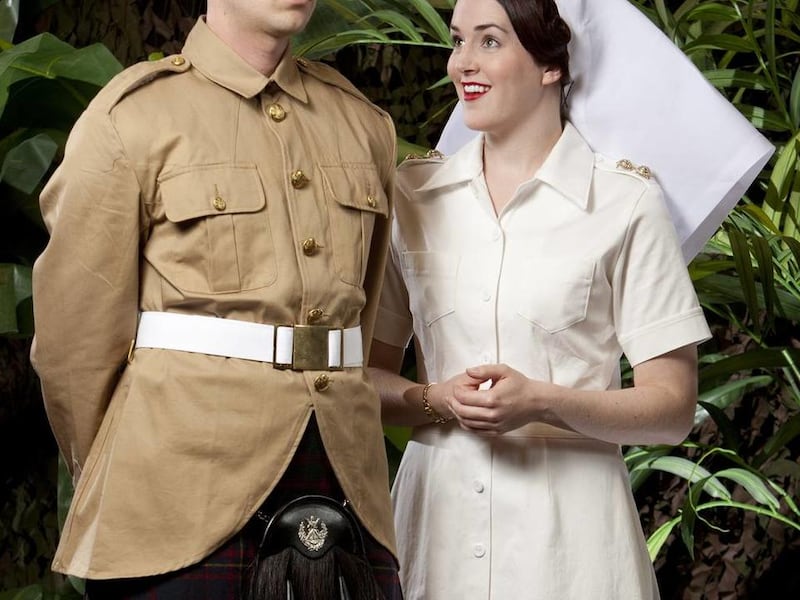
WEST VALLEY CITY — The redemptive power of friendship is the topic of the deeply affecting comedy-drama “The Hasty Heart,” at the Hale Centre Theatre, April 16 through May 28.
Drawn from Pulitzer-winning dramatist John Patrick’s own wartime experiences, the optimistic play is set in a World War II army hospital in Burma. The characters are recuperating patients waiting to be shipped home to family and loved ones but confronted with a lonely and embittered Scotsman — and his presence changes everything.
“This is a play where you do a lot of laughing,” director John Adams said. “Then there’s some crying. We enjoy the emotional journey; it’s like a roller coaster ride of powerful feelings.”
While “Hasty Heart” has often been staged at the Hale theaters, it returns by request following a survey of area audiences.
“The theme of the play is that there is an underlying goodness to man; that people are good,” the director said. “This is a beautiful message that is appealing to Hale audiences.”
The play’s title is derived from a saying — “Sorrow is born in a hasty heart” — that is repeated by the protagonist. “It’s a epigram that has been passed through generations and warns against being hasty, to think before you jump,” Adams said. “And hesitation is seen through much of the play by the Scotsman.”
The soldiers are a rainbow coalition representing the cross-section of Allied forces. They joke among themselves and call each other not by their actual names but by the slang designation of their country of origin: Yank is the American, Digger hails from Australia, Kiwi is from New Zealand and Tommy comes from England. The only nicknaming exceptions are Margaret, the ward’s saintly nurse; Blossom, an African tribesman who knows no English except for the one word that becomes his name; and Lachlen “Lachie” McLachlen, the native of Scotland.
“We did a lot of work with the many dialects,” Adams said. “It is hard to separate New Zealand from Australia, and Scottish can be hard to understand if the actor doesn’t back off a bit. These are different sounds that Americans may not be used to hearing, but the authentic accents give a unique international flavor to the production.”
The original play enjoyed a 204-performance run on Broadway in 1945 and a 2004 off-Broadway revival. But most likely remembered is the 1949 movie with notable performances by Richard Todd, Patricia Neal and a young actor named Ronald Reagan.
“Hasty Heart” is the playwright’s first of two stage successes (the other was “Teahouse of the August Moon,” which won the Pulitzer and Tonys for Best Author and Best Play). Patrick also enjoyed a Hollywood career penning “High Society” and “Three Coins in the Fountain” among others (including a “Leave It to Beaver” episode).
But “Hasty Heart” has been largely dismissed as schmaltzy and dated. Though all but one of the war-torn characters are men, the dialogue is disarmingly innocent and profanity free.
“I believe in my heart that John Patrick is a unique kind of writer,” Adams said. “Our society is overly into naturalism and is so godless that anything to do with triumph is seen as overly sentimental.”
“Hasty Heart” recalls an era when decent plays were not only admired but also regularly attended — with still-timely insights about what gives life meaning.
Blair Howell is a freelance editor and writer.