


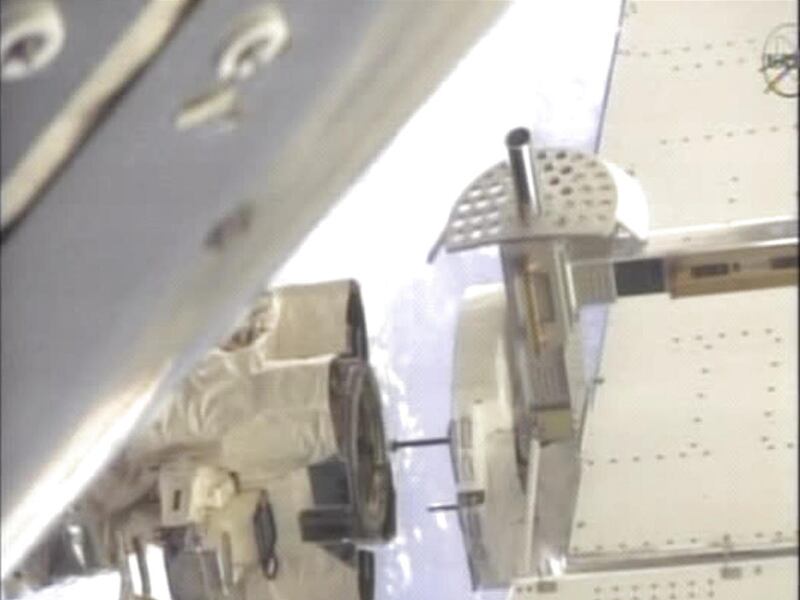

CAPE CANAVERAL, Fla. — Endeavour's astronauts accomplished the No. 1 objective of their mission Thursday, installing a $2 billion cosmic ray detector on the International Space Station to scan the invisible universe for years to come.
But hours after astronauts finished that work, NASA said it might add one more job: a detailed inspection this weekend of a troublesome damaged thermal tile on the space shuttle's belly.
The space fliers used a pair of robot arms to remove the Alpha Magnetic Spectrometer from the shuttle, then hoist it onto the sprawling framework on the right side of the station. It marked the grand finale for America's role in the construction of the orbiting outpost, which began 13 years ago.
The instrument — which has a 3-foot magnet ring at its core — is the most expensive piece of equipment at the space station and certainly the most prominent scientific device. It will search for antimatter and dark matter for the rest of the life of the station, and hopefully help explain how the cosmos originated.
Nobel Laureate Samuel Ting, the principal investigator, personally relayed his thanks from Mission Control in Houston. He's worked on the project for 17 years and fought to get it on a shuttle, when its flight was suspended several years ago.
"This has been a very difficult experiment, and I think in the next 20 to 30 years, nobody will be able to do such a thing again," Ting told the astronauts. "I hope together with you, we will try to make a contribution to a better understanding of our universe."
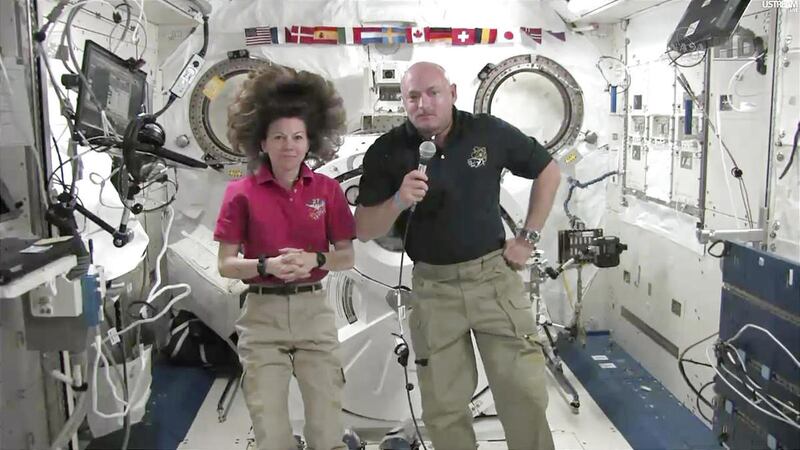
Shuttle commander Mark Kelly — whose wife, Rep. Gabrielle Giffords, had surgery to repair her skull Wednesday — said he held his breath as the spectrometer was latched down.
"It's a $2 billion cosmic particle detector, it's got 600 physicists that have been working on it ... and it was all in the hands of four of my crew members," Kelly said in an interview with The Associated Press. He said he told his crew afterward, "Isn't it a relief that it's no longer our responsibility, that we safely got it installed?"
As for his wife, Kelly said she's doing "really, really well, as good as possibly could be expected" following Wednesday's surgery in Houston, just two days after seeing her husband blast into orbit. Doctors put in a piece of mold plastic to replace part of her skull that was removed after she was wounded in the head in a Jan. 8 shooting rampage in Tucson, Ariz., that left six dead and 13 injured.
Kelly said he hoped to call Giffords later Thursday, using the space station's Internet phone. He spoke with his mother-in-law and identical twin astronaut brother Scott on Wednesday, and exchanged e-mails with his wife's neurosurgeon and chief of staff.
He took into orbit his wife's wedding ring; he's wearing it on a chain around his neck. He also has the turquoise wristband he's worn for months — bearing the name "Gabby," a peace symbol and a heart. Some of the 11 other orbiting astronauts are wearing similar bracelets.
NASA engineers spent Thursday analyzing damage to seven spots on the shuttle's belly where thermal tiles were gouged and nicked during Monday's liftoff, the second-to-last for the shuttle program. They determined five, and probably a sixth, were no problem. But they weren't sure about one last one.
They have tentatively scheduled an unusual closer inspection Saturday of the gouge, which is about the size of a deck of cards. The shuttle astronauts would use a camera and a laser attached to a giant boom to examine the suspect tiles, said deputy shuttle program manager LeRoy Cain.
A similar gouge was found on a 2007 Endeavour flight — coincidentally commanded by Kelly's identical twin brother Scott — and it got the extra inspection, but was determined not to be a problem.