


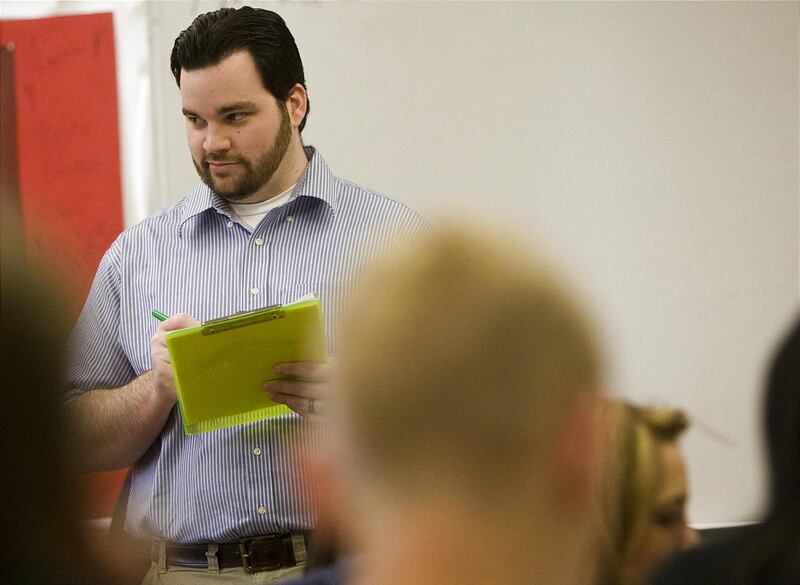


MURRAY — Jason Carpenter almost didn't go into teaching. He thought about being a lawyer instead.
But one of his professors said something that stuck with him — that teaching was one of the last noble professions.
"As a teacher, you are not trying to take advantage or turn a profit," the second-year middle school English teacher explains. "You are trying to make the world a better place, trying to make tomorrow better than today."
Yet increasingly, public school teachers have come under attack.
Many have said the American public school system is failing and that teachers are to blame. State lawmakers across the country often complain that teachers have too much job security, not enough accountability and aren't educating children the "right way."
"Teachers have become such a target in the last six to eight months, and it has got to be pretty demoralizing," said Elizabeth Foster, director of strategic initiatives for the National Commission on Teaching and America's Future. "I think a lot of people are holding them up as a scapegoat for failed state policy."
Foster says movies like "Waiting for Superman" make it seem like most teachers are not teaching for the right reasons, which she said is not the case. It also makes it seem like a "hero teacher" is necessary to save schools, which is unrealistic and unsustainable, Foster said.
Not surprisingly, this has had an effect on both teachers and those considering the job.
Out of the most popular fields in college, only two have gone down in the number of graduating students over the last 10 years. One is computer and information sciences. The other is education.
Education has become a less attractive field to some because of the low pay, high pressure and current negative stigma around it.
"Teachers say, 'I don't encourage my children to go into teaching because it has become such a low-status, low-paying, giant headache of a job.' That is awful," said Nancy Flanagan, a 30-year teaching veteran from Heartland, Mich., who was Michigan's 1993 teacher of the year and now writes about education. "It remains a great job — it is just the external pressures are so much greater than they once were."
Sharon Gallagher-Fishbaugh, president of the Utah Education Association who taught for over 30 years, said she doesn't blame some students for not wanting to go into teaching when they are being vilified before they even enter the field.
In fact, 30 to 50 percent of new teachers are now leaving the profession within the first five years, Flanagan said, which costs schools a lot of money because it requires training and recruiting new people over and over again.
Greg Bemis, a science teacher at Hillcrest Junior High with 24 years of experience, said the constant attacks on his profession is sometimes dispiriting.
"Suddenly being a public employee is a bad thing," Bemis said. "It is discouraging to listen to the leaders who never have a kind word to say. You don't often hear them thanking you for going into the classroom an hour and a half early and staying late and punching out to keep working."
Many teachers work similar long hours. Bemis is in the classroom every morning at 6:20 a.m. and often doesn't leave for home until 5 p.m.
Amy Nelson, a second-grade teacher at Riverview Elementary in Spanish Fork, also works 10 to 12 hours a day, saying she often brings work home with her.
"Your students are always on your mind for those nine months, and then during summer break, you are working on things for the next year," Nelson said.
Contrary to popular belief that teachers reuse the same lesson plan every year, Nelson said she changes and tweaks her lessons each year based on the personalities and pupils in her class.
"I think some people have misconceptions about teaching as a whole," Nelson said. "You hear about the system failing a lot which is hard to hear because you think, 'I am doing my best.'"
A variety of factors have led to the current hostility directed towards public school teachers, says Linda Manuel, regional outreach director for the National Board for Professional Teaching Standards.
Not only has the economy tanked, which caused cuts to education budgets, but the world has become more competitive and business leaders are concerned about the upcoming workforce, Manuel said.
Technology has also put pressure on teachers to work faster and harder and produce more, she said. And testing has become more of a focus, making teachers feel like they have to teach to the test, which sometimes cuts out creativity, Flanagan said.
"When teachers are forced to teach to a scripted curriculum, the joy that comes from teaching can be ironed out of the profession," she said. "I don't think we are there yet, but I think it could happen. I have never met a parent who said it is my goal in life for my kid to do well on the state assessment."
U.S. demographics have also changed over the last several years, with more students coming into school as second-language learners or on free and reduced lunch, said Flanagan.
So while testing has become more of a priority for states, the changing demographics have made it harder to achieve the testing goals. This comes at a time when many states are focusing more on standardized tests to rate how schools and teachers are doing.
'We have insisted to do more and more things in standardized ways, but we forget the individual," said Kenneth Bernstein, a National Board certified teacher in Maryland who was a 2010 Washington Post Agnes Meyer Outstanding Teacher.
Yet Flanagan and other teachers say it seems that those who have the most say in education reform have little to no classroom experience.
Michelle Rhee, who is known for trying to reform D.C. schools and is now looked as an expert in education reform, only taught in the classroom for three years. Arne Duncan, U.S. Secretary of Education, was a school administrator, but never taught a class and was only an administrator for eight years. Other prominent reformers are people like Bill Gates, a philanthropist, billionaire and former CEO who has money to offer schools and has voiced his opinion on larger class sizes and how teachers should be paid based on how well they teach.
Even President Barack Obama didn't go to public school growing up in Hawaii, and both his daughters attend private school.
"Everybody feels like since they went to school they have the same expertise that teachers have," Foster said.
But even those who first enter the classroom out of college say they had much to learn over the years about teaching.
Karen Chatterton, who taught for several years before becoming an assistant principal at Stansbury and Granger Elementary Schools, said she had no clue how different students' backgrounds can be and how much pressure some students have starting in elementary before she became a teacher.
Flanagan says that instead of focusing on things like raising test scores there needs to be a national discussion of what the U.S. wants for future generations.
"We need a country where people are able to distinguish fact from advertising. We need a country where there is genuine hope for children in poverty and that public education is a real way to lift them out of poverty," Bernstein said. "We have settled for raising test scores, and we haven't paid attention to big sweeping concepts. The crisis is that we don't have our priorities straight."
EMAIL: slenz@desnews.com