

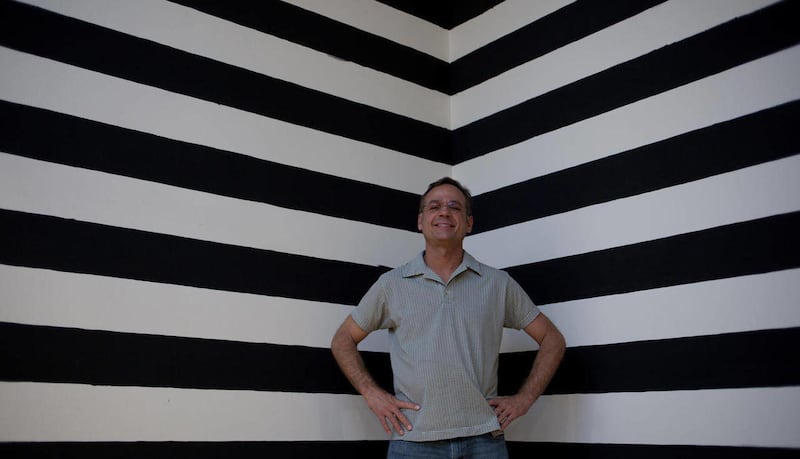
PHOENIX — On the second day of painting the gallery walls with jailhouse black and white stripes, Gregory Sale ordered a halt to the work. He gathered the seven inmates, the seven artists and art students helping them out and the seven armed officers standing watch over them to look at the incomplete project at the Arizona State University Art Museum.
Sale had them walk around and look at the flaws on the black and white stripes. Some were obvious. The northeastern corner wasn't done. And the upper stripes on the east wall, near an air-conditioning vent, were splotchy and smeared, in need of a second coat. There were smaller flaws, too, like the stripes that were dripping or crooked.
The inmates from the Maricopa County jail, the county corrections officers and the artists wanted to finish the work, to fix the mistakes and refine the stripes. To make it as perfect as possible. After all, it would be up for the next several weeks and be a starter for conversations about the prison and jail systems.
Sale then asked a question. "If we're having a talk about the system of incarceration," he recalled telling them, "wouldn't you want that desire to fix it to be that strong in this room?"
That's why the walls at the "It's Not Just Black and White" art installation at the gallery are unfinished. Sale said visitors probably don't notice right away.
"When you first look at it, it's perfect," said Sale, who was born in Arizona. "You have to move closer."
Sale is the sixth artist-in-residence at the ASU Art Museum. The program allows the public to interact with artists as they create their works. A previous artist put a working office in the gallery and made visual art out of his interview on a morning news program.
For this exhibit, Sale wanted to make "artistic gestures" that would explore incarceration. He wanted to host discussions, have dance performances, speeches and readings.
He also wanted to provide an interesting space for all of that. He did so by procuring two groups of inmates, who were part of a voluntary drug-rehabilitation program, to paint the stripes over two Saturdays.
"It creates this charge in the room," he says of the stripes. Especially after visitors know they were painted by jailed inmates while wearing similar striped jailhouse uniforms.
One concrete element the installation will create is a pile of rubble. One wall in the gallery — a non-load-bearing one — is coming down. It's a wall that Sale had the inmates cover with sayings or drawings. His only request was they keep the content clean. Since the exhibit was opened to the public, Sale has provided colored markers and pencils for visitors to leave comments on the wall.
"I'm going to change my future," one inmate wrote in block letters. Another wrote his name and booking number in large black print. Another, who had done state-prison time, complained obliquely about that institution's uniform: "The color orange is ugly."
Sale is working with a group of juvenile inmates who will decide how to tear down the wall and what to do with what's left.
Sale says it is possible that when Angela Davis, the civil-rights activist, is in the space for a reception Thursday, she might be standing near a pile of rubble.
As Sale gave an interview, Cub Scout Troop 274 entered the gallery. Their den leader showed them the graffiti wall and Sale explained how it was going to be torn down in a few weeks.
Leo Reyes, 9, of Tempe, asked the artist, "Why are you tearing it down? It's so beautiful."
Sale told Leo that the wall was a metaphor and a space for exploration and something about impermanence. "I don't know if that answered your question," Sale said.
It seemed to. Leo picked up a marker and added his contribution to the wall: "Good is beter than bad." He signed it with a smiley face.
Information from: The Arizona Republic, http://www.azcentral.com