
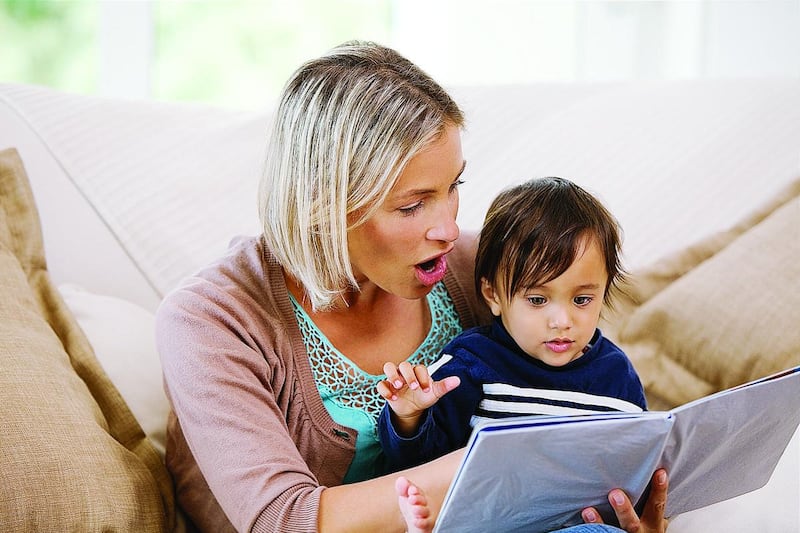

LOGAN — "Go, Dog. Go!" and "The Very Hungry Caterpillar" may be classic bedtime stories, but a team of researchers at Utah State University has found that many mothers are more responsive to their children when they read them books with no words at all.
"In a wordless book, parents may feel more comfortable leading, guiding and following up on what a child says, rather than feel compelled to finish the story or read the story in a prescribed way," Utah State associate professor Sandra Gillam said.
Gillam, who teaches in the Department of Communicative Disorders and Deaf Education, and her students Jessica Shaw and Allisa Blackburn, video-recorded how mothers read to their toddlers from different books. Then they evaluated their word choices.
They discovered that mothers who read a wordless book used richer language, more complex sentences and longer phrases than mothers who simply retold the printed story. Mothers also responded better and more frequently to comments or sounds from their 20- to 30-month-old children when they were reading without words.
"The part of this that I think is exciting is that parents are doing this naturally," said Lisa Boyce, an assistant professor in Utah State's Family, Consumer and Human Development department and another faculty adviser on the project. "It is so easy for any parent to do."
It just requires that parents sit down with their child and a book and talk about the pictures. When the child makes utterances, parents can expand on the comment, point out other objects and ask the child to describe more of what they see.
"No matter their education, socioeconomic status, (parents) have something to say to their child that is important, that is relevant and that will enrich their child's knowledge," Gillam said.
The children in this study were all participants in early intervention programs, meaning they had shown delays in either physical development, vision or hearing, feeding or dressing, social or emotional, communication and language learning, problem solving and play — situations in which extra interaction and intense language stimulation is crucial to their development, the professors said.
And while reading a wordless book won't automatically solve the problems of a child with delayed language skills, data like these are encouraging for speech therapists, who can encourage parents to keep doing the good things they're already doing.
"What this study really says is there are important language foundations that have to be laid before the print foundations," Gillam said. "These wordless picture books are the bridge between unstructured language activities where parents are interacting, to that more structure (including print)."
Yet, the wordless books can't be the infant board books with one giant picture on each page. Instead, the books must lend themselves to a narrative structure, which helps children learn important storytelling skills, said Carla Morris, children's services manager at the Provo City Library at Academy Square.
One way to develop such skills is by "reading" the beginning and middle of a wordless book, then encouraging the child to make up a different ending each time, Morris said.
"Research has shown that narrative skills help in comprehension," she said. "It gives meaning to what you're reading. If you're just reading mechanically and don't know what you've read, it's almost the same as not being able to read."
To promote emergent or early literacy, the American Library Association will be introducing the second edition of their national Every Child Ready to Read program in late June.
The program is built around five simple, yet profound principles, Morris explained: singing, talking, reading, writing and playing.
"It's encouraging language," she said. "It's important for kids that we're talking to them more. Not just reading to them more — which, as a librarian, that's what we've been preaching forever — but (we) need to talk to (our) children as well."
It doesn't matter if the conversation seems unrelated to the pictures on the page, or even if these conversations revolve around pictures on a cereal box. As long as a parent is engaging the child, asking open-ended questions and responding to the child's utterances, essential learning is taking place.
It's just unfortunate that more parents aren't doing this, Morris said, citing the growing number of children who are going into kindergarten unprepared.
"I thinks some parents are aware that (reading and conversing) is good, and get a lot of good feedback, especially when their child nestles in next to them and wants to sit through more and more pages of a book," Boyce said. "But I don't know, in general, that parents really know how important this is for their children."
email: sisraelsen@desnews.com