

MEDICINE BOW, Wyo. — It's early morning. You're driving to Casper through Medicine Bow, an old Carbon County railroad town with fewer than 300 people and about as many head of cattle.
Here, a house. There, a church.
You blink — THUNK — and drive off the road.
In a land that time (and apparently zoning ordinances) forgot, you gawk at an industrial zoo assembled along a wooden fence.
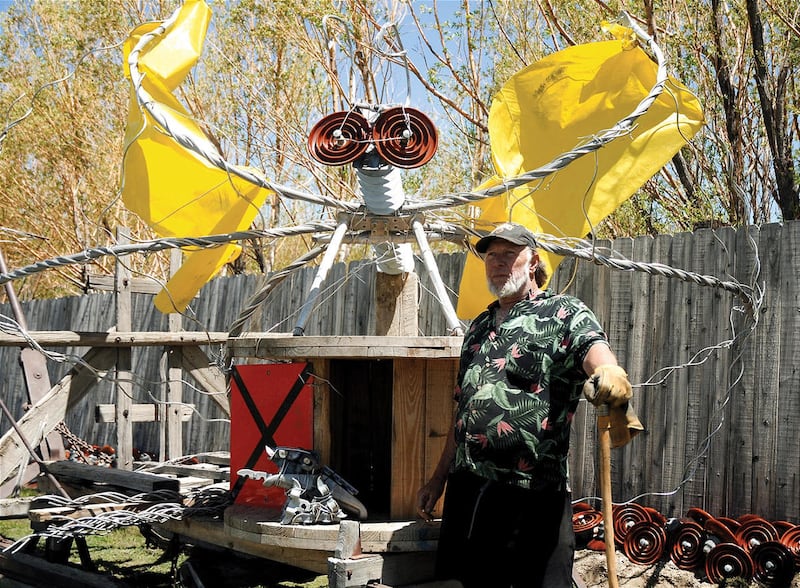
An aluminum alligator grins bolts, a wiry pterodactyl poises mid-swoop and a butterfly behemoth flutters atop a hay sled.
Here be monsters!
Along the rest of the yard, silvery wires stretch between posts that look like Tesla coils. NO TRESPASSING signs dot the fence, but one appears friendlier.
It reads, "307-379-2681 :)."
"All this stuff is garbage," said Denis Bame on a May afternoon in his improvised metal sculpture garden in Medicine Bow.
Bame works on high-voltage transmission lines, and these gigantic lawn ornaments are crafted from construction and demolition jobs otherwise destined for the dump.
"When I see that stuff in the back of a truck, I just. Freak. Out," said the Utah-to-Wyoming transplant. "And it's mine-mine-mine-mine-mine."
Although Bame's three-lot yard is littered with clunky beasties, a junk composite motorcycle and David Lynch wind chimes, his theatric gestures and constant wordplay monopolize attention.
He brings his surprisingly tidy piles of scrap metal to life in a surprisingly tidy garage using pliers and an old electric saw.
The first was the pterodactyl. It began with the skull, a shoe-fitting from the Seminoe to Cheyenne line he tore down in 2006 for S.E., Incorporated, a Wyoming-based electrical contractor.
"Sometimes he just seems plumb crazy to me," said David Sorenson, S.E. vice president and project superintendent. "You've got to watch him around the Dumpster on the worksite. After he's done for the day, he's digging through stuff."
Kimatha Bame, his wife of a dozen years and New York-to-Wyoming transplant, put it simply, "He's just an old redneck cowboy."
In the side yard, along the roadside, she pointed out one of her favorites.
"The bumble bee, I love that one," she said. "She had the first blue eyes."
Bame frowned and stared.
"I didn't get the hinge right, or it'd flap better. See?" he said, striking it with a cane. He calls the cast iron anchor atop of it a "love knocker," and no sculpture is finished until it's been hit a few times.
"Well, don't hit her," Kimatha protested.
Bame locked eyes with her and rapped it again.
"He's doing fine," he said, letting a grin slip.
Despite his wife's insistence, Bame doesn't consider himself an artist.
"I'd rather be called a lot of other things than an ar-TEE-st," he said, affecting one of many accents.
Still, he's fond of some of it.
"The stuff out there, that's junk," Bame said dismissing the yard ensembles.. "The stuff in here, I'm proud of it."
Framed inside a south-facing window inside their trailer, Bame pulled down a placard with a trio of butterflies and wire flowers.
"I made this for her," he said, tilting it in the light. The butterflies were a gift from one of Kimatha's friends, but the rest came from Bame.
"I got the wire, and these are the first flowers I ever tried to make," he said. "This is my idea of a carnation. This one's kind of like a daisy. And you can't really see it, but this one's got a bumble bee, and I braided this one for a grape-type look."
He and Kimatha — she's got a hand in some of the jewelry — use a lot of rocks in their handiwork, most of it from a Lovell estate collection. They started that project about the same time Bame began collecting power line leftovers.
One of his favorite pieces was a Tiffany lamp with antlers and ostrich eye geodes, but it's not around anymore.
"She's what makes me do all of this, really," he said, face suddenly hardened. "She gives all the neat stuff away, and I have to make something else."
Stepping out of the Bame's home, a similarity between the miniature creations inside and the monstrous sculptures outside comes to light — a lot of them are insects.
"Well, I'm getting the bugs out of power lines, right?" Bame offered. "Maybe I hate bugs. Maybe she hates me bugging her."
Nobody's driven one off the lot yet, though.
"I've had one phone call about them in five years," Bame said, adding a kaleidoscope of colorful explanations, mostly at the blue end of the spectrum.
"I'm thinking of throwing some more together and featuring them in a miniature golf course," he said. "I want golf balls to spit out of their mouths into a pond."
In the meantime, Bame plans to add wheels and moving parts to his scrap metal creations.
"There's my odd-id-ity," he said swinging his cane in an arc across the yard, in apropos of nothing in particular.
Kimatha, who first befriended Bame 33 years ago, said deep down he's a sweetheart.
It's another title he rejects, but if nothing else, the largest roadside sculpture may prove her point.
Bame's story: He tried to make a jungle gym spider, but it was too heavy to support itself.
"I wasn't going to throw the whole thing away," he said. "So I made something else."
Kimatha's version: She was just getting back from a hospital in Salt Lake City, where her daughter was diagnosed with leukemia. She stopped at their yard when she noticed something strange. (Well, OK — stranger than usual.)
"I pulled up around 8 or 9 at night and went, 'Oh my (gosh), what's in our yard?'" Kimatha said.
She got out of the car to take a closer look.
"I'm standing right there, looking at the biggest butterfly in the whole world, almost in tears," Kimatha said. "And in the center is this heart. That just told me how much he loves me."