
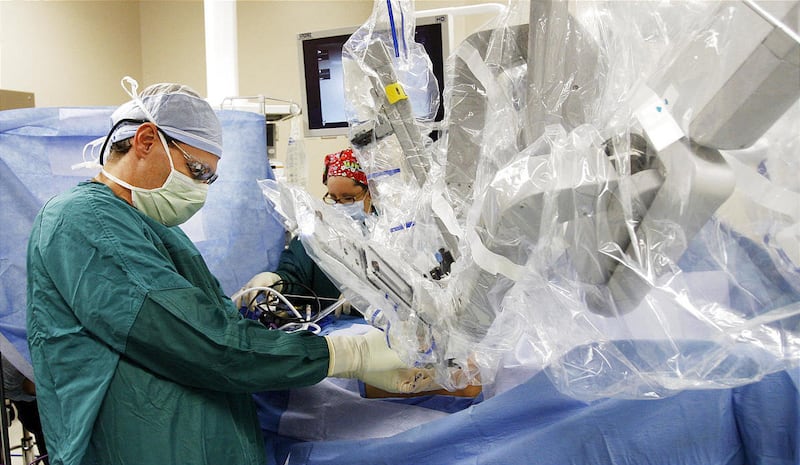
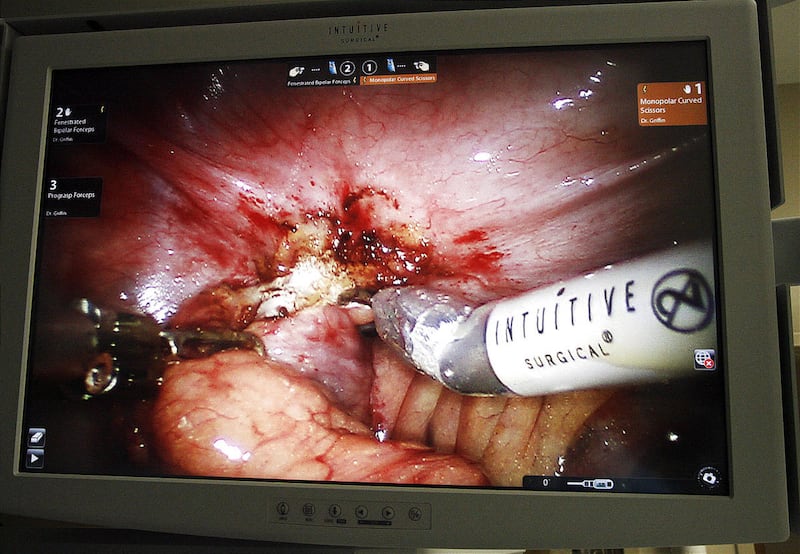

SALT LAKE CITY — As Byron Karsch slept on the operating table at St. Mark's Hospital, Dr. John Griffin used his four arms — the number four — to remove a section of colon that plagued the 45-year-old with infection and inflammation.
Yes, four arms — courtesy of a DaVinci robot that's often used for prostate surgeries and hysterectomies, but is just coming into use for colorectal operations.
Griffin was the first Utah surgeon to employ robotics for such a surgery when, in October, he removed a section of Bob Bayer's colon that was an early-stage colon cancer. Since then, he's used the robot for about 10 colorectal surgeries. Two other Utah colorectal surgeons, both in Utah County, have also begun exploring its utility.
Karsch's surgery was actually a hybrid between a robotic operation and a laparoscopic one. There are strengths to both methods, Griffin said, and he alternated between the two surgical methods as needed as he went along. For Karsch, he did the early prep work and the closing both laparoscopically, rather than robotically.
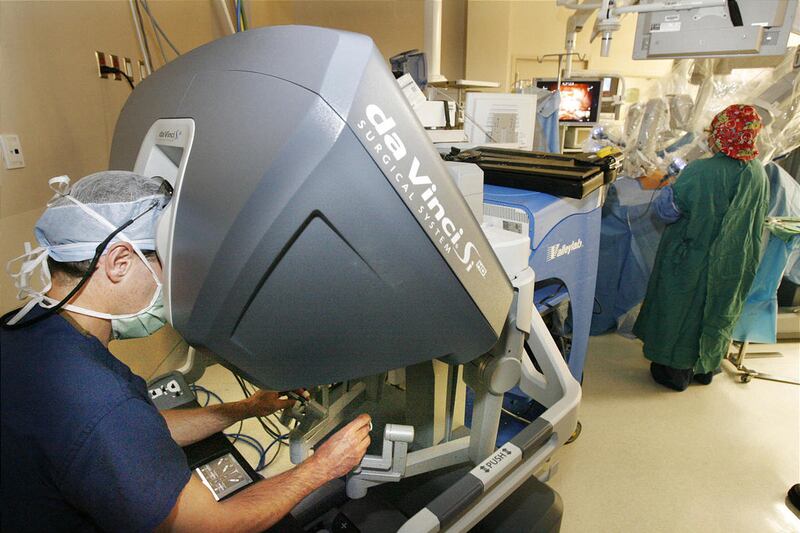
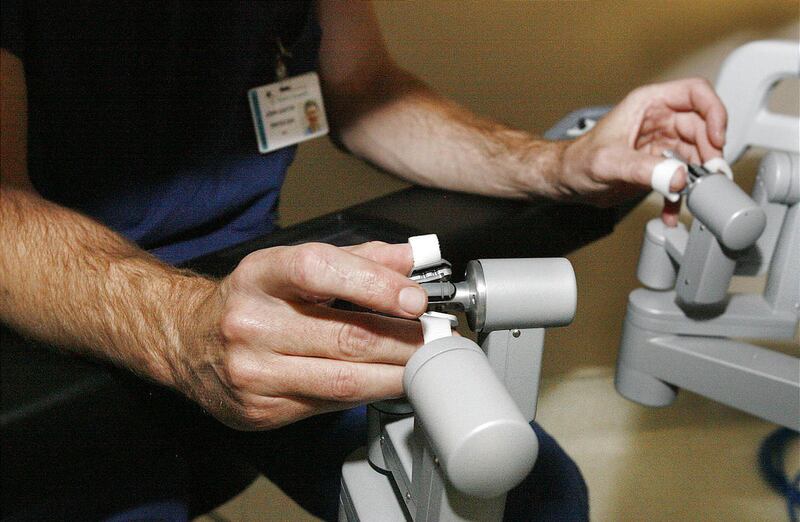
In robotic surgery, the surgeon sits at a console a few feet away from the operating table where a patient has small incisions cut in his abdomen to serve as portals through which the instruments will be fed. The surgeon controls the robot's four arms with thumb and forefinger. His feet engage pedals which control some additional functions, such as cauterizing vessels to control bleeding.
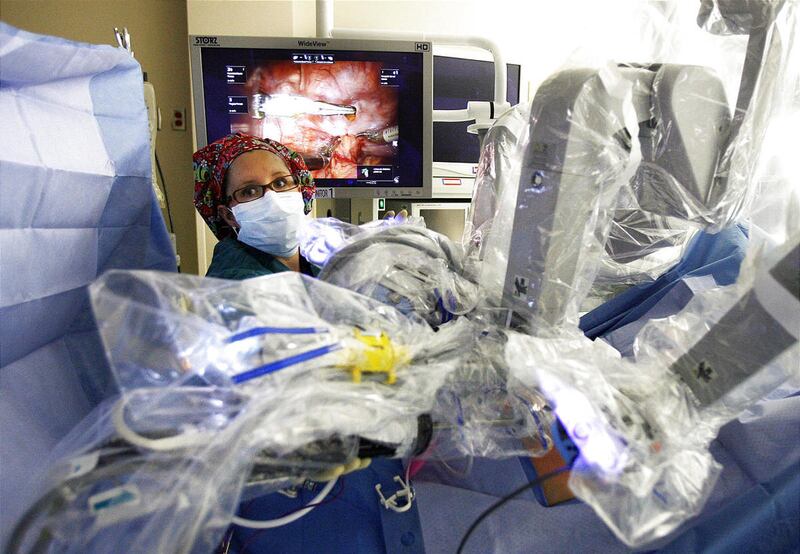
Griffin watches what he's doing in 3-D through a pair of lenses right in front of him, while the other members of the operating team are with the patient.
Griffin said he doesn't use the robot at all in some cases, but he's apt to employ it in areas where he is operating deep in the pelvis or in especially tight areas.
The advantages of the robot for colorectal surgery, Griffin said, include the 3-D imaging and excellent lighting provided by the robot, better magnification and a wider range of motion for the tools than is possible with laparoscopic surgery tools. In the latter, small tools are deployed through ports on the end of rigid handles. DaVinci's tools can waggle back and forth as needed on flexible handles. It's also easier to work in tight spaces and virtually eliminates any tremor a surgeon might have. One benefit is the ability to see better, making it less likely that the tube that carries urine from the kidney to the bladder will be nicked, which can happen quite easily with colorectal surgery. And sitting down at the console is more comfortable than standing at the operating table.
"The more comfortable you are, the more you can do," Griffin said. And the fourth arm is an "assistant that doesn't talk back," he teasingly pointed out to his own assistants.
The downside includes increased cost from more expensive instruments and the fact that the surgery is typically a little slower because there's additional set-up time as the patient and robot are "docked." That also means the patient is under anesthesia a bit longer, as well. The complaints are largely the same complaints that arose when laparoscopy was new, he noted.
Griffin said he doesn't know anyone who does an entire colorectal surgery using the robot yet and, to some extent, "the jury's still out."
Diverticulitis, like Karsch had, while benign, can cause pain, fever, sweats and an increased white blood cell count. After pulling the sigmoid colon away from a section where it had attached itself to the bladder, Griffin carefully threaded it out through a different small incision made in Karsch's abdomen for that purpose and cut off the inflamed piece. Then the colon was placed back in his abdomen and reconnected to the other end. Finally, Griffin checked to be sure there were no leaks before instruments were removed and the small abdominal incisions closed. He said Karsch will likely be hospitalized for about four days.
It's too soon to tell how Karsch, of Murray, feels about the procedure. But several months after his cancer was removed, Bayer is more than satisfied with the result. While his was malignant, it was early-stage — his doctor delighted him by calling it the "earliest catch on the planet" — and he now only has a few small "hyphens" as he calls the little incisions on his abdomen, as a reminder.
But the most important thing, said Bayer, 61, of Sandy, is not how the doctor chooses to operate. It's getting screened to be sure that any colon cancer you have is caught in the simple-to-treat stages. Because he did that, he didn't require chemotherapy or more extensive treatment.
EMAIL: lois@desnews.com